American Action Fund for Blind Children and Adults
Future Reflections Summer 2025 BREAKING NEW GROUND
Welcome to Blind Cricket: A Rising Phenomenon
by Abey Finklea
From the Editor: When I met Abey Finklea at the 2025 Midwest Student Seminar in Chicago, I had never heard of the adaptive sport called blind cricket. Abey’s enthusiasm was contagious, and I invited her to share her story with the readers of Future Reflections. She eagerly seized this opportunity to spread the word about this exciting new opportunity for blind athletes.
Less than a year ago, in the fall of 2024, there was not a whisper about competitive blind cricket in the United States. Yet somehow, in the fall of 2025, the National US Women’s Blind Cricket team will travel to India to compete in history’s very first Women’s Blind Cricket World Cup Championship. For any sport to grow so quickly is remarkable. It’s all the more amazing when the sport is blind cricket, which was nearly unknown only months ago.
Gathering Momentum
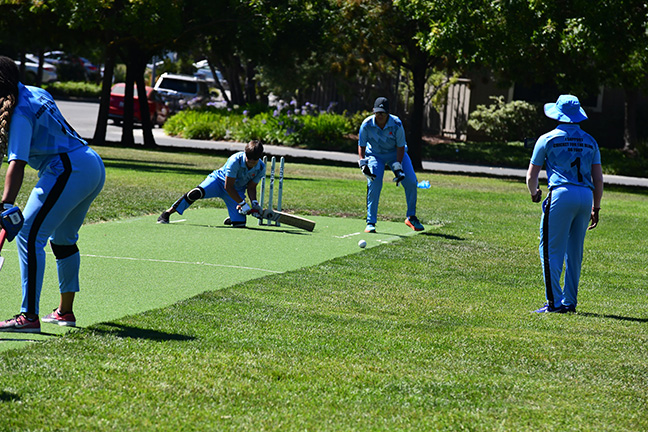
Although cricket is the second most popular sport globally, falling just behind soccer, it is not commonly played in the United States. Despite this challenge, blind cricket has gained a strong foothold in the US in the past year. For the first time in blind sports history, this US blind sport is growing up alongside its mainstream counterpart, rather than waiting for the mainstream sport to become deeply established in US sports culture. Furthermore, the women’s team is being built up first, whereas typically, women’s blind sports don’t develop until long after the men’s sport has taken root.
The seeds for US blind cricket were sown in July of 2024, when the Cricket Association for the Blind in India provided a blind cricket demonstration at the NFB National Convention in Orlando, Florida.
At the time, blind cricket was completely off my radar. Although I was aware of mainstream cricket as a sport, I knew almost nothing about the game. I never guessed that attending the blind cricket demo at Convention would completely turn my world upside down, dropping me into international adaptive sports and a whole new life abroad! It might seem overly dramatic to make such a claim, but as you read, I’m sure you’ll come to see just how profoundly my life changed because of cricket.
My initial attraction to the NFB blind cricket event stemmed from my interest in traveling to India, and the sports aspect was only a secondary motive. Of course, I was eager to try the sport, but most importantly, I wanted to explore options for volunteering in India. I saw the event as an opportunity to network with India’s Cricket Association for the Blind. That was the extent of my expectation when I arrived at the event. Yet by the time I left an hour later, I found myself agreeing to help establish blind cricket in the United States. More importantly, I had received an invitation from the organization’s founder, Dr. Mahantesh, to travel to Bangalore, India, for one month to learn cricket.
A Journey to India
Although my brother, Drew, was not with me at the blind cricket event, the instant I told him I was traveling to India, he was eager and ready to leave with me. I had met India’s Cricket Association for the Blind right at the beginning of its US tour in early July. By the time the group headed back to India in late September, Drew and I had our visas approved and our tickets booked. We were set to arrive in early October. We were warned to expect severe culture shock when entering southern India, but we slid right into our new lifestyle. We fell in love with the languages, the people, and the culture of Bangalore.
Upon arrival in India, I knew only the most basic information about how blind cricket is played. I had experienced the adapted ball, which is similar in size to a standard cricket ball or baseball and filled with small metal ball bearings that rattle loudly. Unlike the traditional leather ball used in mainstream cricket and American baseball, the blind cricket ball is white and made of hard plastic. I also had experienced the bat used in blind cricket, which is nothing at all like a baseball bat. It is made of wood, and one end is wide and flat, somewhat resembling an oar or a paddle. I had only the most basic understanding of the game: I knew that one person throws the adapted ball toward the batsman, and the batsman must hit the ball. Beyond that I was hopelessly lost.
From day one, my life in India revolved around cricket. During my first week, I attended a training camp of twenty-five women in Karnataka State. While my fellow cricketers lived in a group hostel for the week, I walked from Dr. Mahantesh’s house and joined the group first thing each morning. I arrived for training at 7:00 a.m. and remained until 6:00 or 7:00 p.m. Not only was I engaged in a deep immersion in cricket for the first time, but also in the Karnataka State culture and language. Few of the women in the camp spoke English. Since I lacked the ability to communicate with body language, I quickly picked up my first words and phrases in the local language, Kanada. Although the coaches attempted to provide me with instructions in English, the language barrier made it challenging for me to pick up the sport. Nevertheless, I quickly fell in love with the feeling of playing on a team and building my skills as a cricketer.
After I finished my week of group training, I transitioned into daily one-on-one coaching sessions with Lokesha (Loki), one of India’s long-time national players of blind cricket. All day, every day, six days a week, Loki trained me alongside Kavya, a state player for women’s blind cricket. As I trained under Loki, I was preparing myself to bring my new skills back to the United States and to pass them on to others.
The Rules of the Game
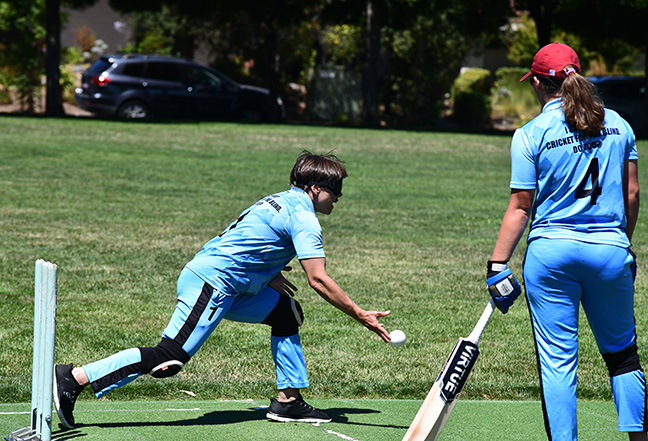
Many people like to compare cricket to baseball. The truth is that baseball was developed based on cricket, and it carries many similarities. Rather than running to bases, cricketers run between two base-like structures known as wickets. There are two wickets on the cricket field, positioned on opposite sides of the pitch. The batsman stands next to one wicket, while the bowler stands across from them, at the opposite wicket. Once the bowler throws the ball toward the batsman, the batsman will strike the ball before running across the pitch to the bowler’s wicket to score one run. Meanwhile, members of the bowler’s team, known as fielders, are spread throughout the field. Once the batsman strikes the ball and begins running, the fielders must retrieve the ball. The fielders attempt to get the ball to the wicket before the batsman finishes running. If they can beat the batsman to the wicket with the ball, the batsman will be out, and another will replace them on the pitch.
One team will bat exclusively for the first half of the game, while the opposing team will exclusively bowl and field. Halfway through the game, their positions will reverse. The team that was originally batting will begin bowling and fielding, while the bowling team takes up the batting. At the end, whichever team scores the most runs is the winner.
One of my favorite things about blind cricket is that very few adaptations have to be made from the mainstream sport. The major adaptation is the ball, which is a hard leather ball in mainstream cricket. For blind cricket, a hard plastic ball was developed, filled with metal ball bearings as a non-electronic auditory adaptation. Aside from this, all of the equipment in the sport is the same as that of mainstream cricket.
The two other primary adaptations made for blind cricket are the batting and bowling styles. In mainstream cricket, the ball is thrown overhand, bouncing on the ground just before it reaches the batsman. In blind cricket, we throw the ball underhand, much like the regular bowling style, so that the ball makes a clear sound when it rolls toward the batsman. Due to this adaptation, the batsman may choose to stand and bat like a mainstream cricketer, or they can lean down and sweep the entire length of the bat against the ground in a powerful sweep shot.
Apart from these three primary adaptations, blind cricket is very similar to the mainstream sport. Often people watching blind cricket don’t even realize that the game has been adapted into a blind sport. I cannot count the times people have mistaken me for a sighted cricketer. When they find out that I’m playing blind cricket, they’re completely perplexed.
Bringing It All Back Home
Once I had learned the basics of blind cricket, it was time to take the game back to America. However, I was very reluctant to leave India. After just one month soaking up Indian culture, I came to see my new community as family, and I was addicted to playing cricket every day. My only consolation was that my brother and I would be working to build blind cricket from the ground up in the US. It was a daunting task, but teaching is a passion for both of us. The challenge of establishing a national sport was exciting and empowering.
I wish I could say that the US blind community welcomed cricket with open arms. The truth is that it took time and extended exposure to build interest in the sport. Many people had never heard of mainstream cricket, let alone blind cricket, and at first they were hesitant to try a new sport.
The first step was to begin the exposure process, showering the blind community with information about blind cricket. During November and December 2024 and January 2025, Drew and I focused solely upon online outreach. From NFB email lists to blind sports networks, we blasted the community with news of our intention to start national men’s and women’s blind cricket teams.
Although it took time for interest to build, once it was there, Drew and I found ourselves in a whirlwind of excitement. We were bombarded with requests for us to provide in-person demonstrations. By the end of January, our calendar was completely booked up through May, and we had fifteen clinics scheduled in eight states. We traveled to schools for the blind such as Perkins, the New York Institute for Special Education, and the Maryland School for the Blind, where we held all-day clinics with the students. The focus of these clinics was to introduce the youth to a new sport and to teach them the basic skills of the game. Most importantly, our goal was to give the students a good time. I’d say this effort was a definite success, as the students at many of these schools are still asking for more cricket.
In addition to teaching at schools for the blind, Drew and I traveled to adult training centers such as SAAVI Services in Arizona and the Louisiana Center for the Blind. We traveled to state conventions and blindness-centered events, where we spread the word about blind cricket and invited people to join us on our journey toward forming the national men’s and women’s teams.
Building the Spirit, Creating a Team
It’s hard to believe that in November 2024 blind cricket was largely unknown in the US. Now, in the summer of 2025, we just finished our first national training camps for the first US women’s team. Often Drew and I feel like proud parents! We have breathed life into this project, and now we’ve watched the birth of a new sport in the US. Soon we will see the impact that it’s having on the lives of our players. No feeling can compare to this! Not only will the game shape me as a person, but it will affect those who have taken the initiative to jump into a new sport and give it their everything.
In the second half of June 2025, twenty-four women traveled from eleven states to attend our first two national training camps for women’s blind cricket. Twelve players trained for three days in New York. The other twelve traveled to California the following week for their own three-day camp. Throughout this journey, there have been many magical moments for me, but nothing compares to the experience of seeing twenty-four women come together to take on a completely new challenge.
During clinics, I only worked with players for a few hours at most. But during these camps, I spent three days with the women and got to know each of them as we learned and played together. The magic of these camps came from the way the women interacted with each other and with the sport itself. I watched them build each other up and bring the absolute best out of one another. Any activity has the power to bring people together and to change lives, but never have I witnessed this phenomenon so closely before. I’ve seen these players restructure their lives around cricket and each other to build a strong, resilient team of incredible women.
With this achievement under their belts, the women who have been selected to progress through the program will attend an intensive eight-day training camp from July 26 to August 3. During this camp, the women will dive more deeply into cricket, learning the intricacies of the sport. At the conclusion of this camp, the top seventeen players will be selected as our very first National Women’s Blind Cricket team. Rather than easing into their role as international athletes, these players will jump straight into the World Cup competition in November of 2025. With only a few months of training to prepare, these dedicated athletes will travel to India and Nepal for one month to make history in the first ever World Cup for Women’s Blind Cricket.
Although the United States has lagged behind other nations in mainstream cricket, we are right up at the top for blind cricket. We are right on time to compete in this historic event.
It’s hard to believe that there was almost no interest in blind cricket back in November of 2024. Now, exactly one year later, the US will compete for the World Cup. This remarkable feat is a reflection of the strength, passion, and tenacity of our US athletes. They have embraced change and joined forces to create something new and beautiful. Someone always has to be the first to take a step toward change and progress to inspire others. These athletes will inspire generations to come to embrace change and dive wholeheartedly into new adventures.
If you take only one thing away from this article, I hope you are as inspired as I am by these women. I hope to see you cheering the US National Women’s Blind Cricket team on during the World Cup this November!