American Action Fund for Blind Children and Adults
Future Reflections Winter 2026 PROGRAMS
Baltimore Reflections
by Rachel Bodek
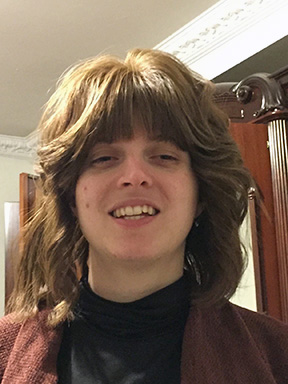 From the Editor: As a member of the 2025-2026 cohort of Teachers of Tomorrow, Rachel Bodek recently spent a weekend at the NFB’s national headquarters in Baltimore. On her way home she wrote the following letter to the many dedicated people who organized this weekend of intensive training and reflection.
I’m on my way home from this spectacular experience, and, thanks to my husband, who’s encouraging me not to wait, here come my reflections.
I’ve been part of the NFB in various capacities over the past twenty years. I have benefited greatly from my involvement and shared what I’ve learned with others, thus impacting many people. Yet my feelings today are on a new caliber—I feel like I really came home. I feel more part of the Federation family than ever before—together with all my new Teachers of Tomorrow (TOT) siblings.
As I kept telling my husband over this weekend, they are saying everything I keep saying. I feel so validated, and I am getting the encouragement to keep doing what I do, despite much pushback at times. At the same time, I was led to the realization once again that there is still more I can do for my students, for my Insight Beyond Eyesight support group—and for myself as well! Let this new chapter begin!
Here comes a small list of the “bajillion” things I heard and experienced this weekend. I’ll write just one more sentence before I start, to thank all those people who were involved in this beyond amazing endeavor—the people who handled all the logistics, the presenters, the volunteers whose names I know and those whose names I don’t know, those I met and those who worked behind the scenes. You did a great job putting this weekend together, and it is much appreciated!
Now here I go for real! Mr. Anil Lewis, I am so glad the Georgia sheltered workshop did indeed not get another Lewis, and the blindness world got you instead! You are changing the world for the better. And yes, it is so important for our students to have autonomy while they’re encouraged to set and reach high expectations. Learned helplessness won’t get you far in life.
President Riccobono (I know how to spell your last name now because I read it in your letter to us in Braille! Otherwise, I definitely would have inserted a k. There! Just another proof as to the importance of Braille literacy). Your energetic and engaging portrayal of the “vision industrial complex,” where it is wrongly presumed that eyesight equals superiority, enraptured our attention. I can still picture the children at the Wisconsin School for the Blind being led by the trays they’re holding (like pull toys) instead of using their canes and learning to carry their trays independently. Each time I think about this it elicits a sad chuckle.
Another story is the one about the blind teacher getting injured while looking for a runaway student; the teacher tripped over the child on the staircase. This teacher generally used human guides instead of using a cane. The teacher wondered what could be done in the future to prevent this situation. You said, “Just use your darn cane!”
Your emphasis on the importance of mentors was a theme throughout the weekend—it’s the ultimate solution for many issues. As you stated, “The NFB shares many stories. This is the way people find common ground to help one another.” And to us teachers you emphasized the importance of teamwork as you prudently declared, “Although we are good fighters, we’d always rather be partners than litigators.”
Then came the “treasures discovery” session—we got such useful gifts, including adapted games, slates and styluses with a training pop-it to help us learn the concept of using a slate. (Look out, students of mine! I will give it another try with you—even though you found it difficult the previous time!) Karen Anderson claims writing with the slate can help you remember information better. And the drawing board will give our students more opportunities to do artwork.
Then came Mr. Jonathan Mosen and technology extraordinaire! With limitless patience and expertise, you gave us a tour of your fascinating IBTC (International Braille and Technology Center) and answered all our questions. Wow! What an experience!
We marched on to the Independence Market and the tenBroek Library tour. There were so many great products to be purchased and so many interesting artifacts to be seen and touched!
Finally, for Friday’s last program, we had the behind-the-scenes tour with Mr. John Berggren. It was intriguing to hear about the history of the Kenneth Jernigan Institute and plans for the future. Furthermore, your perspective as a sighted employee (in this case a minority) was entertaining yet meaningful. You honestly shared how your view of blind people changed from “a bunch of quirks” to normal people who happen to be blind. The reports of how you speak up for the dignity of blind people in a soft, yet strong manner (relieving self-advocacy fatigue) show your genuine view of and compassion for humanity without judging exteriors. If only the rest of the world were just like you it would be a much better place for all!
That much in one day! The wise ones of us ended it there so as to get a proper night’s sleep before the music went off at 6:00 a.m.!
Saturday started with a bang—in a refreshing and unique way. Karen, your personal account was quite moving. Although you really are one amazing person, it is not for reading 50 wpm in fourth grade, nor is it for getting away with murder for not performing well at school and passing anyway. Boy, did we become cognizant of how crucial it is for our students to be held accountable and having consequences for their actions (or inactions) from your presentation and others!
First Lady Melissa Riccobono—with charm and charisma you walked us through your challenges, starting with your five-year-old self, whose friend didn’t think you could count dollar bills, all the way to your daughter’s reading difficulty saga and the lessons you learned from it. You alerted us to the fact that many times blindness is only one characteristic, and there might be other underlying diagnoses that need to be addressed. We all want to be your friend, now that we know you are into true crime and medicine—just in case we ever need your help. Yes, it would have been nice if you had pursued your dream of becoming a doctor, which would have placed you in very exclusive ranks, shared with a small handful, including Dr. Jacob Bolotin. (I’m obsessed with him, and I hope a children’s book will be written about him some day!) We appreciate everything you do for the blind and others in various capacities.
Bre Brown’s talk about the “dirty words” was an insightful (no pun intended) discussion about all the other terms used—anything but the word blind itself. Her session later on how to cut fruits and vegetables under learning shades was presented with so much patience and clarity! Bre, you are a superb instructor!
Ronza Othman’s powerful and poignant life story held us captivated, notwithstanding the encroaching lunch slump fatigue. Her accomplishments in spite of her underprivileged background are truly remarkable! She alerted us to the fact that extended time is not something that lasts in the real world. Employers have the right to give equal pay for equal work; hence, blind students need to be weaned from this entitlement when they prepare for their future vocational aspirations. Ronza’s session later on pouring drinks was filled with more details than we considered before, and definitely piqued our awareness.
The Zoom sessions with students who are part of NABS (National Association of Blind Students) were enlightening and informative. The suggestion of using one’s blindness as an asset in a job interview is brilliant (of course accompanied by concrete skills it has taught the person).
The other Zoom call with former Teachers of Tomorrow participants was very interesting and informative as well. It is so nice to hear how much this program has given them and how they still feel connected. Their advice is invaluable, and we will try to follow their lead!
It was so much fun to explore and play with all the games, tools, and equipment at the center! I hope our suggestion of building a goalball court in the empty space on the second floor will be taken seriously!
The sessions with Nikki [Jackson] to practice using the long canes and the session on carrying trays were the cherry on top. The one on carrying trays was a fascinating (and a bit scary) experience. Now we can understand our students a bit better and teach them another skill or two!
Karen, I know you had help setting up this program. But you were there almost the entire time, seemingly without resting for a minute! You welcomed me into this program so graciously, and you offered to tackle any issues that might arise due to my religious needs. Apparently, you changed some of the schedule and locations just for me! You and those who have worked with you on this are true models on inclusion, acceptance, and loving kindness! Words are insufficient to express my boundless gratitude.
May you all be blessed! I’m looking forward to a year of growth, learning, and working together to improve our skills and our outlook for blind people—thereby bringing more good into this world!
P.S. Perhaps we can take my students’ questioning of the name “Teachers of Tomorrow” seriously. We could rename this program something like TOT-TOP, Teachers of Tomorrow, Teachers of Posterity.
With endless appreciation,
Rachel Bodek