American Action Fund for Blind Children and Adults
Future Reflections Winter 2026 CAREERS
Making It in the Media
Presented by Nikki Jackson
From the Webinar Where the Blind Work
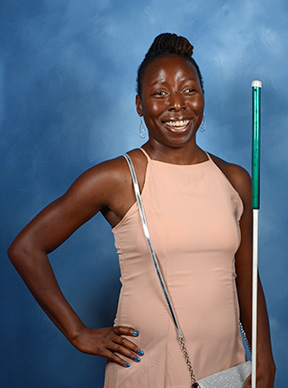 From the Editor: Where the Blind Work is a monthly webinar presented by the Committee on Employment of the National Federation of the Blind. You can listen to the monthly webinar by visiting https://nfb.org/programs-services/employment/where-blind-work. In this session, host Nikki Jackson interviews three blind people who have built successful careers in the media.
NIKKI JACKSON: Our first presenter, hailing from Florida, currently works as accessibility coordinator for the FIFA World Cup 2026. Please give a warm virtual welcome to Natalie Gross! Natalie, please share with us a little bit about who you are and what you do.
NATALIE GROSS: Hi! My name is Natalie Gross. I’m originally from Pasadena, California, so I’m a long way from home right now. I’m currently the accessibility coordinator for FIFA World Cup 2026.
Getting to this job has been quite the journey! I’ve done quite a few things in entertainment. It was not a straight path to what I’m doing.
When I graduated from college I wanted to be a publicist. But there were no blind publicists. There were not any disabled publicists of any kind that I could reach out to for mentorship. They just weren’t hiring us. I wanted to do publicity in fashion or sports. I know those are very different fields, but I love them both, so either one would have been a good fit for me.
 I did a lot of freelance work. I did a lot of internships. I worked at a museum as an intern, and then I interned for one of Katie Perry’s background singers. She was super nice! Her name is LB, for Lauren Baugh. I was kind of hustling, because nobody was hiring blind people in the entertainment industry when I graduated from college. I thought, this is a big problem! Why aren’t we more represented in this space?
At that time, I wasn’t well connected in the blind community. I went blind right before I started college, and most of my peers weren’t disabled. I really wanted to make connections in the community, so I joined a blind theater group. They reached out to me, and I thought it would be a great opportunity to be around other people who were experiencing the same things I was. I decided to join the group, and I found that I really loved it. I ended up getting scouted at one of our rehearsals. A casting rep came in and said they were looking for someone to be in a commercial. It was raining, and my hair was crazy. I came in and said, “This is me not at my best!” But I guess something went well, because they invited me in for a callback!
I did not get that commercial, but they liked me so much they introduced me to a talent agent. That’s how my acting journey began.
It was really slow at first. This was in 2017. A handful of people with disabilities were getting into television shows and commercials, but work was still pretty scarce. Only one agent in LA was working with actors with disabilities—that’s one out of maybe four hundred agents, so it was really wild!
In the meantime, I kept doing freelance publicity work as I was getting into acting. I worked with theater groups, and I ended up joining a dance group as well. As most people know, when you have a disability, you have to hustle! So, I joined a dance team and started doing salsa professionally with a team of folks with and without disabilities.
I still wasn’t finding substantial work. I wanted to be on my own and pay the bills! It was a rough road! I asked myself what I could do in the meantime, since I didn’t have any stable job. I loved fashion, so I decided to start a podcast with my best friend, Melissa. Through the podcast I caught the attention of some people who were interested in working with me on a fashion line. I began my brand, called Not Your Inspiration.
I was doing acting, doing fashion, dancing—and finally I got the opportunity to work as publicity and marketing coordinator for Blind Institute of Technology. It was a really great job. I loved it!
From there I connected with a consulting agency that was looking for someone with an entertainment background. They did a lot with Google and The Academy, and they worked with the Grammies. It was a great opportunity for me to get my foot back into entertainment, but more as a nine-to-five job.
I learned so much from them! I found out I love working on event accessibility. I loved working for big events like the Academy. From there the FIFA job opened up. In the beginning I wanted to work in sports, so it came full circle. I would have to move to Miami, but FIFA World Cup is the biggest game in the world! It’s been a great opportunity! I got a lot of experience working at a stadium and using all kinds of amazing accessibility features. We introduced ASL commentary to FIFA, audio commentary, a sensory room, and captioning—all the things that make an experience accessible for disabled spectators. I’m really excited about the work we do!
NIKKI: Let’s move on to our next guest, hailing from Texas. This person is a performer and a consultant. Please give a warm virtual welcome to Cristina Jones!
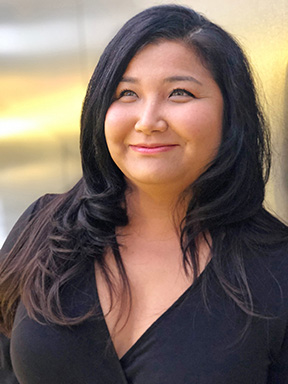 CRISTINA JONES: Hi! I’m an opera singer, and I also do consulting. I’m an educator as well; I teach Braille music and private voice lessons. I’ve taught at a couple of universities, usually survey classes on opera and musical theater.
Right now, I live in Austin, Texas. I grew up in southern California, in the Long Beach, Orange County area. I went to the Braille Institute in Orange County, and I took part in the Johnny Mercer Children’s Choir there. When I was in high school the children’s choir director asked me what I wanted to do. I couldn’t see myself doing anything outside of music, so I went to college to be a choir director. Then I discovered that I really love opera! I don’t want to sit and listen to it all the time; I want to take part in it. That’s basically what I do.
I do primarily opera performance or concert work, which is basically opera without the staging. I also do some consulting work with companies such as Netflix and Disney, Sesame Street and Reading Rainbow. I’ve also done a bit of acting—not out of a burning desire to do it, but I’ve been in a few films because the opportunity dropped in my lap.
I’ve found that whenever I do something that’s off the beaten path, it tends to give me more work in the area that I want to focus on. As a blind contractor you have to hustle. But when you’re distracted away from areas where you want to concentrate, when you just let life happen, more things tend to come your way. I don’t know if this is everybody’s experience, but it’s certainly mine.
I should mention that I got my master’s in London. I also have an Alexander technician license, which means I work with people on their body.
NIKKI: Thank you very much! I really like what you say about letting life and art lead you. I think many of us can relate to that.
Finally, this next individual hails from New York. I’d like you to give a warm virtual welcome to Jourdain Searles.
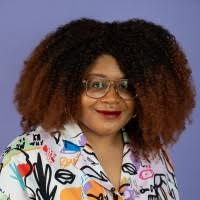 JOURDAIN SEARLES: Thanks for having me! I’m from Augusta, Georgia, and I went to college there. I wanted to move, but my mom didn’t think I could be out on my own. When I finished college I got a lot of encouragement from professors. They thought I knew a lot about film, and they wanted me to go to film school. It had never occurred to me! I applied to NYU, and I got in and studied dramatic writing. I got into UCLA, too, but I did a lot of research on LA, and with their public transportation system it didn’t seem very feasible. People would have to be driving me around all the time. If I got into a school in New York, I could be totally independent. I could walk and take the train everywhere.
When I moved to New York I rode the trains all over, just trying to learn the system. I got lost a whole bunch. When I was younger my TVI (teacher of the visually impaired) taught me to get the lay of the land, so I rode the subway all over the city, trying to figure it out. Now I know it pretty well.
I started writing film criticism on my blog. I didn’t really expect anybody to notice, but I got a fellowship with a magazine that doesn’t exist anymore. They were a feminist publication that started out in the northwest. It was a fellowship for pop culture criticism. The cool thing was you had to write eight digital articles for the fellowship. So, I immediately had those bylines. Then I wrote a long-form research piece for the actual print magazine, one of my earliest pieces of long-form writing.
It’s a little weird being a film critic when you have low vision. I don’t notice certain things as much as other critics do. I pay a lot of attention to the dialog. I ask other critics about things they’ve noticed that I might not pick up on. It makes for an interesting conversation. It’s extra special when I have the chance to write about a film involving people with low vision.
I’ve done a lot of film podcasts to raise my profile. I’ve also done stand-up. I started doing stand-up a year after I came to New York. It was a way for me to figure out my identity and assert my independence. When you’re standing on stage you can’t see anybody because the lights are so bright. I thought that would be scary, but the fact that I can’t see anybody’s face is great! I can say what I want to say, and I can’t see the judgment.
Once in a while I include jokes about how I see. I’m giving the audience permission to laugh, because I’m fine. You live your whole life with people asking you, “Do you want to get this problem fixed?” No, I don’t want to get it fixed! It’s fine. I just want to talk about it.
When I was growing up my mom was afraid I’d look like a dork with my thick lenses. Now so much of my adult cred is built around wearing big glasses. I love wearing big glasses! It’s my favorite!
Doing stand-up has been very helpful with my job as a film critic. I do a lot of film Q&As and panels. I get asked to do these things because I’m very comfortable being onstage. With Q&As I can’t see all the hands, but everybody’s very chill about it. I’m very comfortable talking about what I need. I’ll tell producers exactly where to stand so they’re in my line of vision. I have to time myself in case I don’t see them; otherwise, I’ll run the light and go a little longer than I’m supposed to.
I feel really fortunate living here, because I can go to all these events and do all these things. I’ve been on film festival juries. I was on the jury of the Melbourne International Film Festival, and I had the chance to mentor another writer while I was there.
I’ve written for the New York Times and Vanity Fair and the Hollywood Reporter. If they like your work enough, editors are willing to work with you. I never thought I’d be able to live as independently as I do, and I feel very fortunate!
I don’t know how to explain why, as a person with low vision, I love movies so much. It’s as though I’m trying to watch as many movies as I can for as long as I can. When I was a kid they thought I would lose all of my vision. That didn’t happen, but it made me want to read and watch as many things as I could. It also made me think about how much filmmakers can learn from listening to disabled voices.
There was a movie I was supposed to review a couple of years ago. There were “Easter eggs” all over it, and everybody was talking about all the things they saw in it. I was focusing on the characters, and from that angle I wasn’t getting much from it. My review sounded so different from everybody else’s reviews! That’s a really cool thing about film criticism. It’s your unique perspective. Whatever observations you have are going to be interesting, even if it’s not the traditional way people talk about film.
NIKKI: It’s really nice to hear how comfortable all three of you are in your craft and with who you are as individuals. I’m sure all of you have faced some challenges with accessibility in your work. What are some of the ways you’ve been able to work with those accessibility challenges to produce a level of work that matches that of your sighted peers? I’ll ask Cristina first.
CRISTINA: I’m a contractor, so my work comes from everywhere—opera companies, orchestras, universities. Some places are union, some are not. One area where I sometimes have a hard time, depending on what I’m auditioning for, is comfort and timing around disclosing my blindness. Over the past seven years I’ve pushed myself to be more comfortable on my blindness journey. I realized that a lot of my hesitation was my own internalized ableism. I wanted to be seen as competent and on an equal footing. I realized that when I wiped blindness out of the equation to be seen as equal, I was erasing a fundamental part of myself. I ended up incorporating blindness into my brand. My website is blindsoprano.com.
Sometimes I wonder, if I didn’t disclose, would I get more audition offers? Having blindness as part of my branding has forced me to be honest with myself and the people around me. I’ve gotten a good amount of work. People know what to expect.
One challenge is juggling time and resources, when resources aren’t provided for me consistently. I have to get my scripts in Braille or learn by ear. A lot of times we’re hired very quickly. They might send me the sheet music two weeks before I have to perform. They don’t give me a lot of time to get done the things I need to get done.
The way I deal with that challenge is that I have several readers who I know and trust. I can call them and say, “Please, please! Let me buy you coffee! Can you read this sheet music for me?” Or I look online to see if the music I need might be available through the National Library Service for the Blind (NLS). I look to see if it’s in the public domain, or if there are recordings anywhere.
Another challenge for me is staging. A lot of directors have assumptions about what I need or what they think I’m capable of. Explaining to them in a way that’s firm but not rude about what I need and don’t need, how much spoon-feeding I need with the staging, involves trusting myself. I’m pretty comfortable with myself and my skills. But I’m not immune to insecurity! If something goes wrong, I sometimes assume it’s me. I assume I stepped out of place or did something else wrong. Most of the time it turns out it’s not me, but now and then it is. Everybody makes mistakes. I worry that if I make a mistake as a blind person, I might be messing things up for other blind artists. That’s something I need to let go of.
The other thing for me, in terms of accessibility challenges, is that sometimes, even though people look at my website, they don’t get it. When they meet me, they say, “Oh! You really are blind!” “Well, yeah!” In my head I can be pretty snarky, and when somebody says something like that, it’s challenging for me to bite my tongue and not be a jerk.
NIKKI: Jourdain, what about you?
JOURDAIN: The major thing I deal with in a lot of film festivals is they’ll tell me to watch from up in the balcony. I tell them I can’t see from up there. I have to advocate for myself to get what I need. I wear glasses, so they assume that whatever my issue is, it’s fixed.
Film festivals can be pretty chaotic. A lot of the time I can’t figure out which line I’m supposed to stand in. I have very low depth perception, and going down the stairs I need to hold the railing. If I can’t get to a railing, I just have to wait. Other critics don’t have to jump through those hoops.
NIKKI: Is audio description an option with films at festivals?
JOURDAIN: Some of the big festivals have audio description, but every festival needs it. It’s up to the festival to provide it. Most of the time they’ve been good about it, but they could definitely be better.
NIKKI: Miss Natalie, what about you?
NATALIE: When I was going out and auditioning they’d give us a script, and sometimes things would be crossed out or underlined. It would indicate whether they wanted you to speak loud or cut the line off. I use a screen reader, and a lot of that didn’t work. At first I didn’t speak up. Once I got my footing I realized I needed to speak up. They spend so much money on casting; they’re going to accommodate you. You don’t have to feel like you should just be happy to be there. People don’t know what they don’t know. Now I ask my agent to make sure I get the script in a Word document.
Also, I have to be vocal about how I show up on the screen. Producers will have very stereotypical ideas. It’s not one-size-fits-all; not all of us wear dark glasses, not all of us have dogs. I remember once I was shooting a commercial, and they said, “Put her cane in the shot next to the couch!” I had to explain I would not have my cane next to the couch. I’d leave it by the door when I come into the house. It doesn’t have to be in the shot. When I explained it, the director realized it was kind of silly, and they took it out. You tend to be a little shy, you don’t want to lose your job, but there’s a way to explain things and get people to understand. I’ve been lucky that I’ve had very supportive managers, but that’s not always the case. Working in accessibility so long, I find that people just don’t know. Usually, they say no because they haven’t done it before, but when you come with a solution, then they’ve got it.
NIKKI: I love that you spoke about being your own advocate. It’s easy to fall into the mindset that we’re just lucky to be here at all, but that’s not how we change things and make a difference.
It sounds like all of you have had to be very resourceful in your work, because things aren’t always accessible. My next question is about the arts and entertainment field as a whole. How do you think the field can better represent and include blind professionals?
JOURDAIN: It would help if accommodations were considered more important. There should be more accessibility in venues where you watch film. There should be more engagement with disabled arts collectives, more awareness that we’re here. Often I’m the only visually impaired critic around. I seem to be the only critic who’s struggling. Most industries have to be forced to care. We have to create a unified front.
I remember a film called Vision Portraits. It was a documentary about low-vision artists, made by a filmmaker who was losing his sight. It’s really good, and I wrote about it. We obviously need more films like that! When I reviewed it I felt really lucky, because I didn’t even know it existed. The filmmaker reached out to me. I wish there were more connections between us all.
NATALIE: I think the industry as a whole need to allow disabled people to be part of the conversation. A lot of times folks without the lived experience try to speak on our behalf, and they end up missing the mark. When they don’t get it right and they get backlash, then they say, “Well, we’re not going to do it at all then!” They’re upset because they didn’t get it right the first time, but they didn’t get it right because they didn’t consult us.
One thing we like to say is, “Nothing about us without us.” We need to make sure that we’re not only being brought to the table, but we’re leading the conversation about us, about what real disability representation could look like—not just the sob stories and the tropish things they like to put out! Blind people are moms, sisters, husbands, teachers, whatever the case may be. That’s not always portrayed in the media. It would be really helpful to get the industry into a more inclusive space.
CRISTINA: The main thing I would say is that we need people with disabilities to be represented on and off screen. It shouldn’t only be the performing artists advocating for themselves. There should be representation everywhere. It’s really important that we encourage each other as blind people to look beyond jobs that might seem easy for us to have. It’s important to me as a blind opera singer to have more work created specifically for blind people.
I’m always sending other blind singers to directors, because that networking is so necessary and important. We need open communication on both sides, and we need to build positive relationships. We need to have discussions and allow people to ask questions.
NIKKI: Thank you for saying that. That’s such an important point! Why can’t there be blind people working backstage with the stage crew? Working at every level? Now, can each of you tell us about an exciting project you’re currently working on?
NATALIE: We have a lot of accessibility features for blind and low-vision spectators. We have audio description. We’re bringing back the haptic board, where you not only listen to the audio description, but you can put your hand on a tablet and feel the progress of the ball. It’s really cool! I got to try it out! Come see me at World Cup next year and have a blast!
CRISTINA: I just finished filming something with Lifetime, and I’m really excited for whenever that comes out. I have no idea when that will be.
JOURDAIN: On November twenty-first to twenty-fifth, I’ve programmed a series of Angela Bassett movies at Brooklyn Academy of Music. I’m very excited about that. It’s my first time programming a series. Mostly I did it because I wanted to show Strange Days. It’s the thirtieth anniversary. I’m showing Strange Days, Waiting to Exhale, and What’s Love Got to Do with It? I’ll be introducing some of them. It’ll be a lot of fun.
NIKKI: What advice would you give people who are interested in finding success in the arts and entertainment field, in whatever art form they want to pursue?
JOURDAIN: I’d say do as much research as you possibly can. There were so many things I didn’t know that I didn’t know!
One thing, I wish I’d had more conversations with my mother. Parents feel like if they have a child with a disability they’ve got to protect them. I didn’t get the encouragement to go out there that I wish I had had. I wanted to go out there. I wasn’t afraid of going out there. Know that you can do basically anything. Sometimes it takes a bit more work. I don’t mind watching a film thirty times, because I love what I do, and I want to get it right. Love what you do, try your best, and people are going to appreciate it.
NATALIE: A piece of advice one of my friends gave me years ago was, “Anything you’re scared of, run straight toward it. That’s how you overcome fear.” I’ve truly been running ever since. Things can be a little scary. Like I mentioned, I’m a long way from home. It’s been an incredible journey, and I don’t regret it.
NIKKI: Cristina? Cristina, are you there? We seem to have lost Cristina.
I really appreciate you all hopping on and talking about your experiences and your backgrounds, and giving such words of encouragement. Thank you all for being here! And thank you to our listeners, too. If you have questions or comments, please email us at [email protected]. We look forward to seeing you at our next webinar.