American Action Fund for Blind Children and Adults
Future Reflections Winter 2026 ADVOCACY
Protecting Key Programs in the Department of Education
by Justin Young
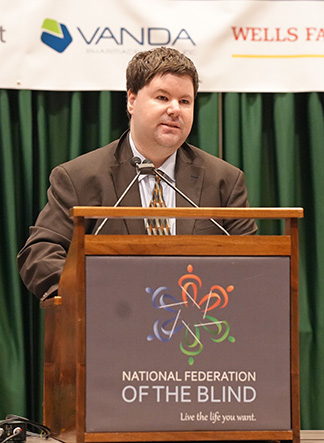 From the Editor: Justin Young is a member of the Advocacy and Policy Team at the National Federation of the Blind Jernigan Institute. In this article he updates readers of Future Reflections on proposed changes to programs under the US Department of Education, changes that may affect blind people of all ages.
Over its long history, the National Federation of the Blind has used multiple strategies to advocate around federal, state, and local issues that have an impact on blind Americans. These advocacy efforts include making phone calls, writing letters, sending emails, and meeting with elected officials in Washington and at the local level. We use these strategies from our advocacy toolbox to protect the federal laws and programs on which we, as blind people, depend.
At the 2025 Washington Seminar, we visited the offices of our members in Congress. We told specific stories of how the Individuals with Disabilities Education Act (IDEA), the Rehabilitation Act, the Americans with Disabilities Act, and the many programs housed within the US Department of Education have a direct impact on our lives. Our representatives and their staffers understood our position and told us they would help to maintain these programs, ensuring that our rights would be protected.
Then, in March, an executive order was issued, beginning the official process of closing the Department of Education. Important programs that impact blind Americans would be shifted to different federal agencies. The executive order would begin a lengthy process of reductions in force (RIFs), having an impact on how these programs are managed at the federal level. Federationists wrote to the Secretary of Education, explaining our concerns and indicating the importance of IDEA, the Rehabilitation Act, and such rehabilitation programs as those under the Randolph-Sheppard Act, the Older Individuals Who Are Blind (OIB) program, and the quota system for the American Printing House for the Blind (APH) that helps local schools and agencies afford Braille materials and access technology items.
Here are some examples of how these programs have a direct impact on blind people and our families:
IDEA covers individualized education programs (IEPs), ensuring that blind students have the right to a free and appropriate public education (FAPE). It ensures that blind students have the right to learn and use Braille, having it as the primary learning medium. Federal funds under IDEA also help school districts pay teachers of blind students to instruct in the K-12 school system, teaching Braille, access technology, and cane travel.
Vocational rehabilitation services help pay for job training or college studies, and they can assist with providing access to technology. Vocational rehabilitation services also may pay for blind people to attend an adjustment-to-blindness training center where they can gain competence in the skills of blindness.
The Quota Funds Program of the American Printing House for the Blind helps school districts afford access technology such as the Monarch and provide access to Braille materials, including tactile maps.
The Department of Education helps offset the cost of Bookshare, a program that provides books in accessible formats for students at the elementary, secondary, and postsecondary levels.
Programs under the Randolph-Sheppard Act allow blind people to become business owners and entrepreneurs, helping reduce the high unemployment and underemployment rates for blind Americans.
For blind seniors, the Older Individuals Who Are Blind program provides independence skills training, allowing blind people to age in place with their families.
Throughout the federal government’s appropriations process, the NFB has monitored the budget bills of the Department of Labor, the Department of Health and Human Services, and the Department of Education. Federationists have met with committee staff, attended mark-up budget meetings, and continued the conversations that began at Washington Seminar in 2025.
Not all twelve budget bills were passed by September 30, 2025, resulting in a shutdown of the federal government. The government attempted another RIF of the Department of Education staff, with sweeping layoffs in the Office of Special Education and Rehabilitative Services (OSERS) and the Office for Civil Rights (OCR). Through the loss of key personnel, the Department of Education would lose key institutional knowledge of how these programs are administered.
During this period our plan was to set up targeted meetings with the Senate Health, Education, Labor, and Pensions (HELP) Committee members. We asked our affiliates that had at least one Republican senator on that committee to send one or two individuals to Washington for in-person meetings. The HELP Committee is the relevant committee of the Senate charged with providing Congressional oversight of education programs and federal agencies. It has been our hope that bipartisan support around this issue will be expressed by the members of this committee and the House of Representatives Education and Workforce Committee.
In addition, we asked all Federationists to set up district meetings with our representatives to explain our concerns and continue our advocacy on this important topic. The continuing resolution that will fund the federal government until January 30, 2026, included a provision to bring back all the staff members who were furloughed during the forty-three-day shutdown. However, it is unclear what may happen after January 30, 2026. We will continue to advocate and urge our Congressional representatives to fight on our behalf, ensuring a partnership with the organized blind movement.
Always remember that it is never too late to reach out to your senators and representatives, telling personal stories of how the above-mentioned programs directly impact our lives. Personal stories are among the most important components in the advocacy toolbox, and we must use them whenever possible. The above-mentioned programs have a direct impact on our community. We need to keep up the pressure on our elected officials so they will help us in the fight to protect these critical programs from being harmed in any way. We need to ensure that blind people can depend on them for the present and into the future.