American Action Fund for Blind Children and Adults
Future Reflections Winter 2026 ADVOCACY
Broadening Perspective and Narrowing Focus: What Blind Students Need to Know about Changes in the Department of Education
NABS Now Podcast, December 31, 2025
From the Editor: NABS Now is the monthly podcast of the National Association of Blind Students (NABS). It is available on such mainstream platforms as Spotify. In this episode, NABS Now hosts Qualik Ford and Izzy Bailey interview NFB President Mark Riccobono about the proposed cuts to the US Department of Education.
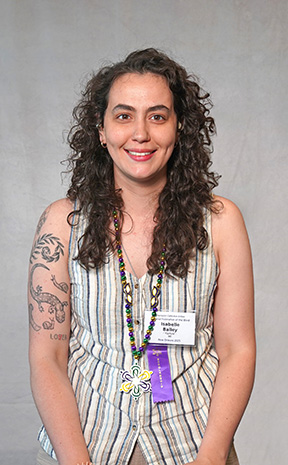 IZZY BAILEY: Hello everyone, and welcome back to the NABS Now podcast. I’m Izzy Bailey, and I’m joined by my co-host, Qualik Ford.
QUALIK FORD: Hi, everyone. This is Qualik Ford, and I’m super excited to be back with another NABS Now podcast.
IZZY: Qualik, we have a very, very exciting episode today. Do you want to share a little bit about that?
QUALIK: Yes. We’re going to be talking about a very important topic, and talking to one of the integral leaders of the National Federation of the Blind. He is our wonderful national president, who is doing so much for students and for members all across the organization: President Mark Riccobono.
MARK RICCOBONO: Thanks for having me. I appreciate it! This is my first time. I’m a rookie.
IZZY: That’s very exciting. Thank you for being here. We’re honored. I want to share a quick anecdote: I got the original voicemail saying that you were joining us, and with the iPhone it will transcribe your voicemail if you don’t catch it. It did in fact tell me that we were interviewing President Obama! Initially I was pretty excited—but when I heard it was you, my excitement quadrupled. I’m thrilled to have you here and to chat with you. Thank you for being here.
PRESIDENT RICCOBONO: If you can get President Obama, I’ll be bumped any time—as long as you can get him to commit to do something for us.
IZZY: I’m sure we can get that scheduling figured out! Qualik, do you want to start off with the first question?
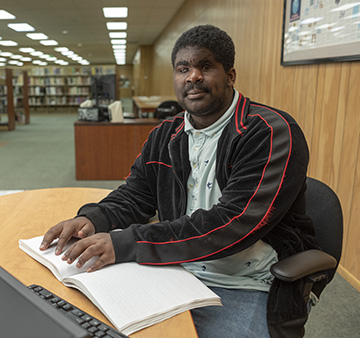 QUALIK: First, President Riccobono, give us an overview of who you are and what it means to be president of the national organization. Then we can jump into our topic.
PRESIDENT RICCOBONO: My name is Mark Riccobono, and I have had the honor of serving as president of the National Federation of the Blind, first elected in 2014 and re-elected every two years since. What does it mean to be president? Well, it really means representing the hopes and dreams of blind people across this nation. That means you have to listen to a lot of blind people. I try to talk to more blind people in a year than anybody else does. My goal is that, any situation I get into, I know what blind people will think about it. I am a blind person, and I do have opinions, but I’m informed by dozens, hundreds, thousands of other blind people—diverse by age and almost any other characteristic you can think of. I’ve met blind people doing things that there’s no way in the world I would want to do, and blind people doing things that I might aspire to do myself. My job is to synthesize all that into something that makes sense for as many blind people as possible.
QUALIK: Our topic today is about the current landscape of education and the Department of Education. You have a familiarity with education, right?
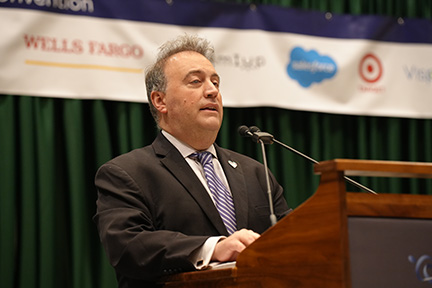 PRESIDENT RICCOBONO: I got a business degree from the University of Wisconsin last century, and I went into retail management. But the most interesting stuff I was doing was as a volunteer. I served as president of the National Federation of the Blind of Wisconsin. In our state at that time there was a big debate about the education of blind children, and about whether or not to close the Wisconsin School for the Blind. It’s a very interesting story, but I’ll save it for another time.
I knew a lot about the education of blind children. Actually, I knew exactly what not to do, because that was my lived experience. I knew that anything opposite that was a good idea!
I put a lot of ideas into the mix of the debate that was happening in the state. I borrowed a lot of ideas from other Federationists across the country and from the good work that had been done. The State Superintendent of Public Instruction asked me to run the statewide agency that served blind children. I was just short of my twenty-fourth birthday, and as I said, the only thing I knew about education was what not to do. I had to take my understanding of blindness—the understanding that I got from the lived experience of blind people across the country, the positive philosophy of the Federation—and try to put it into practice in a traditional system. I meant to get an education degree from Johns Hopkins University, but honestly, the paper was not nearly as valuable as the real-life work experience.
QUALIK: As a Baltimore native I love Johns Hopkins, but as you say, experience is what’s important. Give us an overview of what’s been happening with the Department of Education and funding cuts—the different aspects of this whole situation and how it’s affecting blind students across the country.
PRESIDENT RICCOBONO: First and foremost, a lot of people don’t think about the role the Department of Education plays in their lives until they find a need for it. We knew that eliminating the Department of Education was going to be a topic of conversation in 2025, based on the priorities that the president had been articulating on the campaign trail. In January of this year (2025), right before our Washington Seminar, we decided to change the priorities that we talked about with Congress. We didn’t change them that much, but we added one—to talk about the programs that are essential to blind people, programs that live within the Department of Education. We’ve been very careful not to get lost in the debate over whether or not there should be a Department of Education. Our goal is to protect the programs that impact blind people.
The Department of Education at the federal level has a number of important programs that impact blind people. I’ll talk about the ones that specifically impact blind students, either in college or K-12. The first one, of course, is special education services. One function of the Department of Education is to distribute money to the states, and the Department of Education also provides important technical assistance to school districts on the implementation of the Individuals with Disabilities Education Act. One prime example for blind people is that we were able to get the Department of Education, more than twenty years ago now, to create a technical assistance Dear Colleague letter. The letter made it clear that under the law and the regulations, Braille should be the default reading medium for blind students unless the team decides otherwise. In the past it was not that way, and you had to fight for Braille. Now you have to fight to eliminate Braille. That means a lot more kids are getting Braille than used to, but we know there are still kids who are not getting Braille and should get it. That change was due to our advocacy, and also because the Department of Education offered that technical assistance.
Another aspect is the rehabilitation program. Almost any blind person who is going to pursue higher education is probably going to go through vocational rehabilitation to get technology and support. That program, besides the dollars flowing from the Department of Education, has a lot of technical assistance elements that the department enforces.
Unfortunately, I would mention, is enforcement and oversight. That comes from the Office of Civil Rights, which is responsible for doing enforcement under the law, whether it be the Individuals with Disabilities Education Act, the Americans with Disabilities Act, and any aspect of the education laws that would be overseen by the Department of Ed. Cuts in the Office of Civil Rights were actually some of the first to be made, and a lot of blind students have already been waiting for their claims of discrimination to be processed by the Office of Civil Rights. Cuts in the personnel mean that you wait longer to have your accessibility concerns addressed by the department. Of course, students can’t just stop being students. It probably means that a lot of these concerns are never going to be heard, because students aren’t going to wait around. They’re going to continue to push forward and try to graduate. Once they graduate their accessibility concerns don’t have any merit. Unfortunately this has a very negative impact.
IZZY: Thank you for speaking to that. That was a very comprehensive answer. I appreciate your touching on all those issues.
How have funding reductions affected education access opportunities for blind students in grades K through 12, college, and vocational training?
PRESIDENT RICCOBONO: In terms of funding, the funding is kind of flat at the moment—that’s the good news. The bigger issue over the past year is the uncertainty with what’s happening with the personnel at the Department of Education. These people have a lot of institutional knowledge in terms of the law and making sure that the procedures the government uses to enforce the law are followed. The bigger problem is the loss of those personnel. A lot of personnel were lost with the reduction in force during the shutdown. Congress did reverse the reduction in force—the RIF, as they call it—but if you know there’s a lot of uncertainty in the job that you have, you’re likely to start looking for a job where you have more certainty! That means that potentially we’re going to lose a lot of institutional knowledge about the Rehabilitation Act and special-education law.
Funding is an issue, too. Congress never has fully funded special education at the 40 percent level that was promised back in the 1970s. It never happened. We know that funding is inadequate to provide the services that are needed for blind students in grades K-12.
The uncertainty also takes the pressure off of schools. If we look at higher education, the law makes it clear that educational technology should be accessible. The Title II regulations for the Americans with Disabilities Act are set to come into effect fully next April. The uncertainty at the Department of Ed undoubtedly will make a number of schools think they’re probably not going to go through with that, so they can be less diligent about the accessibility of our technology. I’m sure some of the listeners to this podcast are already experiencing that.
IZZY: That’s a good point. A lot of the conversation that I’ve been exposed to has been specifically about funding, but sticking to that disruption in decades of institutional knowledge—that is huge! Thank you!
QUALIK: Our organization, our movement, is constantly at the forefront of making sure that our voices are heard, that blind students’ voices are heard, that blind people’s voices are heard. What current initiatives are we pursuing right now, or have we pursued, in relation to this? I know you’ve written several letters and contributed in multiple facets.
PRESIDENT RICCOBONO: This is kind of an interesting time for the organized blind movement. We’re usually the ones pushing innovation, pushing for change, pushing for modernization. But actually, our position right now is to protect the status quo. It’s not that we think the status quo is perfect! But the threats to the programs affecting blind people have been so real that we have gone to Congress. We have said we need champions in Congress to protect the Rehabilitation Act, special education programs, programs for blind entrepreneurs. If Congress is not hearing from people about those programs, they will be very easy to get rid of. Congress is going to be much more resistant to getting rid of things that they’re getting pushback on.
This is really interesting, because usually it’s the rest of the blindness field that’s trying to protect the status quo when we’re trying to change things. We’ve heard from some other organizations and people in the blindness field who are arguing that this is a time of innovation. I feel that is really a mistake. We know that the administration would love to hear people say, “These programs for the blind—let’s blow them up and build something different!” As we’ve seen, it’s very easy to tear things down. It’s much harder to build them back up.
I don’t exactly want to say that we’re playing defense. We’re playing offense in terms of making sure we find those champions in Congress who are going to protect the programs when those questions come up.
IZZY: Looking at the micro level, how can an organization like NABS support this work?
PRESIDENT RICCOBONO: It’s really important to let your members of Congress know why these programs are important. We need to share stories of how these programs make a difference. We need to tell stories about getting Braille and specialized instruction in K-12. We need to talk about the importance of having accessible technology in higher education and the real harm that is done by not having accessible materials. We need them to know how the Rehabilitation Act has provided support so that blind people can pursue the things they really want. Those personal stories are critical! It’s about being able to put a name, a face, an experience to what these programs mean.
If you think about it, most Americans have never utilized services under the Rehabilitation Act. So, when a policymaker says, “Let’s reduce the rehabilitation program,” thousands of people have no clue what they’re talking about. It has no impact on their lives, as far as they know. So, they think, okay, that’s easy to get rid of. The more we tell our stories, especially to lawmakers, the harder it is for those programs to be seen as easy to throw away.
The other thing I’d say is of course we have our National Federation of the Blind Washington Seminar coming up in January. It’s a great opportunity to come to Washington, DC, and advocate with members of Congress along with five hundred other blind people. It’s really empowering to sit in your senator’s or representative’s office and tell those stories directly.
QUALIK: It is such a powerful experience! I’ve been to several Washington Seminars, on the advocacy side and the Student Connection side. There’s so much to be gained, and it really does help you realize the impact when you actually get in a room with a congressman or congresswoman to talk to them about what your life is about. A lot of the time when the congresspersons are there, that’s what they want to know about. They want to know about their constituents’ lives rather than just hearing about the bills. Not to say that the bills aren’t important, because they definitely are! But the tie-in to the personal side is massive.
PRESIDENT RICCOBONO: There are only one or two members of Congress who are blind or have low vision. Most people in power don’t have that lived experience. You’re right—they can look up the bill and read the bill, and they can have a staffer analyze the bill, but they need to know the real, personal elements and why it all matters. That’s what’s going to motivate them.
Another thing people can do is really stay clued in. Take the time to read what’s being said, to dig into the details of what’s happening. This is why we’ve been very careful about not getting into the fight about the Department of Education specifically as it relates to blind people. Put our program into the Department of Labor, create a new department if you want, but just don’t kill the program. That’s the important thing! We actually think our programs are okay at the Department of Education, and we’ll be happy if they stay there. But if the Department of Education is going away, which is what the administration has said they want to happen, we don’t care. That’s not our lane! Our lane is protecting programs for blind people.
It’s really important that people take the time to read about the issues. Sometimes what’s on the surface is a distraction from the real advocacy work we should be doing.
QUALIK: What would you say is a message you have for students who are super nervous or overwhelmed? As you said, the student journey keeps moving on, but that doesn’t mean there isn’t a ton of anxiety. What would you say to blind students who are looking to soothe that anxiety?
PRESIDENT RICCOBONO: I think it’s a difficult time to be a student in America, not just a blind student. I think blind students have it better than a lot of populations. You have a whole network of people who you can share ideas and resources with. You also have a whole social network across generations, all the blind people who have come before you, people who have your back. That’s huge! There are lots of populations out there who wish they had that. Just remember that you’re not alone. The fight is worth it. The fight has been different for various generations. But as blind students today you still have more advantages than any generation of blind students before you. That’s because of the amount of accessible technology that’s out there, and because of where the laws are. You’re better off than any other generation of blind students, and you have a powerful network. That should give you a degree of faith and hope, even when times are hard. Do something old-fashioned! Pick up the phone and call another member of NABS, and I guarantee you, they’ll be there to support you.
IZZY: That’s a lovely segue into my last question. I love history, I love our shared history and the history of the organized blind movement. In times like these, I try to look to our history to find inspiration. Are there any events in history similar to what we’re going through now? Are there any mentors or historical figures you look to for inspiration when dealing with contemporary issues?
PRESIDENT RICCOBONO: In terms of past events, thinking about the Department of Education specifically, you have to remember that the Department of Education is a pretty modern invention. It’s less than fifty years old. That means that times could be different and have been different.
In terms of inspiration as it relates to blind people, there are lots and lots of choices. Today I think I’ll elevate Dr. Jacobus tenBroek. I had the opportunity to visit with the Commissioner of the Social Security Administration, Frank Bizignano, who came by the NFB Jernigan Institute earlier today. Dr. tenBroek was pushing on getting the Social Security program to work for blind people in a meaningful way when it was brand new. Social Security was established in the middle of the 1930s, and Dr. tenBroek was hammering on it from the beginning to shape it into something that wasn’t just viewed as welfare for blind people or an entitlement. He worked to get the program to provide meaningful support for blind people to have a basic level of financial means to get out from under their families and find some independence. From today’s perspective it’s really hard to fathom! It’s so basic now that we would have that right, that ability. I find that pretty inspirational, because he was dealing with a time when blind people had little to nothing. Today we’re dealing with problems, but as I said, today blind people have so many more advantages than we had back then!
I encourage people to check out our Walking Alone and Marching Together podcast, which covers the first fifty years of the organized blind movement. I think you’ll find a lot of inspiration and powerful stories about people and ideas that are still applicable, even in 2025.
QUALIK: It is a wonderful listen! I’ve definitely been immersing myself in it.
Thank you, President Riccobono, for talking with us and for sharing such insight into the landscape in front of us, and also for giving us guidance on the way forward. I think everything you talked about is hugely important. Izzy and I are grateful to have the opportunity to talk with you. Hopefully this is the first of many opportunities to talk to you on the podcast. Thank you again!
PRESIDENT RICCOBONO: It’s been a pleasure to be here. Let’s go build the Federation!