American Action Fund for Blind Children and Adults
Future Reflections Winter 2026 ADVOCACY
My First Adventure with Advocacy
by Willow Townsend
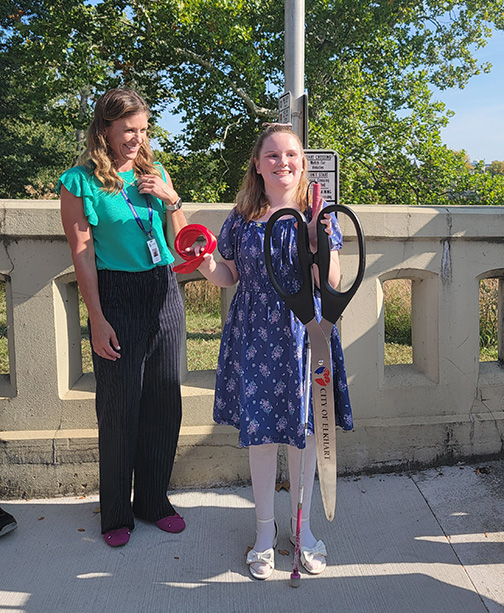 From the Editor: A native of Elkhart, Indiana, Willow Townsend has taken part in the Bell® Academy held in Springfield, Illinois, every summer since she was four years old. At the 2025 NFB of Illinois Convention she shared the story of her first foray into advocacy. With her teacher’s encouragement she discovered that one person speaking up for change really can make a positive difference.
One day I was doing an O&M lesson with my teacher, Miss Julene Fitch. We were working on cardinal directions and street crossings in my neighborhood. I noticed that there was one intersection where the traffic patterns were very confusing. I could not cross independently while also staying safe. Miss Julene had to help me cross the street by being a sound beacon.
After this experience we began discussing the use of accessible pedestrian signals (APSs). Miss Julene and I agreed that APS signals would improve our city, and we decided that maybe we could do something about it. This was the beginning of our grand adventure, the quest to make our city more accessible.
Miss Julene started out by giving me some guiding questions that we could answer together. She wanted me to be able to describe what APSs are, how they work, and the cost of their installation. Accessible pedestrian signals are devices that are placed at intersections to help blind or low-vision people cross streets safely. They provide nonvisual cues such as sounds, spoken messages, or vibrations to indicate traffic signals. APSs can help blind and low-vision pedestrians make better judgments about crossing streets safely. These devices can be placed at the center of an intersection where the crosswalk is located.
After finding the answers to Miss Julene’s questions, we took a walk around our city to identify places that would be a good space for APSs to be installed. This process required us to take pictures of intersections that could benefit from having an APS at the crosswalk. We identified three intersections where it was unsafe for blind and low-vision people to cross, and we took photos of the intersections.
After we completed our research, we began preparing a speech for the mayor. We started by writing a guide that I could follow when I presented the speech. This guide included questions that the mayor might possibly ask me. For a while, I practiced reading my speech and answering questions that the mayor might ask.
Finally I presented my speech to the mayor himself. My speech was very successful. The mayor then invited us to an event called the State of the City. He gave a special mention to the work we had done.
A few weeks later, Miss Julene showed me an email that she had received from the mayor. We found out that the mayor had begun installing APSs in many locations around the city. I was invited to a ribbon cutting for one of the city’s first APS installations. I helped cut a huge ribbon with a pair of massive scissors in front of a crowd of supporters.
I think that the most rewarding part about advocacy is seeing the impact that you can have. Even advocating for something small can make a major difference in someone’s life. Being able to know that the streets in my city are more accessible is something that I can be happy about.
One of the biggest challenges about advocating for the installation of APS devices was working up the courage to talk to the mayor. I was not sure that the mayor would listen to a twelve-year-old kid, but he did. The challenge was definitely worth it. I would love to advocate for more accessibility in the future!