American Action Fund for Blind Children and Adults
Future Reflections Winter 2026 PERSPECTIVES
Sea Glass
by Lydia Schuck
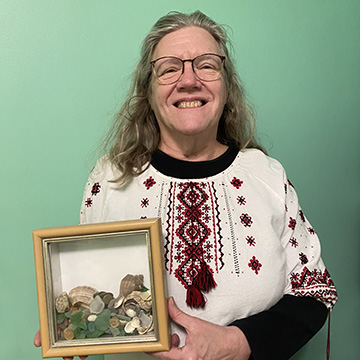 From the Editor: Lydia Schuck is an educator and researcher who has written numerous articles for Future Reflections and other publications. Much of her work is informed by her experience raising her blind daughter, who has cerebral palsy and autism. In this article she shares her experience volunteering at a camp for people with disabilities in Ukraine.
Do you remember sea glass?
I lived a mile or so from Lake Michigan during my childhood. Walking along the shore we would sometimes find pieces of glass from broken bottles: green from Seven-Up or ginger ale, sometimes blue or amber, mostly just colorless glass. The pieces had tumbled over and over in the sand and water until they were polished smooth. Lake Michigan is really just a big rock tumbler!
It’s hard to find real sea glass these days. In the US fewer and fewer products are sold in glass containers, and there are new ways to recycle glass bottles and jars. Some states offer incentives such as deposits on each bottle sold. Residents of those states get 5 or 10 cents back on every bottle they return. Some people actively search out bottles and cans from the trash, returning them for the deposit they can collect.
There just isn’t as much sea glass as there used to be. One friend of ours breaks glass items and tumbles them in a rock tumbler to simulate the dull colored glass pieces that used to wash up on the shore. You can even buy factory-made sea glass in craft stores today!
On the shore of the Black Sea in Europe, however, sea glass still abounds. At least it did back in 2017, when I had the chance to go to Ukraine. For a week I worked at a camp for individuals with disabilities. My husband and two of my kids stayed a bit longer and worked at a children’s camp, too. It’s a cultural thing in former Soviet countries: kids go to camp for a week or so.
Now that the Soviet Union no longer exists, it is a bit harder for kids to get to camp. There is no longer a Soviet children’s program, at least not in Ukraine! Poverty is an issue, too. Who can afford a week of camping on the Black Sea coast?
The opportunity to camp on the shore of the Black Sea is especially out of reach for most individuals with disabilities. Even if you had the money, you probably would not have access to camping activities. There are few ramps or other accommodations. On arrival you’d need someone to help you get down the steep gravel road to the beach, and then you’d need help to roll or walk through the sand. Finally, you’d need someone to help you out of your chair and into the water.
The camp program gives people with disabilities the opportunity of a lifetime! Volunteer cooks and other helpers are on hand to assist people to move around the campgrounds and the beach. They help campers maintain good hygiene and take part in social activities. My husband, my daughters, and I did a lot of wheeling people down to the beach and back up the steep unpaved road to the campsites.
Several families brought children with autism. I have an adult child with autism myself. She is also blind, and she has some mobility issues due to cerebral palsy. Because of her extreme hypersensitivity issues, she did not go with us to Ukraine.
Yet, while I was in Ukraine, I thought about my daughter over and over. I told camp guests, especially the parents, that I have a child who is blind and has autism. Everyone met my husband and our two other daughters in person. To my regret, I’d forgotten to bring a photo of my oldest daughter. (It is like me not to carry photos!)
On the last day of my visit, I decided to get some sea glass for my daughter back home in Michigan. I went down to the beach and saw a woman named Natasha with her young-adult son, Daniel. Daniel has profound autism. At nineteen years old he stood almost six feet tall. My husband and I had been playing with Daniel during the week at camp. I explained that I was collecting glass for my daughter.
Natasha helped me gather sea glass while Daniel played in the water. The Black Sea looks like Lake Michigan, but it is salty. While we were on the beach, we saw harmless transparent jellyfish pulsing through the waters.
When I’d gathered enough glass, I climbed back up the steep hill to the campground. The next day I flew home from Odessa to Detroit.
Several months later, I got a message online from one of my daughters, who has extensive contacts in Ukraine. A friend had forwarded to her a message from Natasha—yes, “sea glass” Natasha! Natasha told a mutual friend that she had had a wonderful time at camp. And on the last day, she said, she got to help another parent of a child with autism. She helped that mom pick up sea glass to take to her daughter, back in the United States.
Natasha wrote, “I never knew I could help another parent. I was so happy!”
I knew how Natasha felt. Sometimes I am so consumed with arranging medical care and school accommodations that I think of myself and my family as “takers.” I so want to be a “giver,” but I think I don’t have anything to give. But I do, and I did, even back when my child with disabilities seemed to need endless support. The National Federation of the Blind and many outdoor education experiences gave me opportunities to share life with others in my blindness community.
Are we like Natasha, happy about helping each other, loving each other, and loving each other’s children? By joining together with other parents, we have a unique opportunity. We learn that we can give, and not merely take from the disability and special education systems. We learn that our very beings, our experiences, successes and failures, joys and sorrows, everything about us contributes to the experience of all of us.
We also have the opportunity to learn about blindness from people who live it every day. Our own children, their friends, and all of our adult NFB friends teach us to help, to persevere, and to be joyful! We come together to share our joys and our difficulties, to march together, instead of walking alone.