American Action Fund for Blind Children and Adults
Future Reflections Special Issue on Braille TECHNOLOGY
The Information Age Braille Technology Timeline: 2026 Edition
Compiled by Clara Van Gervan, Anne Taylor, and Jonathan Mosen
 From the Editor: Jonathan Mosen serves as Executive Director of the Center for Accessibility Excellence at the NFB Jernigan Institute. His Access On podcast delves into every aspect of access technology.
Introduction by Jonathan Mosen: The Spring 2009 issue of Future Reflections celebrated the evolution of Braille in the two hundred years since Louis Braille’s birth. Anne Taylor and Clara Van Gervan, who at the time worked in the field of access technology for the National Federation of the Blind, compiled a timeline of Braille technology. Though some professionals in the field claimed that technology would make Braille obsolete, the reverse has occurred. Technology actually has made Braille more abundant and relevant, delivering new tools to ensure that Braille continues to thrive.
Plenty of technology has been developed in the seventeen years since that article was written. With abundant thanks to Anne and Clara for their original work, here is an update of their timeline. I cannot claim that it covers everything, because the pace of change and the number of products has increased dramatically. However, the timeline presents the incredible journey we have taken since Louis Braille devised his six-dot code.
For those unfamiliar with access technology, we added a short glossary to the timeline, explaining many of the most important terms. Here it is:
Glossary
Braille translation software: The fastest Braille embosser available cannot produce even one dot of material unless a Braille translation program is installed on the computer. Three programs are most prevalent today: the Duxbury Braille Translator, Braille 2000, and MegaDots.
Embosser: A Braille embosser, also referred to as a Braille printer, is a piece of very specialized computer hardware. The embosser allows Braille files that have been created on the personal computer (PC) to be produced in hard-copy Braille.
Notetaker: First introduced by Blazie Engineering in the mid-1980s, these easy-to-use personal organizers allow a person knowledgeable in Braille to create documents, read text, keep addresses and appointments, and access a list of special utilities. These devices were available to Braille users almost a decade before the sighted population found similar convenience in the Palm Pilot and Pocket PC.
Refreshable Braille displays: These devices allow the user to interact with his or her computer using Braille. They are called refreshable because the unit is made up of a line of pins that move up and down to display the Braille dots. Braille displays also have navigation keys that allow users to move around the computer screen without taking their hands from the display to perform tasks. Recently, multiline Braille displays have become available.
The Information Age Braille Technology Timeline: 1971—2026
1971: Triformation Systems, which later became Enabling Technologies, released their first embosser, the BD 3. In the late seventies came their popular LED 120 embosser.
Early 1970s: The six-dot Braille cell was extended to eight dots to meet the demands of computer access. Louis Braille’s original six-dot cell (two vertical columns of three dots each) yields only sixty-four possible combinations, fewer than the ninety-five printable characters in the ASCII character set used by computers. The solution was to add two more dots to the bottom of each cell, creating two four-dot columns with dots seven and eight in the lower positions. This configuration yields 256 possible combinations and can represent every character in the full eight-bit extended ASCII set. Triformation Systems produced the first Braille embossers capable of printing eight-dot computer Braille in the early 1970s, building in part on the Braille Mboss developed at MIT. On refreshable displays, the additional dots took on an equally important secondary function: dots seven and eight together are used to mark the cursor position. Individually they can indicate attributes such as capitalization, bold, or highlighting, without obscuring the underlying character. By the late 1980s, eight-dot cells had become standard on virtually all refreshable Braille displays.
1975: Papenmeier Reha undertook a development program with Dr. Werner Boldt of Dortmund University, Germany. In 1975 they produced the BRAILLEX, an electronic device with a refreshable Braille display. In the same year Klaus Peter Schönherr, working in Horb-Nordstetten, Germany, invented the first Braille module using piezo-electric technology, enabling the first dynamic tactile display of Braille. This foundational cell technology underpinned the entire refreshable Braille display industry until alternatives started to emerge forty years later.
1976: The first installation of the Duxbury Translator took place at the Canadian National Institute for the Blind in Toronto, Canada. Duxbury was the first commercial Braille translation package to be released.
1980: The original version of nfbtrans, a Braille translation package, was released. For a time, it sold for $350, but in the early 1990s Dr. Kenneth Jernigan felt it would better serve the needs of blind users if it were released to the public domain.
1980: Wolfgang Baum founded an engineering office in Wiesenbach, Germany, initially importing assistive technology products from the US. This enterprise evolved into BAUM Retec AG, which became one of the most significant European Braille display manufacturers. It was best known for the Vario line of displays. In the 2000s and 2010s, BAUM manufactured OEM versions of HumanWare’s Brailliant and BrailleConnect displays, ending that partnership in 2011. BAUM filed for bankruptcy protection in Germany in the summer of 2017. VisioBraille subsequently acquired the product lines and continued manufacture.
1982: The VersaBraille, by Telesensory Systems Incorporated (TSI), became the first refreshable Braille display available in the United States. It featured a twenty-cell refreshable Braille display and stored data on standard cassettes. It could function as a notetaker, reading machine, or computer terminal.
1987: The Braille ‘n Speak, the first portable notetaking device with a Braille keyboard, was launched at the NFB National Convention. Deane Blazie invested ten thousand dollars, built ten units, and brought them to the NFB convention in July 1987. He sold nine on the spot. The device weighed two pounds and sold for $895. It offered speech output with file storage, calendar, phone directory, calculator, and stopwatch. The success of this device opened the door to similar popular notetakers in use today.
1989: TSI released the Navigator, its first dedicated refreshable Braille display designed for PC access. Available in twenty-cell (six-dot desktop), forty-cell (eight-dot), and eighty-cell configurations, the Navigator attached to the bottom of a PC keyboard and provided cursor routing keys for screen navigation. The Navigator was succeeded in the mid-1990s by the PowerBraille line.
1990: Dr. Kenneth Jernigan opened the International Braille and Technology Center for the Blind (IBTC) at the NFB headquarters, a one-of-a-kind, comprehensive evaluation and demonstration facility. Today it contains 2.5 million dollars’ worth of nonvisual access technology, making the IBTC the largest evaluation center of its kind in the world.
1991: The US Patent for cursor routing was issued to Arend Arends and Jaap Breider, the president of Dutch Braille display manufacturer Alva B.V. The original Dutch patent was filed in 1987. Cursor routing quickly became an expected feature of refreshable Braille devices.
Summer 1993: Blazie Engineering released the Braille Lite. Adding a refreshable Braille display to the speech-only Braille ‘n Speak platform, the Braille Lite 18 featured an eighteen-cell refreshable display, a Braille keyboard, speech output, and an advance bar for panning. A forty-cell model followed. Together with the Braille ‘n Speak, the Blazie family of notetakers held the dominant share of the notetaker market for more than a decade.
1995: The first release of Duxbury for Windows brought Braille translation to the new operating system.
2000: Pulse Data International of Christchurch, New Zealand, released the first BrailleNote, the first notetaker built on the Windows CE operating system. With HumanWare as the North American subsidiary, the Classic BrailleNote was available with Braille and QWERTY keyboards, synthesized speech, and a refreshable Braille display. In 2005 the second generation mPower series followed. BrailleNote Apex was released in 2009, the BrailleNote Touch in 2016, and the BrailleNote Touch Plus in 2019. With the BrailleNote Touch, the BrailleNote moved from Windows CE to the Android platform.
2001: Papenmeier released its Elba notetaker, the first Linux-based notetaker, with Braille and QWERTY keyboard and a refreshable Braille display.
2001: ViewPlus Technologies announced the Tiger Advantage, the first of its Braille-capable tactile graphics printers.
2003: Freedom Scientific began shipping the PAC Mate notetaker, a Windows Mobile-based device available with Braille and QWERTY keyboards and running JAWS for Pocket PC. Twenty- and forty-cell Braille display versions followed at the end of 2003. The second-generation PAC Mate Omni was released in 2007.
2003: The Alva Mobile Phone Organizer was released, the first and only cell phone and notetaker hybrid. It featured a twenty-cell Braille display, a Braille keyboard, and a speech synthesizer.
2004: HIMS International of South Korea released the original BrailleSense notetaker. The BrailleSense featured refreshable Braille, synthesized speech output, a Braille keyboard, LCD window, MP3 player, DAISY player, and external monitor support. GW Micro of Fort Wayne, Indiana served as exclusive US distributor beginning around 2006. In 2008, HIMS enhanced the device as the BrailleSense Plus and added the Voice Sense (speech-only) model. The GW Micro distribution relationship ended in late 2010, when HIMS opened its own US office in Austin, Texas. Enhancements to BrailleSense have been released regularly, including a range of form factors and a move to the Android operating system.
2004: Freedom Scientific released the first Focus Braille display line. It was available in forty-four-cell, seventy-cell, and eighty-four-cell configurations. A second generation followed, offering forty-cell and eighty-cell models. Focus Blue added Bluetooth support. The Focus line became one of the most widely used Braille displays among JAWS users.
2004: At the NFB National Convention, HumanWare released the BrailleNote PK, the smallest notetaker available in the United States, with an eighteen-cell refreshable Braille display and speech synthesizer. The hardware was Baum’s Pronto.
2004: HumanWare launched the Brailliant 20 and 40, the first refreshable Braille displays with Bluetooth wireless connectivity. HumanWare has released various models of display under the Brailliant brand. Its latest model includes notetaker, book reading, and audio functions.
2010: iOS 4 introduced VoiceOver Braille display support on iPhone, making it the first mainstream smartphone platform to offer this capability. Braille support was also added to the new iPad tablet.
2012: Google released BrailleBack for Android. This separate accessibility service worked alongside TalkBack to provide the first native refreshable Braille display support on Android via Bluetooth.
2014: iOS 8 introduced Braille Screen Input (BSI). Apple’s BSI allowed VoiceOver users to type Braille directly on the iPhone touchscreen without any physical keyboard, in both tabletop and screen-away modes.
2016: Orbit Research announced Graphiti, described as “the world’s first affordable tactile graphics display,” featuring a 60x40 pin array (two thousand and four hundred pins) with variable-height pins using Orbit’s Tactuator technology.
2017: Orbit Reader 20 premieres at the NFB Convention. Limited units sold at the NFB National Convention in Orlando for $449, making it the first refreshable Braille display priced under $500. Co-developed by Orbit Research, APH, and the Transforming Braille Group, it used Orbit’s revolutionary electromechanical Tactuator cells. The 20-cell device served as a standalone book reader, basic notetaker, and Braille display terminal. It became the single best-selling Braille display in the world.
2017: Windows 10 Fall Creators Update added Braille display support to Narrator. For the first time, Windows’ built-in screen reader supported refreshable Braille displays natively, without requiring a third-party screen reader.
2017: Dot Watch began shipping commercially. The world’s first Braille smartwatch, developed by Seoul-based Dot Incorporated (founded 2015), features four refreshable Braille cells.
2018: HIMS QBraille XL was released, a forty-cell display featuring both Perkins-style and full QWERTY keyboards.
2018: USB-IF published HID Standard for Braille Displays. Developed collaboratively by Microsoft, Apple, Google, Orbit Research, HumanWare, Freedom Scientific, and NV Access, this standard enables plug-and-play Braille display connectivity across operating systems. Conforming displays are recognized like any keyboard or mouse, without custom drivers.
2020: NLS Braille eReader pilot was launched. The National Library Service began piloting free twenty-cell refreshable Braille displays for eligible patrons, funded by a five-million-dollar Congressional appropriation. Two models were selected: one manufactured by HumanWare (based on the Brailliant BI 20X platform) and one by Zoomax.
2020: APH Mantis Q40 and Chameleon 20 were released, developed in partnership with HumanWare. The Mantis Q40 is a combined QWERTY keyboard and forty-cell refreshable Braille display.
2020: Google launched the TalkBack Braille Keyboard for Android, allowing Braille input directly on the touchscreen, mirroring Apple’s Braille Screen Input introduced in iOS 8.
2020: Canute 360 began shipping. After fourteen prototypes and approximately seven years of development, Bristol Braille Technology’s multiline Braille e-reader reached consumers. Featuring nine lines x forty cells (three hundred and sixty cells total), it reads BRF and PEF files at under $2,900. A Canute Console variant followed, adding a retractable QWERTY keyboard and thirteen-inch monitor.
2021: Eurobraille b.note launched from the French manufacturer (founded 1980). It was available in twenty- and forty-cell variants, with Bluetooth file transfer, speech synthesis, USB-C Power Delivery, and support for DOCX, PDF, EPUB, and BRF files.
2021: Dot Pad was introduced by Dot Incorporated (Seoul, South Korea). Featuring two thousand and four hundred pins in a pixel-like grid, it was the world’s first tactile graphics display to ship commercially. In December 2021, Apple included tactile graphic API support in iOS 15.2.
2022: Google announced native TalkBack Braille display support built into Android 13, ending the need for the separate BrailleBack app that had served Android Braille users since 2012.
2022: Orbit Slate 340 and Orbit Slate 520 launched. The Orbit Slate 340 offers three lines of forty cells; the Orbit Slate 520 provides five lines of twenty cells.
2022: Orbit Research announced the Orbit Speak. Following the same philosophy of affordability that defined the Orbit Reader 20, the Orbit Speak is a speech-output Braille notetaker with a Perkins-style keyboard in a pocket-sized device weighing under eight ounces.
2023: APH and the DAISY Consortium began development of the eBraille file format, designed to merge tactile graphics and Braille text into a single navigable file, intended to become the global standard for digital Braille content.
2024: Blazie Technologies launched the BT Speak, a modern revival of the Braille ‘n Speak concept for the Linux era. In March 2026, they demonstrated the BT Braille, a modern take on the Braille Lite.
2024: HIMS/Selvas BLV Braille eMotion was released. It was a forty-cell multimedia Braille display with Wi-Fi, text-to-speech, five Bluetooth connections plus USB, and standalone apps including library access.
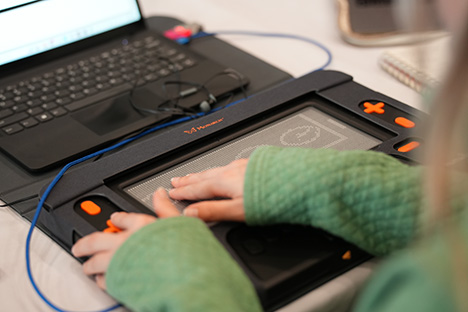 2024: Monarch began shipping. It is the most significant Braille technology product in a generation. The Monarch is a ten-line x thirty-two-cell multiline refreshable Braille and tactile graphics display with three thousand eight hundred and forty equidistant pins. It was developed as a fifty-fifty partnership between APH and HumanWare, with the NFB as advisor and Dot Inc. providing cell technology. It runs HumanWare’s KeySoft suite. Key applications include KeyWord (word processor with MathML), KeyMath (graphing calculator partnered with Desmos), Tactile Viewer (APH’s Tactile Graphics Image Library with two thousand plus graphics), and Victor Reader. It features Wi-Fi, Bluetooth, HDMI visual output, and twenty-four-hour plus battery life. It was named one of TIME Magazine’s Best Inventions of 2025. Software milestones include eBraille file format support (v1.2), multiline screen reader output via JAWS and NVDA (v1.3), and Google Drive access (v1.4).
2025: Apple introduced Braille Access, a new iOS mode allowing Braille display users to access features including notes, BRF files, and live captions directly from their display without interacting with the touchscreen.
2025: Orbit Reader Q40 was released. Orbit Research’s entry combined a full-sized QWERTY keyboard with a forty-cell Braille display, competing directly with APH’s Mantis Q40.
2025: HumanWare previewed BrailleNote Evolve. The Evolve represents a platform shift from Android to Windows 11 Pro, featuring an Intel Core Ultra 5 processor, 32 GB RAM, up to 512 GB SSD, KeySoft integrated with NVDA, a six-month trial of JAWS, Microsoft Office 365 with HumanWare add-ins, Thunderbolt and HDMI ports, and NFC. Initial models in twenty-cell and thirty-two-cell variants with Perkins keyboard; QWERTY and forty-cell models to follow.
2026: Selvas BLV unveiled BrailleSense 7. Available in twenty-cell, thirty-two-cell, and forty-cell models, the BrailleSense 7 runs Android 15 and marks a significant generational leap for the line. Features include touch-sensitive Braille cells, integrated Google Gemini AI, expanded Braille-first applications, a user-replaceable battery, and an included QWERTY keyboard case with a secondary battery.
You can read the Information Age Braille Technology Timeline compiled by Anne Taylor and Clara van Gervan at https://nfb.org/sites/default/files/images/nfb/publications/fr/fr28/fr280109.htm.