American Action Fund for Blind Children and Adults
Future Reflections Special Issue on Braille ADVOCACY
Advocating for Braille Literacy in a Blind Child's IEP
by Sanho Steele-Louchart
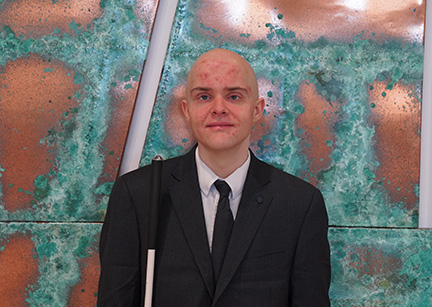 From the Editor: As readers will recognize from other articles in this issue of Future Reflections, many teachers of blind students are staunch champions of Braille, and they are working to ensure that Braille is taught effectively. However, as this article illustrates, too few blind students are learning Braille today, although the law firmly supports Braille instruction.
Sanho Steele-Louchart serves as Legal Program Coordinator for the National Federation of the Blind. In this article he discusses the hurdles that parents of blind students often face when they try to ensure that their child will learn Braille, and he explains how special-education law supports Braille as the first option for blind students.
Today Braille is more affordable to create and easier to access than ever before. With the advent of technologies such as electronic Braille displays, Braille books and worksheets can be downloaded in seconds. Using Zoom, teachers and students no longer need to be in the same physical location in order to work together. No longer can school districts argue, “We just don’t have anyone to teach it” as a pretext for denying services, even in the most rural locations.
Nevertheless, it is estimated that only ten percent of blind children are taught Braille today. Only ten percent of those students are taught Braille to age- and stage-appropriate fluency. Meanwhile, the unemployment and under-employment rates for blind people stand as high as sixty-two percent. Ninety percent of blind people who are fully employed say that Braille is fundamental to their success in the workplace.
Unfortunately, many teachers of the visually impaired (“TVI’s”) report that their university programs didn't teach them Braille at all or taught them only the basics. They were told that Braille can only be read at one-third to one-half the speed at which a sighted student reads print. Programs might acknowledge that some Braille readers reach reading speeds of 250 to 300 words per minute, but somehow it is assumed that those students are gifted or exceptional.
In the classroom TVI’s find themselves faced with the choice between teaching an unfamiliar medium that their colleagues and mentors find slow and unhelpful or offering a medium such as large print, synthesized speech, or a human reader (usually a classroom aide). Not surprisingly, the TVI is likely to choose the method that seems most practical and supported by their colleagues. This decision is further reinforced when they do attempt to teach students Braille, only to see them struggle, plateau, and fall behind.
The Source of the Problem
It is here that two complimentary forces take hold. First, the TVI begins to believe that the problem is Braille, the student, or both. Second, this conclusion serves as proof positive for anyone already inclined to believe that large print, speech, and human readers are the practical path forward for this particular student at this particular time. This paradigm also conveniently allows teachers to claim that they are ardent supporters of Braille in theory if not always in practice.
It is important to note that countless teachers are doing an excellent job of teaching and providing Braille. However, many other teachers believe they are teaching and providing Braille, while in practice their students are standard deviations behind their sighted peers, and their materials aren't being delivered on time. Then there are the teachers who, in their heart of hearts, believe Braille is the medium of last resort. They believe that no one should learn or use Braille if any other medium is remotely viable.
This raises an interesting question: What is viability? Set aside the law for a second and think only in terms of practicality. Is it practical for a student who is using large print to experience eyestrain, tension headaches, back pain, or ocular migraines? If so, for how long? Is this situation sustainable, or will the student’s reading speed or comprehension drop over time? What happens if the student's vision changes from day to day or year to year?
Typically, the answer to this line of questioning is, “That’s why they have a human reader.” Such an answer exposes the implicit belief that a blind child doesn’t enjoy the right to be comfortable in their body, pain-free, and independent in work and in life. If it is true that every child deserves to read without pain, and every child deserves to read for themselves, on their own terms, and with their own minds, then it is also true that being forced to use large print, synthesized speech, or a human reader is neither viable nor practical in the long term.
The Good News
Assume for a moment that you are the parent of a blind child, and you know all that is at stake. You’ve advocated for Braille instruction already. Perhaps your child’s TVI agreed, but your child isn’t making progress. Perhaps the TVI didn’t agree at all and gave you some version of, “I’m the expert. My expertise shows that large print, speech, or a human reader are best.” Perhaps the instructor is one of the great ones, but, for whatever reason, Braille just isn’t a priority for their district administrators. How do you advocate for Braille in a way that doesn’t make things more contentious than they are already?
The good news is that the law is clear. The effective communication and reasonable accommodation requirements under Section 504 of the Rehabilitation Act of 1973 and Title II of the Americans with Disabilities Act of 1990 apply to children as well as adults. There’s also the Braille presumption in Section 300.324(a)(2)(iii) of the Individuals with Disabilities Education Act of 1975. “The IDEA” states that the IEP team must:
“In the case of a child who is blind or visually impaired, provide for instruction in Braille and the use of Braille unless the IEP Team determines, after an evaluation of the child’s reading and writing skills, needs, and appropriate reading and writing media (including an evaluation of the child’s future needs for instruction in Braille or the use of Braille), that instruction in Braille or the use of Braille is not appropriate for the child.”
Section 1414(3)(A)(iii-v) goes on to say, “Each local educational agency shall ensure that assessments and other evaluation materials used to assess a child under this section are used for purposes for which the assessments or measures are valid and reliable; are administered by trained and knowledgeable personnel; and are administered in accordance with any instructions provided by the producer of such assessments.”
TVI’s and district administrators may not understand at a glance how these laws are any different from what they’re doing already. A few notes may be helpful in highlighting the nuance.
The first point to recognize is that the Braille presumption doesn’t say to provide Braille and Braille instruction only if the IEP team agrees. On the contrary, it says that the district must provide Braille and Braille instruction unless the team agrees that Braille is not now, and never will be, appropriate for the student. It is an astoundingly confident district that is willing to risk significant legal exposure on its ability to predict the future.
Next, appreciate the scope of the words “appropriate reading and writing media.” The law does not consider speech output as reading. It does not consider dictation to be writing. Therefore, the only possible literacy media are Braille and print. If print is not appropriate generally, or is not appropriate for both reading and writing, or is not appropriate over time, then here again, it fails to comply with the statute.
Finally, consider the term “evaluation.” Virtually all blind and low-vision students are assessed using the Learning Media Assessment (“LMA.”) Most school districts assume that the LMA must be normed, validated, and reliable. Therefore, they assume that it meets the requirements set forth in Section 1414. However, it is not normed or validated and therefore does not meet the statutory requirements. The only normed, validated, and reliable reading and writing assessment tool for blind students is the National Reading Media Assessment (“NRMA”). Most TVI’s have never heard of it. Those who have heard of it rarely if ever have used it. Those who have used it may well reject it out of hand if its results contradict what they want it to say. Discussing this test is another opportunity to determine whether the district is following the law and the science, or if something else is guiding their decisions.
The Bad News
Let us hope that merely knowing the law is enough for a district to follow it. School districts understand the importance of Braille, they appreciate that Braille can be one of many tools, they support their actions using the NRMA, they hold their teachers of blind children to the same high standards they do teachers of fully sighted students. Yet, although the law is clear, legal arguments on their own are rarely productive.
The bad news is that the law does not change hearts and minds. It’s necessary, yes, but it is not sufficient. What changes hearts and minds are stories. Real, human stories about kids they know and love. You cannot “win” an IEP. You can’t scare people into caring. Their feelings will be hurt, their egos will be bruised, and their heels will dig in. You can’t make them care. You have to show them why.
Imagine for a moment that you’re a teacher. You genuinely care about your students, and you have the best of intentions. A parent comes in, angry, hurt, or confused, and implies or states outright that you don’t care and don’t know how to do your job. You’re going to be shocked. You’ll feel offended. You think of all the students you’ve done right by, all your success stories. You remember the kids you’ve helped when no one else would even try.
Suddenly, you and that parent are functioning from completely different places. Each of you gets defensive. Communication breaks down. Administrators circle the wagons. Maybe advocates or attorneys make things even worse.
Building a Bridge
So, where’s the child in all this? They’re still not learning Braille. They’re still behind, or struggling, or in pain. We would be no better off than we were before.
Now imagine the same meeting, with everyone focused on the student. Yes, the parents might be angry, the teachers might be defensive, but everyone is focused on the child. What are their reading rates compared to those of their sighted peers? Are they in pain or experiencing other challenges? Do sighted students experience those same challenges? Surely we don’t think they’re inherent to blindness. Does the blind student have everything their sighted peers have? If not, why not? What are the barriers? How can we create a system that will mitigate those barriers so that this child, about whom we all care deeply, is okay?
What we find, in all but the most political of cases, is that continuing to bring focus back to the child is enough to build a bridge.
As that bridge is being built, families and TVI’s sometimes wonder together how to help the blind child catch up to their sighted peers. One place to look is the educational standards for their grade, available on the website of the State Department of Education. Then you can look at their current levels and find where they should be to make a roadmap. As for Braille, set the bar higher than you think you should. Very young students might be working on the alphabet, alphabet words, punctuation, and whole-word contractions such as and, for, of, the, and with. You can build from there. It’s my experience that when taught with age-and-stage appropriate expectations, students whose primary disability is blindness can learn the code in six weeks and reach proficiency in six months. Then it’s just a matter of practicing to build speed.
Though compensatory education and a full analysis of service minutes are beyond the scope of this article, I suggest that a good starting place is an hour a day of direct Braille instruction and daily reinforcement. Sighted students receive direct and indirect exposure to literacy all day, every day, from birth. If there are posters on the wall, textbooks in the classroom, and words on the board, the blind child deserves the same exposure. If those things aren’t actually important, why do they exist at all?
Please know that you are not in this alone. The NFB has a team of volunteer IEP advocates trained to assist families for this very reason. To learn more about our IEP Advocacy Academy or to be put in touch with one of our advocates, please email [email protected] or call me at 410-659-9314, Extension 2440.