
What Meets the Eyes: A Comparison Between Translations into Tactile Perspective Bas-Relief
By Selene Carboni and Daniele Marchioni
Selene Carboni, art historian and museum educator.
Daniele Marchioni, semiotician and educator.
Abstract
A key issue in the visual arts education dedicated to blind people is to understand how, when, and why it is opportune to create an accessible tool with a step-by-step approach. Educational and aesthetic praxis at Anteros Tactile Museum of Ancient and Modern Paintings (Francesco Cavazza Institute for the Blind, Bologna, Italy) will be illustrated as an example of substantial experience in this field. A comparison between two different statues shown from a frontal perspective (Kouros from Melos and Riace Bronze) will introduce concepts on artistic stylization, their anatomical details, spatial orientation features, and the relative pedagogical aftermath. The use of tactile interactions, proprioception, and kinesthetic sensory modalities make the feeling of shapes possible with artistic and aesthetic value.
Keywords
Blind, museum, art, bas-relief, perception
Introduction
According to the World Health Organization (2019), it is estimated that there are 285 million people worldwide who have visual disabilities; 39 million are blind, while 246 million have low vision (Pascolini & Mariotti, 2012). Despite the different levels in which visual impairments are classified, their social cost is still considerably high, mainly due to the disabling potential of the various pathologies that lead to a significant impact on school, work, and social inclusion in most individuals. Art and aesthetic education can represent the common point to encourage integration on several levels, avoiding isolation and passivity.
How can we help blind users understand the history of art? What kind of technical solution can we adopt to make historical, artistic, and cultural information more accessible to visually impaired people?
Anteros Tactile Museum was born with the primary objective to facilitate the access of visually impaired people to the cultural heritage. It has been part of the Francesco Cavazza Institute for the Blind since 1999 (Bologna, Italy) (Secchi, 2004, 2014).
Anteros Museum’s collection owns forty perspective bas-reliefs (Secchi, 2004).The main difference between the latter and standard bas-reliefs is the use of sottosquadro (“undercut”) (Figure 1). It identifies with a detached contour line that creates a narrow, concave space beneath the foreground and between the following planes. However, the bas-relief, which will be analyzed here, does not focus on the undercut itself; rather on a distinction between artistic stylizations.
The origins of perspective bas-reliefs are located in Florence during the Renaissance; however, since the main target is a blind audience, there are technical adaptations. These adjustments are shaped both to facilitate a blind individual’s comprehension and to meet a commission’s expectations, whilst maintaining a philological approach and methodology. Hidden details like a hypothetical chair leg covered by a blanket could be complicated to decipher for many users. Blind testers would notice and discuss these critical findings. For instance, if that blanket were relevant to the analysis of the meaning, the staff would change the way the blanket drops and covers the chair leg, as to show a part of its structure and leave the rest to the user’s imagination.
Furthermore, bas-reliefs are special educational and aesthetic devices able to communicate perspective with the “azimuth” and “elevation” shown in a picture (Wnuczko & Kennedy, 2014) to visually impaired people (Secchi, 2014).
Why is it so essential to share visual art with individuals who cannot see it? In addition to the mere art teaching, with historical, cultural, and artistic notions, visually impaired people can learn through art the life skills, endless “possibilities of human experience” (Eisner, 2003, p. 69) and that “sense of inclusion” as described in the recent book by Hayhoe (2019, p. 10, 56-58). Here, a visual experience translated into a tactile counterpart will be analyzed, considering how much narrating and directly feeling via touch may help the blind user to acknowledge the role of art for mankind in the various forms of depiction. Feeling shapes and appreciating the background stories on their skin allows the blind person to discover their potential, both physically, cognitively, and humanely.
Materials and Methods
Methods
To understand art through its different levels (pre-iconographic, iconographic, and iconology analysis) (Panofsky, 2019), visually impaired users can touch different bas-reliefs and learn with verbal information as well as practical activities.
During the pre-iconographic level, shapes and lines are touched and recognized; these elements form geometries that need to be contextualized, and so the main characters of the representation may be acknowledged (iconographic level). The most challenging thing to do is compare those icons with others within a historical framework: this is what the iconological level is about. These levels are not intended as a linear process of a method to enjoy art, but a continuum of observations that have to be recalled by the user for enhancing their comprehension (Panofsky, 2019; Secchi, 2004).
Staff guidance is fundamental, especially within the users’ first experiences; it can be realized in different ways, based whether it happens close to or far away from the user. For the former, the guide gently keeps and moves the user’s hands to let them explore all the bas-relief. Then, from the profile to get to know the dimensions of the artwork, and then proceeding to the main subjects of the representation to examine the respective details. It is vital to add that the “hand-on-hand” style of guide and the autonomous exploration alternates during each reading. Both sighted and blind users may benefit from this technique, as many people tend to focus on familiar details and lose the whole picture. As stated by A.M., who at that time was a new certified guide at the museum: “Aesthetic education has been and still is formative and very rewarding; it lets me sharpen not only the techniques of tactile reading, but also my manual skill” (Carboni, 2010).
Panofsky’s method is a link between the guide and the user within their explorations; for instance, if there are art pieces with particular subtleties that someone might not immediately recognize, a museum guide could still be of value. However, after they learn this technique, the blind people will experience a bas-relief on their own.
Apparatus
The goal is to transform an artwork into an accessible artistic tool for visually impaired users; hence, the bas-relief. Doing a preliminary study is fundamental to elaborate a project of translation and to understand the tactile values. Translation from language to language is the most obvious example of how we try to say the same thing using different sign systems (Eco & McEwen, 2001). It could be the case examined here too, considering art as the linguistic expression depicted by artists. Nonetheless, there are specific adjustments that need to be made for a translation between two sensory modalities, as they will be described in the following sections.
Each bas-relief is handcrafted by a team of experts, including art historians, visual impairment and tactile experts, sculptors, and the blind and low-vision community as testers. Deciding in which dimension have the relief realized is primary. The following phase consists of a handmade preparation of the water-based clay prototype, whose contour lines, volumes, and surfaces of the original work are traced. Only then can a surface refinement in its tactile qualities be performed. One of the last stages includes visually impaired people trained to be testers doing a tactile test and reading the relief, correcting details for the best comprehension. If the clay prototype is approved, Anteros Museum’s team would realize the silicon rubber mold. From this, the positive originals are made in plaster or fiberglass (Gualandi, 2000; Gualandi & Secchi, 2006; Secchi, 2004).
In this specific paper, we want to present an accessible translation of two different statues: Kouros from Melos and Riace Bronze (Figure 2), to understand different art styles and different ways to reproduce the human bodies. This translation is in plaster bas-relief measuring 14.6 in. (37 cm) x 18.5 in. (47 cm) x 0.79 in. (2 cm) and the bottom part reaches 1.8 in. (4.5 cm).
Participant and Procedure
The target Anteros Museum dedicates its services to individuals of many ages: from children to the elderly with many conditions, some other than visual impairments. Blindness may be congenital (from birth or the very first months) or acquired during an individual's life (i.e., because of a disease or a severe trauma). The main difference is the presence, for the latter, of residual memories concerning sight and the overall experience of vision (such is the case of colors) (Hayhoe, 2017). It is indeed crucial to acknowledge those memories since the guide’s methodology can refer to and recall them as much as possible to keep them alive in the user’s representation of well-known and unknown depictions. Furthermore, residual memories can be incorporated with tactile perceptions and stimulate a global and immersive experience despite a present sensory impairment (Secchi, 2004).
Theoretical Framework
The user’s hands are invited to gently slide along the artwork boundaries, from top to bottom, with a specular motion. Most of the time, the dimensions of the copies at Anteros Museum do not perfectly match the original; too large could cause disorientation. In fact, the haptic reading would last too long, and the overall view of the work could be lost. On the other hand, a too small dimension would prevent the tactile identification of significant details, with concern to the tactile sensory threshold (Secchi, 2004). Nonetheless, proportions tend to be much stricter and more investigated, as they are fundamental for the educational activities at the laboratory of sculpting.
Figure 2 shows a comparative bas-relief composed of Kouros from Melos and Riace Bronze (Statue B) from a frontal perspective. Its main purpose is to highlight differences in stylization1 with reference to the historical and cultural counterparts. Kouros (ca. 6th century B.C.E.) reflects a more stylized, geometrical guise in comparison to Riace Bronze (ca. 5th century B.C.E.), which has a more naturalistic, classicist pose.
For the Riace Bronze, however, a significant adjustment is discernible if compared to the original. The arm at the viewer’s right is posing differently. It is distended, whereas in the original is flexed, and the elbow is remarkably backward (Figure 3). The reason behind this choice is related to the educational purpose of the bas-relief. In fact, since the aforementioned main objective revolves around the two different styles, a philological, high-fidelity approach would have been unnecessary.
The following specifications related to the postures of the two characters depicted in the bas-relief build every aspect of the exercises in proprioception.
After having commensurate height and width of the bas-relief, the bottom part raises towards the user (Figure 4). This essential feature helps blind individuals to differentiate the levels of depth. It is then possible to spot where Kouros and Riace Bronze are, slowly touching each one first individually and then then together. Kouros is standing almost inflexibly as his shoulders are at the same level and his arms close to the V-shaped trunk. The arms are stretched and the hands closed in a fist. His left arm, followed by the leg movement, advances slightly and it is more protruding than the other compared to the surface. Up to the pelvis, the figure is presented in a frontal and specular position; therefore, the upper right part is the same as the upper left part of the body. From the pelvis down, however, the legs are placed in a different position, one away from the other. The one on the user’s right is longer, meaning he is about to step forward towards the viewer. Understanding why the Kouros’s leg is stepping forward, and therefore, why the user is invited to replicate that pose, is possible only with a firm grasp on the history of Greek mythology. Subsequently, many details can be appreciated, like the long hair, his smile (so-called “archaic”), and the stylized lines upon the pectoral muscles and beneath them.
Diversely, Riace Bronze has a more naturalistic pose with an elegant attitude, as in Classicism. His head is portrayed in a slight three-quarter front angle. The eyes of the Bronze of Riace are less wide and large. The physiognomy and facial expression are also more natural. The lips show no smile, while the nose and forehead reiterate the Greek profile model. The user could touch his shoulders, and his arms with the fingertips of the thumb and index or middle finger tucked together (resembling a tweezer). The hand at the user's left is holding a hypothetical sword since Riace Bronze depicts a warrior (Figure 3). The hand at the user’s right is supposedly holding a shield instead, and it has been adapted open, again to facilitate blind users’ comprehension. In summary, the adaptations have been proposed for legibility of postures and to facilitate the comparison between historical styles in the representation of the human body.
Riace Bronze’s trunk is more muscular and realistically sculpted in comparison with Kouros. The body weight is sustained from both legs even if the foot on the right seems slightly to move forward (Dunham, 2005, p. 2). Here, the user is invited to pose and compare their own posture with the Kouros’s. This exercise of proprioception helps to understand the user's own body concerning historically determined models. Different poses have different meanings that can be explored with this method. Once the user adopts that stance, temporarily becoming the Kouros themself, they will link that experience with the symbolic values.
The last part of the comprehension of artwork is represented by the laboratory of sculpting. Users reproduce the image by modeling clay with their hands and this process is an essential part of knowing. In the haptic experience with cognitive and interpretative purposes, the exploration of the tactile techniques of artworks and, after that, the creation by hands of the model present a number of variables, and these actions are crucial for the cognitive process of the whole/part relation (Arnheim, 1991; Secchi 2004). The checks made during the tactile workshops need to perfect the tools of perception, interpretation of the forms, and reification of concepts.
The ambitious future perspective is to investigate this method within a special pedagogy of the arts and to widen the horizons for a network between different institutions. Museums, low-vision centers at hospitals, and schools could design projects together, beyond art therapy and beside the ophthalmologist or experts in rehabilitation. This project could be actuated to create a true interdisciplinary work, where the specific and proper skills shall be suited for the visually impaired user (a visitor, a patient, or a student).
Discussion & Results
Common sense says that touch is a realistic and analytical sense, and that sight is syncretic. These two sensory modalities share much more in common than was believed previously (Hatwell et al., 2003). Touch must be educated to understand the different shapes. It is distributed over the entire body’s surface; its privileged organ is the hand, in particular, the receptors positioned on the fingertips. Haptic exploration requires more time than visual analysis, and the former involves the organized movement of the hands on the object to be explored. In this way, both blind and sighted persons can acquire information on the object’s material, structural, and functional properties (Klatzky & Lederman, 1992; Lederman & Klatzky, 2009; Sotirios Argyropoulos & Chamonikolaou, 2016).
Why translate a statue in a bas-relief if it could be accessible via touch? The original statues are in the round works, whose dimensions are almost similar to those of a human figure in real size. For example, "Sculptors carved the strictly frontal kouros with a four-sided block-like shape that invites the viewer to analyze the statue from four points of view: the front, back, and both sides" (Dunham, 2005, p. 3).
The accessible translation in bas-relief shows two nude male figures in the frontal representation. Therefore, the vantage point ideally taken by the observer is deliberately frontal perspective. The perceptual information available is determined by what a sighted observer can see from a frontal perspective. Hence, this information is transposed into tactile modality, maintaining the limits that meet the eyes. For instance, stereoscopic vision (Parker & Ip, 2016) cannot perceive what is behind the Kouros’s body, nor Riace Bronze’s one, and so touch is bonded to that experience. This is why we can only see the frontal section of the bodies and not the back.
It could be argued that a high-relief would solve the issue, having more depth available, or, perhaps, a tactile graphic (Eriksson, 1998; Panotopoulou et al., 2020). With its raised outlines, it could help the user to acknowledge the main, simplified figures. High-reliefs are much more protruding than the bas-reliefs. For this reason, the tactile interactions with surfaces and shapes in the high-relief would be much more similar to the statue than the bas-relief. This is not the reason behind the choice of perspective bas-reliefs. The latter can be considered a form of translation between two sensory modalities (vision and touch) without altering a specific perspective, whether it is adopted by the original artist (as for pictures) or experienced from a specific viewer’s vantage point (as in Figure 2). On a side note, statues have virtually infinite points of view since a person can walk around and look at or touch them. The tactile graphics instead are more complicated tools for showing depth. They have a low, raised line (Picard & Lebaz, 2012), but they are a useful device that a person can use with the unique feature of the perspective bas-relief.
Consider first the Kouros on the left, and then Riace Bronze on the right (Figure 2). Novices are invited to recreate the same position and use kinesthetic and proprioceptive perception. To simplify, kinesthesia warns us of the movement we are making, and the proprioceptive sense represents the complexity of sensation or feelings that inform the brain about the state of the individual parts of the body, whether they are in a state of rest or motion (de Kerckhove & de Almeida, 2014; Proske, 2006; Timmons & Ravenscroft, 2019).
The users are invited to assume the position of Kouros first, more effortless to recreate in comparison with Riace Bronze. When recreating the Bronze’s position, the body weight is supported by the right leg; this results in a slight lowering of the right shoulder and a small lifting of the right hip compared to the left (Figure 5). This phase is fundamental both during the reading by touch of bas-relief to facilitate comprehension. During the clay modeling workshop to recreate the correct position for tension either of muscles and tendons inside the figures (Hatwell et al., 2003). Preventing misunderstanding that the verbal description alone could cause (Haegele & Lieberman, 2019; Secchi, 2004).
The copies are not considered the perfect replica of the originals, preferably as a useful assessment of the users’ skills and comprehension of what previously perceived during the tactile exploration at the Anteros Museum and their knowledge about the artwork itself.
One of the first steps is to transform the complex shape of the bodies into simple geometric figures. The plastic creation requires various stages and constant verification of the bas-relief taken as a model.
Interesting to notice here, the water-based clay is the material used to create the prototype bas-relief as well as during the workshop. Anteros Museum’s team has chosen to use water-based clay because, unlike other materials that many could know (e.g., self-hardening clay, plasticine, or salt dough), it stimulates and encourages the manipulation with its own temperature characteristics. In fact, water-based clay has a percentage of water; the longer it is modeled, the warmer it becomes. Its humidity gradually decreases until it dries on the hands. Thus, the material becomes less and less manageable but once dried, it can still be regenerated by water (Morghese, 2004).
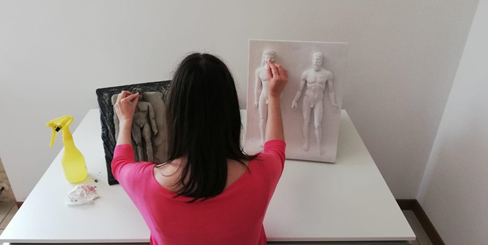
Thanks to its characteristics, the manipulation of the clay may also favor the development of manual skills, such as the prehensility/grip, dynamism, and looseness of the palms of the hands and fingers. Also, the quantification of the clay is necessary to create its own plastic representation, the ability to analyze the finger pressure on fresh clay, and the ability to remove excess material. Clay modeling facilitates learning the reality, from the properties of tools to the proprioception of the body and metaphor (a deeper meaning bond with icons and symbols), through the study and understanding of the shape, edges, boundaries, volumes, perspective plane, and directions. Furthermore, by starting from the analysis of the work, the haptic workshop experience operates on broader cognitive and perceptive dynamics as well, reinforcing the mechanisms of memory, the reconstruction, and the assimilation of spatial and temporal concepts. From the body's anatomy to the morphology of the objects, comprising the form and developing eye-hand-brain coordination in case of low vision, processing and reusing those concepts in everyday life improves tactile consciousness and the use of bi-manual exploration (Figure 7). Hence, the blind and the partially sighted user can be helped to combine the concepts learned with direct experience (Carboni, 2010; Secchi, 2004).
Some cultures and modern societies inhibit the educated development of the sense of touch and, consequently, tend not to integrate a balanced, conscious interaction. Therefore, the lack of a sensory modality forces the researchers to come up with original solutions that can often be useful to a larger audience. The key role played by touch for sighted and blind individuals suggests that these considerations might be relatable to everyone with the right adjustments. To paraphrase Bruner (1960) with the “honest form.”
Implications for Practitioners and Families
This section is for those interested in clay modeling laboratories (educators, families, within users’ houses, schools, recreation centers, etc.).
For a faithful workshop, the perspective bas-relief is crucial; both for carefully reading an artistic device crafted by professionals, and for feeling the adjustments operated throughout the experience. Nonetheless, other alternatives are available.
The laboratory should take into account the degree of visual disability, the psychomotor, cognitive, and emotional conditions of each individual; whether they are a child, a teenager, or an adult.
General Information
Duration of the laboratory: One hour and a half, including the user’s welcome and greeting phases.
The frequency of the workshops should not be less than once every fifteen days.
Disclaimer: Always remember to wet the water-based clay until it is comfortable to handle. Educators and relatives might want to recall the user’s last experiences as a quick summary. Asking them questions about the routine for preparing the workshop and many notions linked to the artwork itself (concerning scholastic curricula or professional settings). Please note that the workshop is intended to be an exercise and an assessment of the user’s understanding of visual art, and not an entrance examination for fine arts academies. These examples described below may be useful for the first experiences with the water-based clay and the reproduction of simple shapes in context. The procedures can be adapted in the presence of other disabilities, according to the user’s level.
Materials and Tools
The materials are inexpensive and easily accessible (Heaser, 2001; Morghese, 2004). Only to facilitate the process, the essential place and tools are as follows:
- Educational room or a calm place where to make the workshop (e.g., a quiet room in the house) with a table and chairs. It is recommended to cover the table where the clay is laid, preventing it from sticking once dried out. For the same reason, wearing an apron could be helpful
- Plywood boards (12 x 16 x 0.4 in.), covered with waterproof plastic material. Each person can use it as a surface for working the clay
- Two trays and spray bottles
- Water-based clay. Preferably no plasticine or playdough; water-based clay has unique physical properties, as argued above
- Clay sculpting utensils, rolling pin, and a needle or sharp tool. Especially for the first experiences in touch with the clay, tools need to be used as little as possible to work directly on the manual abilities. Laboratory assistants may adapt each tool according to the user’s abilities and goals (sharp objects should be avoided for children)
- Simple geometric wood shapes (sphere, cube, tetrahedron, etc.) and wooden fruit
- Real objects
- Wardrobe or shelves to support the products and to keep them always in the same position. This facilitates user’s understanding of the routine of the laboratory and its setting
- Buckets for the remaining clay
- Napkins
Preparing a comfortable, quiet room is the basis; the users are less likely to interrupt the artwork and their overall experience if there are no distractions, especially auditory. The more independent the users are and the more complex the artwork is, the more silent the place needs to be. It helps to stay focused throughout the activity. The user’s wrists and hands should be as relaxed as possible, so the guide (whether the parents, educators, or acquaintances) can gently lead them during the hardest maneuvers.
For the very first experiences with water-based clay, it is recommended to work with three-dimensional objects and to reproduce a 3D copy, with particular attention to keep the same proportions and shapes. It does not require anything fancy, rather a simple geometrical shape or an object that can be built using elementary structures. A pear, for instance: its shape can be seen (therefore, touched) as a combination of an ovoid and a sphere. It is important, for the users, to acknowledge the hidden geometries of everyday objects; how a depiction of reality can be made. Since there are two different shapes, the user will be invited to take two portions of water-based clay. Then, to make two balls using their hands, sliding and smoothing the clay using the surface of the table. Taking the second ball of clay, the user can modify its structure by pressing and shaping it to obtain an ovoid (a 3D oval). The following step is to join those parts, with the ovoid added in the upper part, and to smooth the contours. If a real pear is used as a model, the imperfections could also be implemented in the clay copy later in the workshop, carefully verifying and touching the real pear.
Once the user is familiar with the depiction of a realistic three-dimensional object, they can craft a bas-relief.
Preparing the background of clay is the very first step for beginning the artwork. The clay should be taken from its container frequently and in a small amount. Therefore, the user can shape that modest quantity to obtain many cylindrical strips, as long as the length of the wooden slab (Figure 6). It is not recommended to call these strips “worms” or similar, since the user might be unfamiliar with the visual image. It is relevant to understand the hidden geometric shapes. The following phases consist in layering those strips one by one and joining them together as the background is forming. Spray bottles might come in handy, as the clay tends to dry due to the manipulation. This process usually requires some time and dedication, but, if it is done correctly, the next steps will be much easier and the overall quality will increase.
After smoothing the background of clay, it may be possible to start working on the section of the object to be realized. Then, the user could touch the real pear (three-dimensional), and only after that, one side of the fruit.
Since the pear is taken from a specific point of view (frontal), it may be thought on a two-dimensional plane. It is not possible to look (and touch) the part behind it, which will not be depicted. Thus, a pear could be divided into two elementary shapes, the same used for the 3D artwork, without rotation on the axis (only in two dimensions instead of three). A circle at the bottom and a vertical ellipse (slightly pronounced at the upper part). Since these two shapes are two-dimensional, for a younger user or someone unfamiliar with geometry, it could be helpful to make them pretend to draw on the table first; then on clay, guiding their index finger several times, as if it was a pencil.
The construction of a point of reference is very helpful; for example, symmetry axis (the line that cuts one object in two equal parts). A vertical axis is a practical choice, as the left part will measure the same as the right one. Measurements are fundamental for keeping the same proportion as the original (or the real object, in this case). When the symmetry axis is found, the user could measure the proportions by juxtaposing their hands vertically, beginning with hands close together and gradually moving them away. Then, they can determine the distance between them to set the boundaries of the depiction.
As the reader might have noticed, geometry is essential for a deep comprehension on how to craft even a simple artwork.
Once the reference points are set, it is then possible to lay some little portions of clay, gradually adding volume to the depiction. Verifying many times the right measures is what prevents the artwork from looking disproportionate. The bottom should rise toward the user more than the upper part, which is closer to the background, as if the pear were cut in two halves.
The final steps require more attention to the details. Smoothing the borders between the two shapes and adding those “imperfections” of the real object will definitely make that depiction unique, possibly as close as it can get with the original. For the smaller details and for the advanced users, tools such as a sharp knife or a needle could reach a higher level of features.
Disclaimer
This research did not receive any specific grant from funding agencies in the public, commercial, or not-for-profit sectors.
Declaration of Conflicting Interests
The authors declared no potential conflicts of interest with respect to the research, authorship, and/or publication of this article.
Funding
The authors received no financial support for the research, authorship, and/or publication of this article.
References
Arnheim, R. (1991). To the rescue of art: Twenty-six essays. University of California Press.
Bruner, J. S. (1960). The process of education. Harvard University Press.
Carboni, S. (2010). Didattica museale per non vedenti [Education for visually impaired users within museums-like contexts]. Casa Editrice il Pineto.
Dunham, R.A. (2005). The origins of the kouros [Master’s thesis, University of Florida].
De Kerckhove, D., & de Almeida, C. M. (2014). The point of being. Cambridge Scholars Publishing.
Eco, U., & McEwen, A. (2001). Experiences in Translation. Toronto; Buffalo; London: University of Toronto Press.
Eisner, E.W. (2003). The misunderstood role of the arts in human development. In E. Salzhauer Axel & N. Sobol Levant (Eds.), Art beyond sight: A resource guide to art, creativity and visual impairment. AFB Press.
Eriksson, Y. (1998). Tactile pictures: Pictorial representations for the blind, 1784-1940 [Doctoral dissertation, University of Gothenburg]. Gothenburg University Press.
Gualandi, P. (2000). Appendice 1: Codificazione delle immagini bidimensionali in rilievi a lettura tattile per non vedenti [Appendix 1: Codification of two-dimensional images in tactile reliefs for the blind]. In P. Gualandi & L. Secchi, Tecniche di rappresentazione plastica della realtà visiva [Techniques of plastic representation of the visual reality]. In A. Bellini (Ed.), Toccare l’arte: L’educazione estetica di ipovedenti e non vedenti [Touching art: Aesthetic education for the visually impaired and blind users]. Armando Editore.
Gualandi, P., & Secchi, L. (2006). Logiche di ideazione e realizzazione della pittura tridimensionale per una didattica speciale delle arti [Logics of design and realization of the three-dimensional painting for a special Art education]. In Museo Tattile Statale Omero di Ancona (Ed.), Arte a portata di mano: Verso una pedagogia di accesso ai Beni Culturali senza barriere. Atti del convegno Portonovo di Ancona (21-23 ottobre 2004) [Art at hand:Towards a pedagogy accessing Cultural Heritage without barriers. Proceedings of the conference Portonovo di Ancona (21-23 October 2004)]. Armando Editore.
Haegele, J., & Lieberman, L. J. (2019). Movement and visual impairment. Research and practice. In The Routledge Handbook of Visual Impairment. https://doi.org/10.4324/9781315111353-18
Hatwell, Y., Steri, A., & Gentaz, E. (2003). Touching for knowing. John Benjamins Publishing Company.
Hayhoe, S. (2017). Initial analysis from a grounded methodology study of risk taking and avoidance by students with visual impairments during visual art projects. MuseumEdu, 5, 135-154. http://museumedulab.ece.uth.gr/main/el/node/429
Hayhoe, S. (2019). Cultural heritage, ageing, disability, and identity: Practice, and the development of inclusive capital. Taylor and Francis. https://doi.org/10.4324/9781315149462
Heaser, S. (2001). The polymer clay techniques book. North Light Books.
Klatzky, R. L., & Lederman, S. J. (1992). Stages of manual exploration in haptic object identification. Perception & Psychophysics, 52(6), 661-670. https://doi.org/10.3758/BF03211702
Lederman, S. J., & Klatzky, R. L. (2009). Haptic perception: A tutorial. Attention, Perception, and Psychophysics, 71(7), 1439-1459. https://doi.org/10.3758/APP.71.7.1439
Morghese, R. (2004). Laboratorio con la creta: Percorsi disciplinari e multidisciplinari [Laboratory with clay: Paths disciplinary and multidisciplinary]. Erickson.
Panofsky, E. (2019). Studies in iconology: Humanistic themes in the art of renaissance. Taylor & Francis Ltd.
Panotopoulou, A., Zhang, X., Qiu, T., Yang, X., & Whiting, E. (2020). Tactile line drawings for improved shape understanding in blind and visually impaired users. ACM Transactions on Graphics, 39(4), Article 89. https://doi.org/10.1145/3386569.3392388
Parker, A. J., & Ip, I. B. (2016). Stereoscopic vision. The Curated Reference Collection in Neuroscience and Biobehavioral Psychology. https://doi.org/10.1016/B978-0-12-809324-5.02958-8
Pascolini, D., & Mariotti, S. P. (2012). Global estimates of visual impairment: 2010. British Journal of Ophthalmology, 96(5), 614-618. https://doi.org/10.1136/bjophthalmol-2011-300539
Picard, D., & Lebaz, S. (2012). Identifying raised-line drawings by touch: A hard but not impossible task. Journal of Visual Impairment & Blindness, 106(7), 427–431. https://doi.org/10.1177/0145482X1210600705
Proske, U. (2006). Kinesthesia: The role of muscle receptors. Muscle & Nerve, 34(5), 545-558. https://doi.org/10.1002/mus.20627
Sotirios Argyropoulos, V., & Chamonikolaou, S. (2016). Investigating key functions of hand movements by individuals with visual impairment: Improving teaching practices in special education through research. Contemporary Educational Researches Journal, 6(1). https://doi.org/10.18844/cerj.v6i1.485
Secchi, L. (2004). L’educazione estetica per l’integrazione [Aesthetic education for integration]. Carocci Faber.
Secchi, L. (2014). Between sense and intellect: Blindness and the strength of inner vision, Chapter VII. In D. de Kerckhove & C. M. de Almeida (Eds.), The Point of Being. Cambridge Scholar Publishing.
Timmons, W., & Ravenscroft, J. (2019). Using expressive movement and haptics to explore kinaesthetic empathy, aesthetic and physical literacy. In J. Ravenscroft (Ed.), The Routledge Handbook of Visual Impairment. Routledge. https://doi.org/10.4324/9781315111353-18
Wnuczko, M., & Kennedy, J. M. (2014). Pointing to azimuths and elevations of targets: Blind and blindfolded-sighted. Perception, 43(2-3), 117-128. https://doi.org/10.1068/p7605
World Health Organization. (2019). World report on vision. World Health Organization.
Figure 1
Sottosquadro
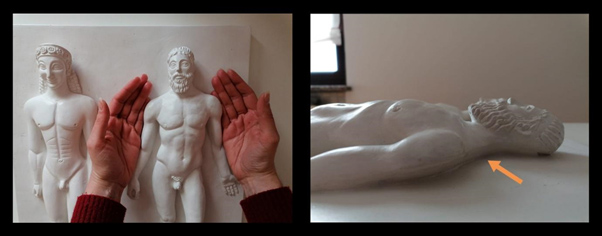
Note. On the left, the user’s hands touch the “sottosquadro”, feeling the detached part of the Riace Bronze from the background. On the right, the “sottosquadro” in detail.
Figure 2
Kouros from Melos and One of the Bronzes of Riace
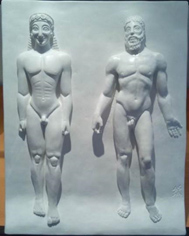
Note. Kouros from Melos (left) and one of the Bronzes of Riace - Statue B (right), both originally examples of all-round sculpture. Bas-relief at Anteros Tactile Museum, Bologna, Italy.
Figure 3
A Comparison Between Riace Bronzes
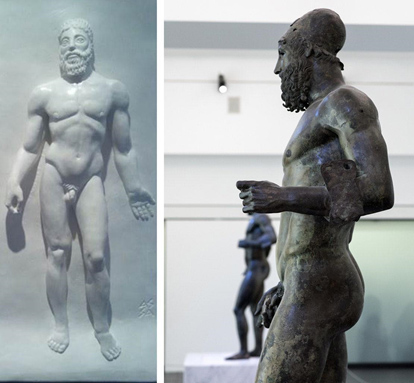
Note. A comparison between Riace Bronzes. Statue B’s side view, on the right. National Archaeological Museum of Reggio Calabria, Italy.
Figure 4
Bas-Relief Side View Detail
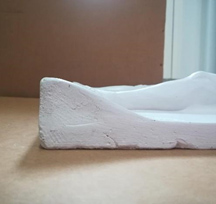
Note. Bas-relief side view detail. Noteworthy is the greater overhang.
Figure 5
A Guided Reproduction of Riace Bronze’s Position
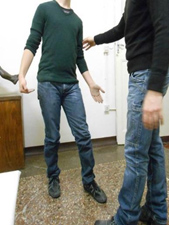
Figure 6
A Preparation of the Clay Surface
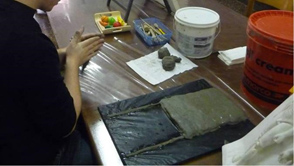
Note. A preparation of the clay surface. Then, the reproduction of the plaster bas-relief is made, depicting the Kouros from Melos and Statue B of the Riace Bronze.
Figure 7
Verification of Geometries and Proportions in the Model and in the Clay Reproduction.
NB: Every image is licensed under the CC BY-SA4.0, except Figures 1, 4, and 7 (https://creativecommons.org/licenses/by-sa/4.0/deed.en).
---------------------
The Journal of Blindness Innovation and Research is copyright (c) 2021 to the National Federation of the Blind.