
Cripping STEM Education: Five Principles for Disrupting Compulsory Sightedness
By Natalie Shaheen
Natalie Shaheen is an associate professor at Illinois State University, jointly appointed in the Department of Special Education and the School of Teaching and Learning. Shaheen is a leading expert in K-12 technology accessibility and born accessible STEM learning. The aim of Shaheen’s work is to disrupt systemic ableism and reimagine technology-mediated education so that disabled youth have equitable access to learning.
Abstract
Across the United States, K-12 schools have prioritized science, technology, engineering, and math (STEM) coursework to prepare students for a STEM-focused economy. This paper contributes a blind pedagogical approach to STEM education that ensures blind and low-vision students are equitably prepared for that imagined STEM future. Drawing on crip theory, I show that the compulsory sightedness of K-12 STEM education is extraneous and exclusionary of blind and low-vision students. I argue that by following the five principles of blind STEM pedagogy educators can construct STEM classes that are born nonvisually accessible and equitable to blind and low-vision students. Finally, I invite educators to become epistemic activists and to conspire with the National Federation of the Blind to disrupt the compulsory sightedness of STEM education.
Keywords
STEM Education, K-12, accessibility, crip theory
Introduction
For decades, K-12 STEM pedagogy has been grounded in the assumption that to do STEM one must be sighted. Consequently, generations of blind and low-vision students have been excluded from STEM learning. But there is nothing inherently visual about conducting experiments, writing code, engineering solutions, or constructing mathematical proofs. Herein, I advance five principles for disrupting compulsory sightedness and reimagining K-12 STEM education as born nonvisually accessible and equitable to blind and low-vision students.
Since 2004, the National Federation of the Blind (NFB) has facilitated 45 STEM programs for blind and low-vision students of all ages. In facilitating those programs, blind and low-vision educators and STEM professionals have iteratively developed a pedagogical approach for facilitating STEM learning that is born nonvisually accessible and equitable to blind and low-vision students.
I joined the collective in 2009 as a young blind educator after accepting a position on the NFB staff. As a child, I loved STEM and, in high school, I was encouraged to pursue a STEM career. But, after a challenging K-12 journey, I wanted to do what I could to make K-12 a better experience for the disabled students who followed me. So, I put STEM aside and pursued a career in education. In 2009, I was ecstatic to learn that my job duties included developing informal STEM education programs for blind and low-vision youth.
Over the last two decades, the NFB has been engaged in epistemic activism—asserting an alternative way of knowing to transform an inequitable reality into a just future world (Hamraie, 2017). The just STEM world that we have created has positively impacted well over one thousand young blind and low-vision people.
Blind and low-vision students have explained that the classes at NFB STEM programs feel markedly different from the STEM classes at their schools (Mau, 2021). At NFB STEM programs, the students feel empowered and engaged, a new and exciting experience (Shaheen et al., 2022). I have felt that difference too, as have the other blind and low-vision adults facilitating the programs.
But what comprises that difference? How do we, blind and low-vision educators and STEM professionals, create classes where blind and low-vision students feel empowered and engaged, particularly in subjects that the majority world insists are “visual?”
Over the years, I have come up with some answers to that question. But my previous answers have been incomplete; they only named the tangible components of our classes. I have previously failed to articulate the intangible or less tangible aspects, and that difference that blind and low-vision students and I have felt at NFB STEM programs transcends the tangible world.
In 2020, I began reexamining NFB STEM programs and K-12 STEM classes using the thinking tools of crip theory (McRuer, 2006). With those powerful thinking tools, I was able to articulate the intangible practices that are critical to creating born nonvisually accessible STEM classes. I initially shared my findings in a keynote at the Dare to Be Remarkable Conference (Shaheen, 2020). I continued to refine those ideas and subsequently shared them in a keynote at the 2023 Advancing Research Impacts in Society Convening (Shaheen, 2023a).
In this article, I present the final iteration of the ideas I shared in the 2020 and 2023 keynotes. The aim of this article is to (a) disseminate the blind STEM pedagogy approach to a broader audience and (b) invite other educators to conspire with the NFB in the epistemic activism project of disrupting the compulsory sightedness of STEM education.
Background
The literature on teaching science to blind and low-vision students is scant (Ediyanto & Kawai, 2019; Koehler & Wild, 2019; Miyauchi, 2020). Two recent literature reviews, which collectively examined research published between 1980-2020, had samples of only 17 and 18 articles, respectfully (Ediyanto & Kawai, 2019; Miyauchi, 2020). The literature indicated that STEM classes have consistently been inaccessible to blind and low-vision students despite over 100 years of pedagogical efforts to make STEM classes more accessible.
STEM classes are often the most inaccessible classes blind and low-vision students take (Shaheen, 2023b) due to numerous access barriers that impede learning (Arslantas & Yalçin, 2022; Bell & Silverman, 2019). Three key access barriers are repeatedly discussed in the literature: inaccessible technologies, spatial information that is presented exclusively in visual formats, and exclusion from critical laboratory learning.
The prevalence of inaccessible technologies in STEM classes has increased dramatically in the last decade. For example, digital simulations and labs are commonplace in STEM classrooms today. So, once accessible analog labs (e.g., dissections), which blind and low-vision students accessed through touch, are now conducted via inaccessible digital simulations (Koehler & Wild, 2019; Moore & Lewis, 2015). Additionally, mathematical content is presented digitally using images rather than machine readable formats (e.g., LaTeX, MathML).
Charts, figures, and illustrations are essential for learning and doing STEM, but the literature indicated that in STEM classes that imagery is customarily presented exclusively in visual formats. Consequently, blind and low-vision students rarely have access to the spatial information that is essential for understanding scientific concepts (Arslantas & Yalçin, 2022; Beck-Winchatz & Riccobono, 2008; Bell & Silverman, 2019; Ediyanto & Kawai, 2019; Fast & Wild, 2018; Kizilaslan et al, 2021; Koehler et al, 2018).
In addition to confronting inaccessible technologies and instructional materials in STEM classes, blind and low-vision students are continually barred from conducting labs independently (Heard, 2016; Jones & Burrell, 2022; Supalo et al., 2014). This exclusion limits blind and low-vision students’ development of crucial STEM inquiry skills (Jones & Burrell, 2022; Kahn et al., 2017).
The National Research Council’s (2012) Framework for K-12 Science Education, which is the basis for the Next Generation Science Standards, emphasized the importance of providing ample opportunities for students to do STEM. “Students cannot comprehend scientific practices, nor fully appreciate the nature of scientific knowledge itself, without directly experiencing those practices for themselves” (National Research Council, 2012, p. 30). Moreover, the Framework identified eight science and engineering practices (e.g., planning and carrying out investigations) and emphasized that all students should master them in K-12. “Equity in science education requires that all students are provided with equitable opportunities to learn science and become engaged in science and engineering practices” (National Research Council, 2012, p. 28).
Pedagogical efforts to make STEM accessible to blind and low-vision students date back to the 1920s (Supalo, 2010). The pedagogical efforts documented in the literature have largely focused on making segregated science classes accessible and evaluating blind and low-vision students’ knowledge. These pedagogical efforts have made three key contributions to the knowledgebase. First, they have provided exemplars of accessible instruction in astronomy, biology, chemistry, earth science, and physics (Beck-Winchatz & Riccobono, 2008; Hilson et al., 2016; Koehler et al, 2018; Miles et al., 2022; Supalo, 2010; Supalo et al., 2014; Wedler et al., 2014; Wild et al., 2013; Wild & Trundle, 2010). Second, prior pedagogical work has identified three strategies that increase accessibility across STEM disciplines: hands-on activities, tactile graphics, and 3D prints (Fast & Wild, 2018; Kizilaslan et al, 2021; Koehler et al, 2018; Rosenblum et al., 2019; Smith et al., 2020; Watson & Bell, 2022). Third, previous work has determined that blind and low-vision students can develop STEM concepts and skills when the instruction is accessible (Beck-Winchatz & Riccobono, 2008; Miles et al., 2022; Rule et al., 2011; Watson & Bell, 2022; Wild et al., 2020).
While blind and low-vision students are usually present in K-12 STEM classrooms, they are frequently excluded from the learning, particularly in high school and advanced STEM courses (Beck-Winchatz & Riccobono, 2008; Hairston, et al, 2020; Jones & Burrell, 2022; Koehler & Wild, 2019; Miyauchi, 2020). But STEM learning does not have to be exclusionary.
To construct STEM learning that is born nonvisually accessible, educators must shift their pedagogical world view. Crip theory furnishes thinking tools that can help educators interrogate their current world view and consider alternative pedagogical world views.
Crip Theory
Robert McRuer (2006) originally advanced crip theory in the academic literature with the book Crip Theory: Cultural Signs of Queerness and Disability. Though McRuer first brought the theory to the academic literature, he explained that he was not the single origin of crip theory. McRuer credited the activist work of crip and queer collectives in the preceding decades for giving rise to the ideas he presented in the book. He explored those activists’ work through a cultural studies lens, which interrogates the natural order of things and explores ways that order could be disrupted. The resulting theory argues that (a) compulsory abledness produces disability and (b) compulsory abledness and compulsory heterosexuality, which produces queerness, are co-constitutive.
McRuer (2006) proposed five tenets of crip theory:
- “Claiming disability and a disability identity politics while nonetheless nurturing a necessary contestatory relationship to that identity politics…” (p. 71)
- “Claiming the queer history of coming out… while simultaneously talking back to the parent culture…” (p. 71)
- “Demanding that… another [accessible] world is possible...” (p. 71)
- “Insisting that, even more, a disabled world is possible and pointing out that… movements that cannot begin to conceptualize that idea—that a disabled world is possible and desirable—as anything other than counterintuitive need to be cripped.” (p. 71)
- “Moving “beyond ramps,” as Marta Russell put it, to questions of how private or privatized versus public cultures of ability or disability are conceived, materialized, spatialized, and populated…” (p. 72)
Crip theorists investigate how disability and queerness are conceptualized and materialized in various spheres of life and the role that cultural homogenization plays in producing disability and queerness. Herein, I examine both (a) the role that compulsory sightedness plays in the construction of K-12 STEM classes and (b) the NFB’s epistemic activism, which has demonstrated that another accessible STEM world is possible.
The Compulsory Sightedness of STEM Education
An abled identity is compulsory when it is viewed as a nonidentity, as the natural order of things, and as the ultimate aim. Compulsory abledness, a form of cultural homogenization, commands disabled people to act more abled and constantly insists, “[y]es, but in the end, wouldn’t you rather be more like me?” (McRuer, 2006, p. 9).
Compulsory sightedness is one variety of compulsory abledness. It is particularly apparent when sighted people ask blind and low-vision people the all-too-common question, “Do you wish you could see?” Compulsory sightedness asserts that “yes” is the only acceptable answer because sightedness is an objectively superior way of being.
In STEM classrooms, sightedness is the natural order of things, a nonidentity, and the ultimate aim. After all, STEM is “visual.” When most people imagine a STEM classroom, they picture sighted people inquiring, experimenting, and engineering through visual means. Moreover, STEM classrooms are designed to take advantage of visual perception—data is rendered in purely visual formats and instruments are designed to extend human visual perception. In STEM classrooms sightedness is compulsory.
In the STEM classroom, compulsory sightedness insists, “You would rather do STEM the sighted way, right?” Educators unintentionally declare it is better to do STEM the sighted way when they attempt to make STEM accessible by determining how blind and low-vision students can do an experiment the sighted way. For example, in K-12 classrooms, students customarily use color to determine the pH of a solution. So, the question becomes how can a blind and low-vision student tell if the color changed? In other words, how can a blind and low-vision student determine pH the sighted way?
If sightedness was not compulsory, educators would not start with the sighted method and then attempt to reverse engineer a blind and low-vision solution. Instead, educators would start by identifying nonvisual approaches for measuring pH such as an olfactory indicator (i.e., an allium solution) or a pH probe.
The compulsory sightedness of STEM education positions blindness as an outlaw ontology, “a way of being or existing that is thought outside the normal and as such to need chasing down, like the unacceptable rogue outlaws of old Western films" (Baker, 2017, p. 147). As a result, blind and low-vision students are excluded from STEM learning and dissuaded from pursuing STEM careers. But outside of K-12, blind and low-vision people have demonstrated that another accessible STEM world is possible.
Members of the NFB have been (a) disrupting compulsory sightedness and (b) cripping STEM education for two decades. I outline how blind and low-vision educators and STEM professionals have created STEM classes that are born nonvisually accessible in the next section.
Blind STEM Pedagogy
Members of the NFB have demonstrated, through our epistemic activism, that another accessible STEM world is possible. Twenty-one years ago, the collective began by centering nonvisual ways of learning, a core tenet of NFB philosophy. From there, we iteratively developed a pedagogical approach for creating born nonvisually accessible STEM classes. Here, I name our approach “blind STEM pedagogy” and articulate its principles. I credit a collective of hundreds of NFB members—educators, scientists, engineers, mathematicians, and youth—for developing the approach.
Blind STEM pedagogy is a challenge to dominant STEM pedagogy, which insists STEM is “visual” and sightedness is compulsory. Blind STEM pedagogy rejects the inclusionist approach (Mitchell et al., 2014) of accommodating blind and low-vision students in visual STEM classes and demanding that they figure out how to do STEM the visual way. Blind STEM pedagogy invites educators to (a) expand their ideas of what it means to learn and teach STEM and (b) subsequently discover and develop inherently nonvisual approaches.
The work of blind STEM pedagogy requires a shift in worldview for most educators, blind and low-vision and sighted alike. Educators are products of their environment and American culture proclaims it is better to be non-disabled than disabled and one must see to believe (and learn). Consequently, the first principle of blind STEM pedagogy establishes the requisite worldview.
The five principles of blind STEM pedagogy are:
- Embrace nonvisual ways of learning
- Create empowering environments
- Teach nonvisual science and engineering practices
- Use accessible equipment
- Use accessible instructional materials
Figure 1
Blind STEM Pedagogy Profile
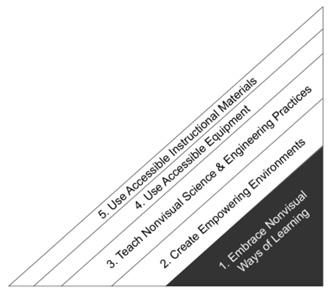
The blind STEM pedagogy profile (Figure 1) is a cross-section that illustrates the role of each principle in shaping the topography of the pedagogical approach. The triangular shape symbolizes the strength of the approach and its radical departure from dominant STEM pedagogy, which falls flat for blind and low-vision students.
Principle 1, embrace nonvisual ways of knowing, is the bedrock of the approach and establishes the triangular shape. Principles 2-5 are layers of sediment deposited in order on top of the bedrock of Principle 1. Each layer builds on and elevates the pedagogical approach. The layers are depicted in order of fundamentality (1-5) and each layer’s depth indicates the amount of effort one should devote to that aspect of the work. On the vertical axis, the depth of each layer is as follows: Principle 1, 33 units of time; Principle 2, 22 units of time, Principle 3, 22 units of time; Principle 4, 11.5 units of time; and Principle 5, 11.5 units of time.
To enact blind STEM pedagogy, educators must engage in the work of all five principles. Cherry picking principles results in flat STEM pedagogy where access is superficial at best. In the remainder of this section, I elaborate on each of the five principles.
Principle 1: Embrace Nonvisual Ways of Learning
Nonvisual ways of learning are methods that do not engage visual perception. For example, Braille is a nonvisual, specifically tactile, way of reading. Blind and low-vision people employ all of their senses, save vision, when learning nonvisually.
Embracing nonvisual ways of learning means willingly and joyfully adopting a worldview that (a) asserts nonvisual methods are equivalent to visual methods of knowledge construction and (b) rejects the dominant narrative that STEM is “visual.” To adopt this worldview, educators must engage in deep reflection and examine their implicit biases about nonvisual ways of learning and the “visual” nature of STEM.
Educators could use the following questions to begin the introspective work of Principle 1:
- What is the biggest barrier blind and low-vision people face in learning and working in STEM? What implicit biases are evident in my response?
- Who benefits when I talk (and think) about STEM subjects as visual? Who is harmed?
- How does the way I teach STEM communicate, explicitly or tacitly, that STEM is “visual?”
Principle 1 in Practice
Though the work of Principle 1 is primarily introspective, the results of that internal work are observable in the classroom. At NFB STEM programs, we talk about STEM as spatial rather than “visual.” Moreover, we give blind and low-vision students time and space to learn nonvisually. We do not send a sighted adult in to “help” when something seems “inefficient.” For example, we know that tactile exploration is a common nonvisual method for orienting to a new space. Consequently, in the lab, we give students time and space to explore a new lab setup and we encourage them to do so tactually.
Principle 2: Create Empowering Environments
Environments that empower blind and low-vision students have two characteristics. First, teachers encourage, rather than merely permit, blind and low-vision students to participate fully in all types of learning—especially when the learning requires “dangerous” tools (e.g., hand saws, Bunsen burners, soldering irons, and acids). Second, blind and low-vision students are both the givers and receivers of access intimacy, which Mingus (2011) described as the automatic understanding of another’s access needs.
The differences between empowering environments and K-12 STEM classrooms are palpable. In K-12, blind and low-vision students are not permitted to conduct experiments or engineer solutions (see Section 2), often because of the teachers’ paternalistic safety concerns (Kahn & Lewis, 2014). Additionally, blind and low-vision students are expected to communicate in visual formats for the benefit of their sighted peers and teachers, but the sighted people do not extend nonvisual access in return. Finally, blind and low-vision students are expected to “advocate” for themselves in a limited number of tolerable ways.
Principle 2 in Practice
When developing curricula for NFB STEM programs, we seek out learning opportunities that require the use of “dangerous” tools so we can teach blind and low-vision students that lab safety isn’t about seeing. In biology classes, blind and low-vision students dissect dogfish sharks nonvisually using scalpels and in engineering classes students build prototypes nonvisually using saws and hot glue guns.
We also intentionally cultivate access intimacy at NFB STEM programs by (a) expecting everyone to communicate nonvisually and (b) acknowledging that the onus is on us (the educators) to create a space where blind and low-vision students experience access intimacy. Consequently, we do not chide a student who cannot or chooses not to share their access needs. Instead, we (a) reflect on why that student did not feel comfortable sharing their access needs and (b) ponder what we can do to cultivate access intimacy for that student, so they feel comfortable sharing their needs in the future.
Some of the questions that guide our reflection include:
- How have we been complicit in creating power relations that make this student feel unsafe sharing their access needs?
- In what ways are our expectations about how a student should communicate their access needs raced, classed, and gendered?
- Could this student be sharing their access needs in a way that our worldview has prevented us from acknowledging?
- What can we do to neutralize power relations and expand our worldview so this student experiences access intimacy?
Principle 3: Teach Nonvisual Science and Engineering Practices
The National Research Council (2012) explained that learning science and engineering is much more than memorizing isolated facts. To engage in scientific inquiry and engineer solutions, the National Research Council (2012) asserted, students must also learn to think and engage with the world like scientists and engineers. In A Framework for K-12 Science Education, the National Research Council identified eight science and engineering practices:
- Asking questions (for science) and defining problems (for engineering)
- Developing and using models
- Planning and carrying out investigations
- Analyzing and interpreting data
- Using mathematics and computational thinking
- Constructing explanations (for science) and designing solutions (for engineering)
- Engaging in argument from evidence
- Obtaining, evaluating, and communicating information (2012, p. 42)
These eight practices have been incorporated into the Next Generation Science Standards (NGSS), which drive a great deal of science education in the U.S.
Both blind and low-vision and sighted scientists and engineers engage in all eight of the practices the National Research Council identified, but they use different methods. Consider Practice 4, analyzing and interpreting data. Blind and low-vision scientists create tactile graphics, 3D prints, or sonifications (non-speech audio) to analyze and interpret data. Sighted scientists use two and three dimensional visual images to analyze and interpret data. Both the nonvisual and the visual science and engineering practices are effective. Scientists and engineers choose the methods that best facilitate their work, given their bodymind’s affordances and limitations.
Blind and low-vision students must be taught nonvisual science and engineering practices in order to learn to think and engage with the world like scientists and engineers. Unfortunately, they do not get that opportunity in school because only visual science and engineering practices are taught in K-12.
Principle 3 in Practice
The nonvisual science and engineering practices that we teach in NFB STEM programs are rarely novel methods we invent specifically for the program. Rather, they are methods blind and low-vision STEM professionals have taught us. Instead of reinventing the wheel, we search for the methods other blind and low-vision people have invented and, where necessary, modify those methods to fit our curricular context.
In the NFB EQ curriculum, an open educational resource, we outlined in detail the nonvisual science and engineering practices we taught students in that program (Shaheen et al., 2023). The table below offers brief explanations of some nonvisual methods that align with grade band specific NGSS examples of the eight science and engineering practices.
Table 1
Nonvisual Methods Aligned with NGSS Grade Band Examples of Science and Engineering Practice
Practice |
NGSS Grade Band Example |
Nonvisual Method |
|---|---|---|
1. Asking questions (for science) and defining problems (for engineering) |
Grades 6-8: “Ask questions that arise from careful observation of phenomena, models, or unexpected results, to clarify and/or seek additional information” (p. 4) |
Direct tactile, auditory, olfactory, kinesthetic, and proprioceptive observation; when objects are too small or dangerous to touch directly use another material like a mini, heat resistant, and/or non-conductive cane to tactually observe |
2. Developing and using models |
Grades 3-5: “Develop a diagram or simple physical prototype to convey a proposed object, tool, or process.” (p. 6) |
Develop tactile diagrams using tactile drawing tools such as the Sensational Blackboard or inTACT Sketch Pad |
3. Planning and carrying out investigations |
Grades K-2: “Make observations (firsthand or from media) and/or measurements to collect data that can be used to make comparisons.” (p. 7) |
Measure nonvisually using tactile or auditory tools such as: click rule, tactile calipers, SciVoice Talking LabQuest |
4. Analyzing and interpreting data |
Grades 9-12: “Compare and contrast various types of data sets (e.g., self-generated, archival) to examine consistency of measurements and observations.” (p. 9) |
Use a screen reader with or without a refreshable Braille display to explore data sets in accessible spreadsheets |
5. Using mathematics and computational thinking |
Grades 3-5: “Create and/or use graphs and/or charts generated from simple algorithms to compare alternative solutions to an engineering problem.” (p. 10) |
Use tactile graphs/charts or auditory graphs/charts (i.e., sonification) |
6. Constructing explanations (for science) and designing solutions (for engineering) |
Grades K-2: “Use tools and/or materials to design and/or build a device that solves a specific problem or a solution to a specific problem.” (p. 11) |
Use an awl to tactually mark where a piece of wood should be cut |
7. Engaging in argument from evidence |
Grades 9-12: “Construct, use, and/or present an oral and written argument or counter-arguments based on data and evidence.” (p. 13) |
Compose written reports and/or presenter notes in Braille |
8. Obtaining, evaluating, and communicating information |
Grades 6-8: “Integrate qualitative and/or quantitative scientific and/or technical information in written text with that contained in media and visual displays to clarify claims and findings.” (p. 15) |
Access visual media and displays via video description, image descriptions, and/or tactile graphics |
Note: All grade band examples quoted in columns two are from the National Research Council (2013).
Principle 4: Use Accessible Equipment
Born nonvisually accessible STEM classes exclusively use accessible instruments, technologies, and tools. Some of the equipment is specifically designed for blind and low-vision people (e.g., Braille calipers). Other equipment is modified slightly to be nonvisually accessible (e.g., adding a tactile marking). Finally, all of the digital technologies are either compliant with the Web Content Accessibility Guidelines or self-voicing.
Principle 4 in Practice
In NFB STEM programs, students regularly use nonvisual measuring tools such as Braille calipers, talking scales, and click rules. We also use the SciVoice Talking LabQuest extensively. The plethora of compatible probes (e.g., pH, salinity, turbidity, temperature, motion sensor) makes the tool indispensable in most bench science classes. When an inherently accessible piece of equipment is not available, we modify existing equipment to be nonvisually accessible. Often the addition of tactile markings can make inaccessible analog equipment accessible. For example, we frequently use a jewelers file to add tactile notches to tools such as syringes and 30/60/90 triangles.
Principle 5: Use Accessible Instructional Materials
STEM classes use a wide variety of instructional materials including textbooks, slide decks, handouts, lab manuals, manipulatives, and figures. Educators who practice blind STEM pedagogy ensure all instructional materials—especially figures—are available in nonvisually accessible formats (e.g., Braille, accessible digital files, tactile figures, 3D prints) at the same time and in the same place as visual formats. Forcing blind and low-vision students to wait hours, days, or weeks for accessible instructional materials is oppressive.
Principle 5 in Practice
In NFB STEM programs there is a great deal of Braille, tactile graphics, and accessible digital documents. In classes that use unique subject-specific manipulatives, we sometimes develop new approaches to ensure nonvisual access. For an engineering lesson about multivew drawing, we developed a nonvisual version of an orthographic cube that allowed students to simultaneously tactually inspect both the wooden object inside the plexiglass cube and the projection on the face of the cube (Goodridge et al., 2020).
Become an Epistemic Activist
There are many ways that you can conspire with the NFB to demand that another nonvisually accessible STEM world is possible. Here, I suggest three starting places; this list is far from exhaustive.
- Hang up your cape. The NFB welcomes coconspirators, blind, low-vision, and sighted, but rejects heroes of all identities.
- Notice. Notice your implicit biases against blind and low-vision people and nonvisual ways of learning. Notice how sightedness is compulsory in the spaces you inhabit, particularly the STEM spaces. Notice how the language you use presumes a shared visual experience.
- Practice blind STEM pedagogy. Start constructing born nonvisually accessible STEM classes by practicing the five principles of blind STEM pedagogy. As you do this work, collaborate with blind and low-vision people, and compensate them for their expertise.
Implications for Practitioners and Families
When educators practice blind STEM pedagogy, born nonvisually accessible STEM classes are possible in all grades and STEM subjects. The NFB has used the five principles of blind STEM pedagogy to create a wide variety of STEM classes for students of all ages. Practitioners and families who want to explore in more detail what it is like to practice blind STEM pedagogy should review the NFB EQ Curriculum (Shaheen et al., 2023) and the NFB EQ Parent Toolkit (Moon & Shaheen, 2023).
Conclusion
Sightedness has been compulsory in K-12 STEM education for decades. But a collective of blind and low-vision people have demonstrated that another born nonvisually accessible STEM world is possible. It is time to bring that born nonvisually accessible STEM world to K-12. We invite K-12 teachers and teacher educators to join us as we crip K-12 STEM education through blind STEM pedagogy.
Acknowledgements
I thank the collective of blind and low-vision educators and STEM professionals for initiating this epistemic activism project in 2004 and for welcoming me into the collective in 2009. I am deeply grateful for the opportunity to learn with you over the last 16 years.
This material is based upon work supported by the National Science Foundation under Grant No. 1712887. Any opinions, findings, and conclusions or recommendations expressed in this material are those of the author(s) and do not necessarily reflect the views of the National Science Foundation.
References
Arslantas, T. K., & Yalçin, G. (2022). Mentoring inservice teachers to support their inclusive science teaching practices for students with visual impairment. International Journal of Contemporary Educational Research, 7(2), 112-131. https://doi.org/10.33200/ijcer.741436
Baker, B. (2017). The hunt for disability: The new eugenics and the normalization of school children. In J. Allan, A. J. Artiles (Eds.), World yearbook of education 2017: Assessment inequalities (pp. 137-173). Routledge. https://doi.org/10.4324/9781315517377
Beck-Winchatz, B., & Riccobono, M. A. (2008). Advancing participation of blind students in science, technology, engineering, and math. Advances in Space Research, 42(11), 1855-1858. https://doi.org/10.1016/j.asr.2007.05.080
Bell, E. C., & Silverman, A. M. (2019). Access to math and science content for youth who are blind or visually impaired. Journal of Blindness Innovation and Research, 9(1). https://nfb.org/images/nfb/publications/jbir/jbir19/jbir090101.html
Ediyanto, & Kawai, N. (2019). Science learning for students with visually impaired: A literature review. Journal of Physics: Conference Series, 1227(1), 1-9. https://doi.org/10.1088/1742-6596/1227/1/012035
Fast, D., & Wild, T. (2018). Teaching science through inquiry based field experiences using orientation and mobility. Journal of Science Education for Students with Disabilities, 21(1), 29-39. https://doi.org/10.14448/jsesd.10.0003
Goodridge, W. H., Shaheen, N. L., & Bartholomew, S. (2020). Teaching technology & engineering concepts through socially relevant contexts: Adapting older engineering graphics methods to facilitate new opportunities in our school systems for blind and low vision youth. Technology and Engineering Teacher, 79(6), 33-37.
Hairston, J. R., Williams, T., Smith, D. W., Sabados, W. T., & Forney, S. (2020). Teaching cybersecurity to students with visual impairments and blindness. Journal of Science Education for Students with Disabilities, 23(1). https://doi.org/ 10.14448/jsesd.12.0007
Hamraie, A. (2017). Building access: Universal design and the politics of disability. University of Minnesota Press.
Heard, B. R. (2016). Science is for everyone. Future Reflections, 35(2). https://nfb.org/images/nfb/publications/fr/fr35/2/fr350209.htm
Hilson, M., Hobson, S., & Wild, T. (2016). Conceptual understandings of students with visual impairments about biodiversity across ecosystems. Journal of Blindness Innovation and Research, 6(2). https://dx.doi.org/10.5241/6-102
Jones, T. R., & Burrell, S. (2022). Present in class yet absent in science: The individual and societal impact of inequitable science instruction and challenge to improve science instruction. Science Education, 106(5), 1032-1053. https://doi.org/10.1002/sce.21728
Kahn, S., & Lewis, A. R. (2014). Survey on teaching science to K-12 students with disabilities: Teacher preparedness and attitudes. Journal of Science Teacher Education, 25(7), 885-910. https://doi.org/10.1007/s10972-014-9406-z
Kahn, S., Pigman, R., & Ottley, J. (2017). A tale of two courses: Exploring teacher candidates' translation of science and special education methods instruction into inclusive science practices. Journal of Science Education for Students with Disabilities, 20(1), 50-68. https://doi.org/10.14448/jsesd.08.0004
Kizilaslan, A., Zorluoglu, S. L., & Sozbilir, M. (2021). Improve learning with hands-on classroom activities: Science instruction for students with visual impairments. European Journal of Special Needs Education, 36(3), 371-392. https://doi.org/10.1080/08856257.2020.1732110
Koehler, K. E., & Wild, T. A. (2019). Students with visual impairments' access and participation in the science curriculum: Views of teachers of students with visual impairments. Journal of Science Education for Students with Disabilities, 22(1), 8.
Koehler, K. E., Wild, T. A., & Tikkun, S. (2018). Implications of 3-D printing for teaching geoscience concepts to students with visual impairments. Journal of Science Education for Students with Disabilities, 21(1), 49-81. https://doi.org/10.14448/jsesd.10.0004
Mau, M. (2021, August 23). STEM education can be accessible—And fun! Voice of the Nation’s Blind Blog. https://nfb.org/blog/stem-education-can-be-accessible-and-fun
McRuer, R. (2006). Crip theory: Cultural signs of queerness and disability. NYU Press.
Miles, R. G., Zambone, A., & Manda, A. (2022). Perceptions of earth science using assistive and supportive technologies by students who are blind or visually impaired. Journal of Science Education for Students with Disabilities, 25(1), 1-19. https://doi.org/10.14448/jsesd.14.0004
Mingus, M. (2011, May 5). Access intimacy: The missing link.Leaving Evidence. https://leavingevidence.wordpress.com/2011/05/05/access-intimacy-the-missing-link/
Mitchell, D. T., Snyder, S. L., & Ware, L. (2014). "[Every] child left behind": Curricular cripistemologies and the crip/queer art of failure. Journal of Literary & Cultural Disability Studies, 8(3), 295-313. https://doi.org/10.3828/jlcds.2014.24
Miyauchi, H. (2020). A systematic review on inclusive education of students with visual impairment. Education Sciences, 10(11), 1-15. https://doi.org/10.3390/educsci10110346
Moon, A., & Shaheen, N. L. (2023, June). NFB EQ for parents: A STEM learning toolkit for parents of blind children. National Federation of the Blind. https://nfb.org/programs-services/education/national-center-blind-youth-science/nfb-eq/nfb-eq-parents
Moore, E. B., & Lewis, C. (2015, October). Opportunity: Inclusive design for interactive simulations. In Proceedings of the 17th International ACM SIGACCESS Conference on Computers & Accessibility, 395-396. https://doi.org/10.1145/2700648.2811387
National Research Council. (2012). A framework for k-12 science education: Practices, crosscutting concepts, and core ideas. The National Academies Press. https://doi.org/10.17226/13165
National Research Council. (2013). Appendix F: Science and engineering practices in the NGSS. https://www.nextgenscience.org/sites/default/files/Appendix%20F%20%20Science%20and%20Engineering%20Practices%20in%20the%20NGSS%20-%20FINAL%20060513.pdf
Rosenblum, L. P., Ristvey, J., & Hospitál, L. (2019). Supporting elementary school students with visual impairments in science classes. Journal of Visual Impairment and Blindness, 113(1), 81-88. https://doi.org/10.1177/0145482X19833801
Rule, A. C., Stefanich, G. P., Boody, R. M., & Peiffer, B. (2011). Impact of adaptive materials on teachers and their students with visual impairments in secondary science and mathematics classes. International Journal of Science Education, 33(6), 865-887. https://doi.org/10.1080/09500693.2010.506619
Shaheen, N. L. (2020, December 15). Dismantling the compulsory sightedness of STEM education and empowering blind learners [Keynote presented virtually]. Dare to Be Remarkable Conference, Baltimore, MD, United States.
Shaheen, N. L. (2023a, March 22). Disrupting the compulsory sightedness of STEM through broader impacts [Keynote]. Advancing Research Impacts in Society Summit, Baltimore, MD, United States.
Shaheen, N. L. (2023b). Exploring blind and low-vision youth’s digital access needs in school: Towards youth accessibility guidelines. EdArXiv. https://doi.org/10.35542/osf.io/5c42v
Shaheen, N. L., Goodridge, W. H., Lopez, S, Anderson, P., Cunningham, A., & Nietfeld, D. (2023, April). NFB Engineering Quotient Curriculum. National Federation of the Blind. https://nfb.org/programs-services/education/national-center-blind-youth-science/nfb-eq/nfb-eq-teachers
Shaheen, N. L., Mau, M.., Eggleston, R., Loberg, M., Mendez-Frances, G., Cataquiz, A., & Duffy, A. (2022, July 10). Stretching the dimensions of nonvisual learning: Blind-led youth programming and engineering [Plenary session]. National Federation of the Blind National Convention, New Orleans, LA, United States.
Smith, D. W., Lampley, S. A., Dolan, B., Williams, G., Schleppenbach, D., & Blair, M. (2020). Effect of 3D manipulatives on students with visual impairments who are learning chemistry constructs: A pilot study. Journal of Visual Impairment and Blindness, 114(5), 370-381. https://doi.org/10.1177/0145482X20953266
Supalo, C. A. (2010). Teaching chemistry and other sciences to blind and low-vision students through hands-on learning experiences in high school science laboratories [Unpublished doctoral dissertation]. The Pennsylvania State University.
Supalo, C. A., Isaacson, M. D., & Lombardi, M. V. (2014). Making hands-on science learning accessible for students who are blind or have low vision. Journal of Chemical Education, 91(2), 195-199. https://doi.org/10.1021/ed3000765
Watson, S., & Bell, J. (2022). Accommodating visually impaired students in secondary science. The Science Teacher, 90(2), 40–49. https://doi.org/10.1080/00368555.2022.12293737
Wedler, H. B., Boyes, L., Davis, R. L., Flynn, D., Franz, A., Hamann, C. S., Harrison, J.G., Lodewyk, M. W., Milinkevich, K. A., Shaw, J. T., Tantillo, D. J., & Wang, S. C. (2014). Nobody can see atoms: Science camps highlighting approaches for making chemistry accessible to blind and visually impaired students. Journal of Chemical Education, 91(2), 188-194. https://doi.org/10.1021/ed300600p
Wild, T. A., Hilson, M. P., & Hobson, S. M. (2013). The conceptual understanding of sound by students with visual impairments. Journal of Visual Impairment and Blindness, 107(2), 107-116. https://doi.org/10.1177/0145482X1310700204
Wild, T. A., Shaheen, N., Fast, D. K., Averill, J., Koehler, K., & Farrand, K. (2020). Students’ with blindness and visual impairments level of engagement in science and engineering practices. Journal of Science Education for Students with Disabilities, 23(1), 16.
Wild, T. A., & Trundle, K. C. (2010). Conceptual understandings of seasonal change by middle school students with visual impairments. Journal of Visual Impairment and Blindness, 104(2), 107-118. https://doi.org/10.1177/0145482X1010400206
The Journal of Blindness Innovation and Research is copyright (c) 2025 to the National Federation of the Blind.