American Action Fund for Blind Children and Adults
Future Reflections Convention 2018 NOPBC CONFERENCE
Kid Talk
by Mark Riccobono
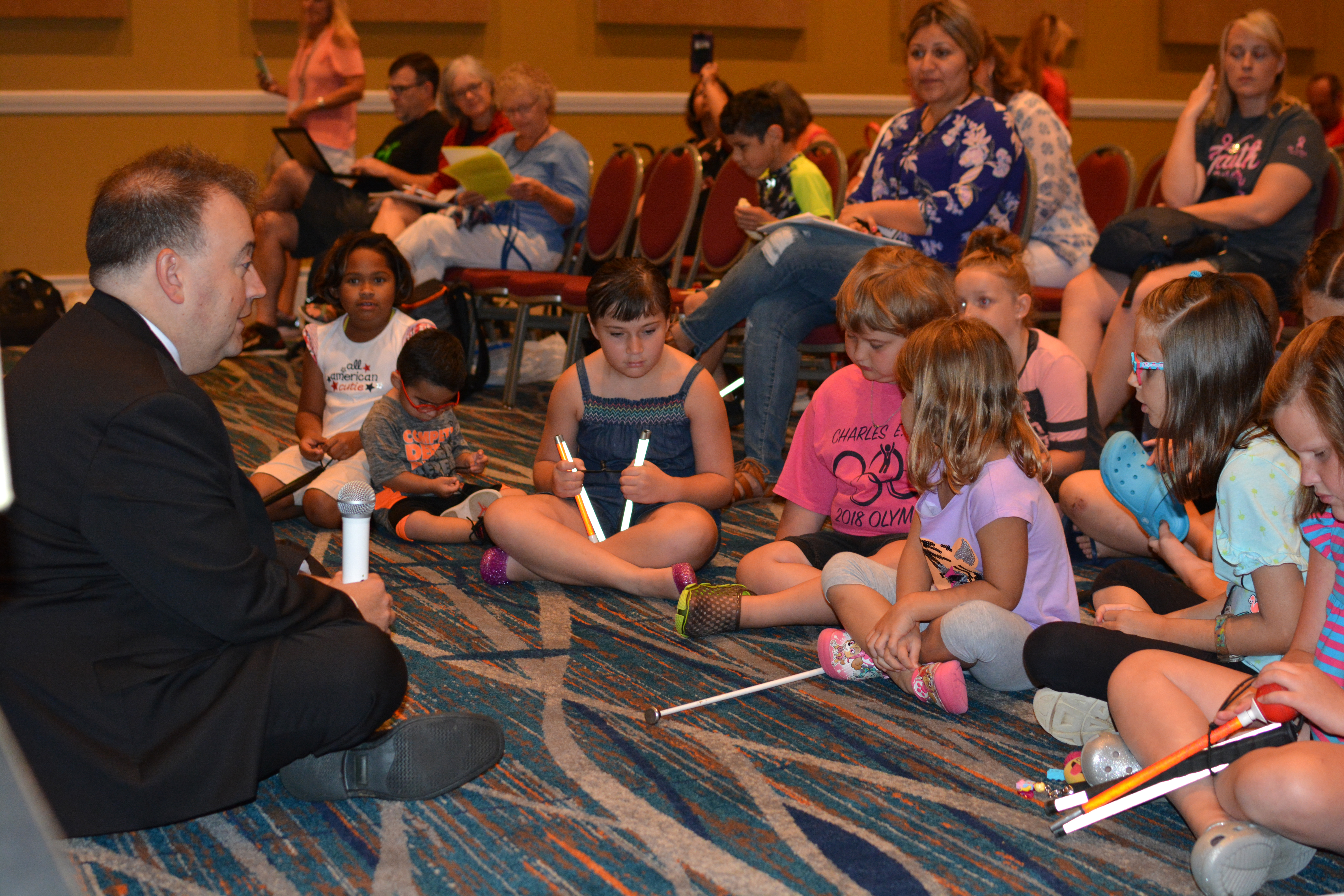 From the Editor: Every year the president of the National Federation of the Blind kicks off the NOPBC Conference at the NFB National Convention by meeting with the children. In keeping with tradition, NFB President Mark Riccobono sat on the floor at the front of the conference room as a circle of children gathered around him. Mark Riccobono is the father of three children, two of whom are blind.
Mark Riccobono: How's everybody doing?
Chorus: Good! Great!
Mark Riccobono: What do you want to talk about? If you have a question, say your name and I'll call on you.
Sydney: Sydney!
Mark Riccobono: Hi, Sydney!
Sydney: When you drove the car for the Blind Driver Challenge, how did you know what the vibrations meant?
Mark Riccobono: Okay, just so everybody has the same information, the National Federation of the Blind built a car that a blind person can drive. That was seven years ago. Probably some of you weren't even born seven years ago! We used technology that would communicate information through vibration, and Sydney asked how did I know what the vibrations meant. That's a very good question. I knew because I had training with the technology. Training is really important when you apply skills in real life. I had opportunities to try the technology, to use it in an environment that was controlled and safe. I learned what the patterns of vibrations meant, and then I could anticipate what to do with those patterns when I encountered them in a real driving situation on the Daytona International Speedway.
That's the same thing we do with our canes, right? When you tap your cane you're learning about the vibrations you feel and the sound of the cane and what it means. The more you use your cane, the more experience you'll have knowing what those sounds and vibrations are. Have you ever tapped the side of a building? A door sounds different from a wall, doesn't it? Keep using those canes, and maybe you'll be driving cars, too. Who else has a question?
Harley: Harley!
Mark Riccobono: Harley—speaking of cars! What's going on, Harley?
Harley: Are there smart canes here at the NFB?
Mark Riccobono: I'm sure there are. There have been a number of projects where people try to put technology into canes. We should continue to see if any of these ideas actually work. One of the beautiful things about the cane I use right now is that there are no batteries in it. If I'm in the middle of the street, the battery's not going to run out. So far we haven't found any technology that can be built into a cane that helps to improve travel for blind people. But we continue to try new things.
Now, you guys are all short, but you won't be short forever. There will be a time when certain things will get in your way, like tree branches. Those are things the cane doesn't find. So we continue to look at new technologies, but for now there's no better technology than the good old long white cane.
Haynes: Are you totally blind?
Mark Riccobono: I am totally blind. I have a little bit of light perception in one eye, but it's not anything to write home about. I do everything without vision.
Clara: I have a doll named Kate who has a guide dog named Jane.
Mark Riccobono: That's pretty cool! A guide dog is another good way to travel. But even folks who use guide dogs use canes sometimes, too. There are some situations where Kate won't want to take her guide dog. If she goes to a rock concert, she might decide that Jane doesn't like loud music, so she'll use her cane. Does anybody else have a doll that uses a cane or a guide dog?
Layla: I do!
Mark Riccobono: That's pretty cool. Anybody else have a question?
Isaiah: If you accidentally put your cane in a fire, would it start to burn?
Mark Riccobono: If you were using a wooden cane, then the answer would be yes. Dr. Jacobus tenBroek was the first president of the NFB, and when he traveled he used a wooden cane because that's what was used back then. Wooden canes are much heavier than carbon fiber or fiberglass canes. You'd probably have to leave the cane in the fire for a little while for it to burn. I don't recommend it. But if you were trying to get out of a fire, I would recommend using your cane. When I went to Boy Scout camp with my son recently, I used my cane to find out where the edge of the fire pit was.
Jennifer: How many different types of canes are there?
Mark Riccobono: There are three or four. Roller tip is one. I like the metal tips that we mostly use in the NFB, and here's why. When I tap it, my cane makes a sound. That sound bounces off things, and I can tell a lot about the environment from that sound. There are some cane tips that don't make much sound, even when you tap them on a hard surface.
Jason: What if somebody knocks your cane down?
Mark Riccobono: That does happen sometimes. You know all these people who get around by looking at things? They aren't always looking where they need to look! [Laughter] They're looking at their phones sometimes. It's quite a distraction, being able to see. Sometimes people will knock into you. If someone does bump into your cane, hold it in such a way that they're not going to break it.
Mindy: What if you drop your cane?
Mark Riccobono: When your cane leaves your hand, that's when you want your ears to start listening. Where did that cane go? You'll hear it when it hits the ground. Usually you'll be able to find it quite easily, and if you can't, someone will help you find it. But what you should do when the cane leaves your hand is listen to where it hit the ground, and go to that spot—unless it sounds like it's seven or eight feet below you, in which case you may want to wait.
Sydney: What does a cane with a battery do?
Mark Riccobono: Well, one idea is that by putting technology into the cane, you might be able to get more information. The problem is that a lot of the time the people who create these canes actually want to prevent blind people from touching things with their canes. But the cane is for touching things, right? If you don't touch it, you don't know what something is. When my cane touches a garbage can, I think, Great! There's a garbage can! I might need to throw something away later. Or if my cane touches a little kid, I think, Hey, there's a little kid sitting there. I better walk around him. I love that the cane tells me where chairs are and stages and people. I can decide what to do. I can map things in my head. Is there one more question?
Siri: How do you get around in a pool?
Mark Riccobono: That's a good question! There are a couple of things you can do. First of all, when you get in, get a sense of the shape of the pool. Maybe you can ask someone about it ahead of time. If you go along the side of the pool, you can find out there's a ladder here, there are steps over there. Here at the Rosen Shingle Creek pool, the sun is going to be a good indicator. Where's the sun? You can use that to orient yourself. You also can use the noise around the pool. Sometimes you can bring your own radio and put it at your chair where your stuff is. Then you'll know where you put your stuff.
When I go to the pool, I look for a chair that's close to the edge so I can find it easily. Sometimes I leave my cane on the side of the pool so I have a good idea where it is—but at a pool here at the Rosen Creek, there might be a lot of canes! Try some things till you find out what works for you. At a pool you can't usually get lost. You can just go around it in a circle.
Henry: What if you're using a guide dog, and the guide dog wants you to stop but you keep walking?
Mark Riccobono: When you use a guide dog, you have to tell the dog where to go. The dog's job is to signal to you if there's an obstacle or a reason for you to stop. You have to be prepared to pay attention to the signals that the dog sends you. Otherwise you'll put yourself in danger. It's just like if your mom or dad tell you to stop. You can choose to not listen to them, but it probably won't end well. When you use a guide dog, you're making the decision to be part of a team. You have to take the signals from the dog. You have to tell the dog where to go, because the dog can't make those decisions for you. The dog can't read street signs. The dog won't know whether you want to go right or left, so you have to make those decisions, and you also have to pay attention to what the dog is communicating to you.
Here's the cool thing. We're sitting here, talking about all the things we want to do and how we want to travel. You know what? All the information I've got comes from talking to other blind people. I've never used a guide dog, but my wife uses a guide dog and I know other people who use guide dogs. I've talked to them about what they do and what works for them. By working together we can learn much more than we learn by staying alone and doing our own thing.
When we work together we create something called synergy. Synergy! What in the world is that? I encourage you to go out and find out what it is. Synergy is what happens when you work with other people so you can go farther than you could go by yourself. Synergy comes from the Latin word synergia, meaning working together. When we work together we can do more than we can do individually. If you have a question about how a blind person does something, there are hundreds of blind people here at this convention who you can ask. You can call them up when you're not here at convention. You can call each other and share ideas. Then we should figure out what you want to do. Whether another blind person has done it before or not, let's figure out how a blind person can do it. We've gotten blind people to drive cars, to summit Mount Everest, to run marathons and ultramarathons. You're not limited by your blindness. By working together we can figure out solutions to any problem that gets in your way. Any last questions?
Layla: When you're going to cross the street, how do you know if they have a pedestrian signal there that you can activate?
Mark Riccobono: When you get to a new intersection, you don't have to cross right away. You can take time to look around with your cane. If there is a pedestrian control, it's going to be on a pole fairly close to the corner. You can slide your cane around and see what poles you find. You can also stand and listen to the traffic patterns and see whether the cars are stopping or going in one direction for a period of time. Any time you come to a new intersection, don't be in a hurry to cross. Take the time to find out what's there. If you're with someone, you can ask them, and if you're unsure, you can wait till someone comes by. At some intersections you might have to wait a long time till someone comes by, but if you're in New York City you won't have to wait too long—people will be coming by all the time. You've got to decide what works for you. You've got to collect as much information as you can to keep yourself safe.
I appreciate the opportunity to talk with you. I hope if you have more questions, you'll find me and ask me. You can come up to the Presidential Suite, Room 13217. I'm looking forward to all the places that you're going to travel and to all of the things that you're going to pursue. I look forward to helping you get there.
Media Share
