American Action Fund for Blind Children and Adults
Future Reflections Convention 2018 NOPBC CONFERENCE
Tools in My Toolbox
by Kim Cunningham
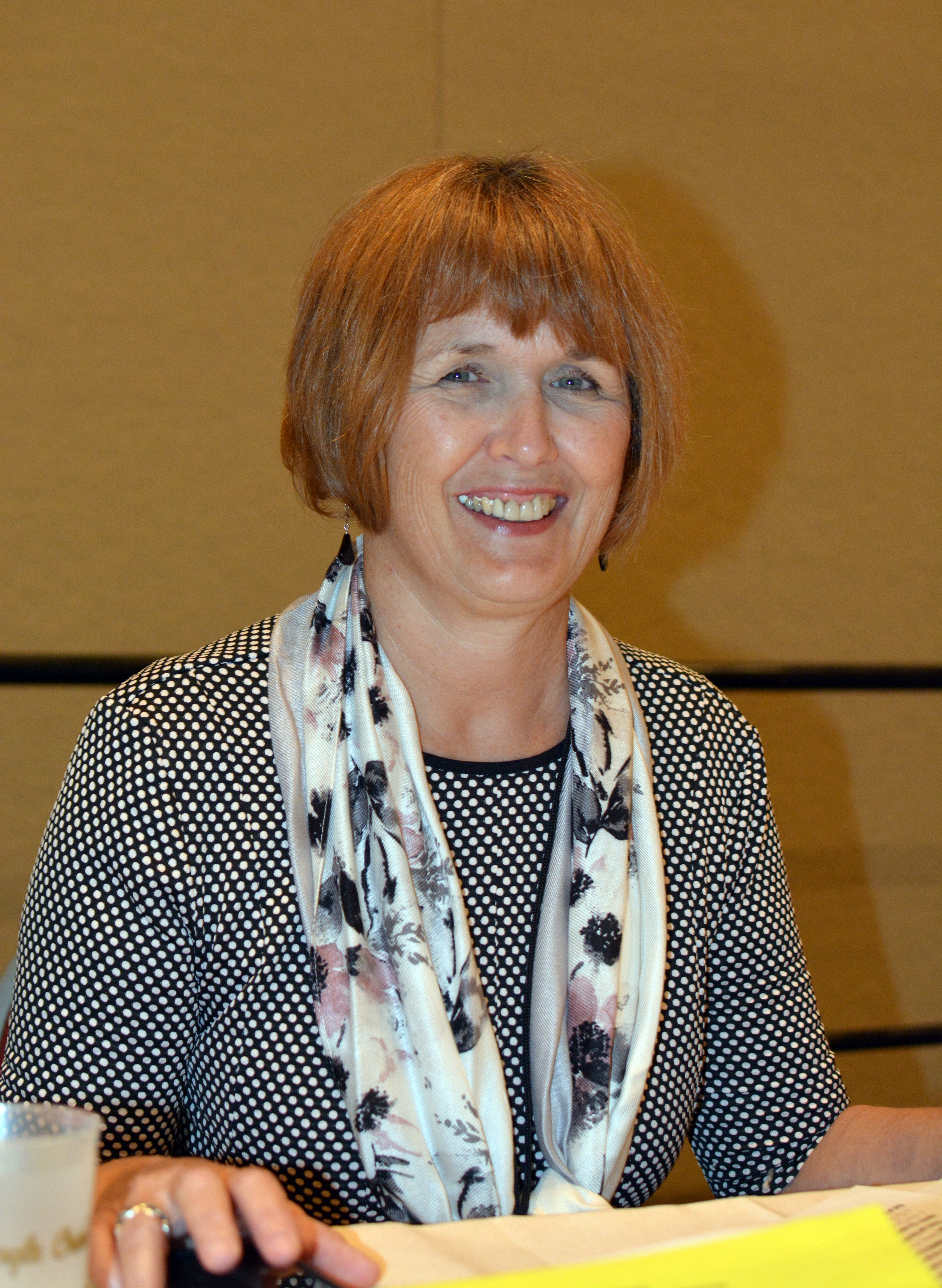 From the Editor: At the 2018 NFB National Convention, Kim Cunningham stepped down from the presidency of the National Organization of Parents of Blind Children (NOPBC). She had served since 2015. In this address she introduces the theme of the 2018 NOPBC Conference.
I'd like to thank you all for attending the 2018 NOPBC national conference, "Tools in My Toolbox." This conference is all about equipping our kids with the tools they need to live the lives they want.
There are literally thousands of blind people here to teach us and lead us. I will warn you right now, your family tree just expanded by a couple thousand people! [Laughter] You are not alone. We are all here to help you on this beautiful journey of parenting a blind or low-vision child.
A little over twenty-six years ago I gave birth to my blind daughter. It was the best of times and the worst of times. I learned very early on that most professionals didn't see her as a blind student; she had a very small amount of residual vision. The professionals didn't see a need to teach her nonvisual skills. Instead, they insisted that she use her residual vision to accomplish any given task. She was given large print books, and she received no training in nonvisual skills. She struggled as a print reader, suffering from headaches, backaches, and lots and lots of stress and anxiety. This was the worst of times. I was lost and confused about what it meant to be blind, or, in our case, what it meant to be not blind.
When my daughter was fourteen we attended our first NFB National Convention. It was here I learned about what it meant to be blind. It was here I learned that my daughter didn't have to rely on unreliable vision. I learned that the skills of blindness were as important and meaningful to her as to someone who had no vision at all. I learned that these blindness skills would be the keys to her leading an independent life.
Our first NFB national convention was a life-changing experience for our family. For fourteen years I had attended various conferences and trainings, trying to learn about blindness. Usually one or two blind people would attend, but I was never able to sit down with them and learn how they navigated their lives. I seemed to learn about everything except blindness. Most of the families I met were even more clueless than I was, and we seemed to travel a maze of uncertainty together.
When I walked into the hotel at my first NFB convention, I stopped and smiled in awe. I said to myself, "So this is where all the blind people are!" [Laughter] I saw people of all abilities doing what we all do at conventions—walking around, shopping, eating with friends, having a few cocktails at the bar, playing with their kids, running business meetings, and mentoring. I learned that the NFB had high expectations for my daughter. It conveyed those expectations by teaching her. It taught her how to navigate the hotel independently and how to handle chemistry labs as a blind student. It taught her how to carry a tray while using her cane, how to build a chatbot, and how to advocate for the rights of blind people. She learned about NFB training centers where blind people teach others how to live the lives they want. These centers expected my daughter to cook a meal for forty people, to clean her apartment, to learn Braille, to use technology, to learn woodworking skills, and to travel near and far using her long white cane. All of these skills were taught while she used learning shades, or sleepshades. Her confidence grew with every step she took.
Parents, if your child qualifies for services as a legally blind or blind student, your child's weakest sense is vision. No matter how big or bold you make things, it will always be a struggle for your child to depend on poor sight. What happens when the lighting isn't perfect? What happens when your child can't see the details? What happens when vision fails?
We must insist that our schools are held accountable for providing our children with a free and appropriate public education. We must insist that all our blind and low-vision students learn the skills of blindness. It has been twenty-six years since my daughter was born, and we aren't getting any better about educating blind children in the classroom. I receive phone calls weekly from families of blind or low-vision children who are being denied services.
Almost every low-vision adult I know who didn't have the opportunity to learn Braille wishes that they had received Braille instruction as a child. The Braille presumption clause in IDEA (the Individuals with Disabilities Education Act) states that Braille should be considered the primary reading medium for a child who qualifies for these services unless it can be proved that the child will never benefit from Braille. This law is for those who qualify for services as a blind or legally blind student. It does not say "only for those who are totally blind."
We all know that schools interpret this law differently. Braille instruction doesn't happen for most of our kids. With that said, I want to applaud all the great TVIs and teachers of blind students who truly get it and teach their students Braille. Thank you for giving our kids this critical tool! [Applause] Thank you to our NFB Distinguished Teacher of Blind Students, Carolyn Mason from Austin, Texas. Carolyn, you are a hero for giving our children the opportunity to live full and independent lives! And thank you to all of the teachers in this room who have come to learn and to support our families. We are blessed to have you! These teachers know that literacy is the key to employment and an independent life.
But too many teachers in the field of blindness have low expectations and poor training. These teachers are destroying opportunities for our kids' futures. How can a person work without the skills to read, or take a bus, or use a computer? The NOPBC needs all families to come together and educate the professionals about what it means to be blind. Braille and long white cane are not dirty words!
Just as carpenters use their tools to build a house, blind people use their tools to build their lives. A carpenter's basic toolbox contains tools such as a hammer, saw, and screwdriver. Without these basic tools, the carpenter will spend an enormous amount of time and effort to complete a simple task. Imagine cutting a piece of wood without a saw, or building a house without a hammer!
Tools in a blind or low-vision person's life are called blindness skills. The basic blindness skills are learning to read and write Braille and use a long white cane. These tools are our hammer and saw. They are not just for those who are blind with no remaining vision. These tools are for those whose eyesight has been deemed their weakest sense. They supplement poor vision and increase children's ability to reach their fullest potential.
Some of you may think that if you enlarge printed material and a student can read the words, then the student is a visual learner. In such cases the opportunity to learn Braille is dismissed, and nonvisual skills are never taught. This is the situation for many families today. Most assessments don't consider how long it takes for the child to read using large print. Many Braille readers can read as fast or faster than many print readers. Those assessments don't consider the backaches and headaches that low-vision students suffer. Most assessments don't measure whether students actually comprehend what they are reading, or if they are just decoding the words with virtually no reading comprehension.
Learn about the National Reading Media Assessment while you're here at convention. Through this research-based assessment, you can determine what your child's appropriate reading medium should be—large print, Braille, or both.
My daughter had a blind friend who read Braille and experienced great success. She competed in the Braille Challenge and benefited from learning the alternative skills of blindness. Meanwhile, my daughter suffered with reading large print. She had no skills to access the world nonvisually. My daughter was treated as a broken sighted person instead of a confident blind person.
It was a long fight, but my daughter did learn Braille. Because she has learned all of the skills of blindness, she is now employed and living independently.
We must push past the caretaker mode of parenting our children and move into the mode of independence training. I urge you to encourage your children to move about independently and explore their world. Teach them to believe in themselves. Equip them with many tools to choose from. Demand literacy for your children. Give them the long white cane. Introduce them to successful blind and low-vision role models. Encourage them to reach for the stars! And, if a blind person hasn't done something yet, as the Federation family we will figure out how to make it happen.
Fill your children's toolboxes with all the skills they may need in life. Give them the confidence to reach their potential. The National Federation of the Blind knows that blindness is not the characteristic that defines you or your future. Every day we raise the expectations of blind people because low expectations create obstacles between blind people and our dreams. You can live the life you want. Blindness is not what holds you back.
Thank you for giving me the opportunity to serve as president of the NOPBC. It is an honor to be a small part of an organization that truly cares about our blind and low-vision kids. Thank you. [Applause]
Media Share
