Future Reflections Winter 2015 TRAVEL
Sighted/Human Guide
One Instructor's Perspective
by Merry-Noel Chamberlain
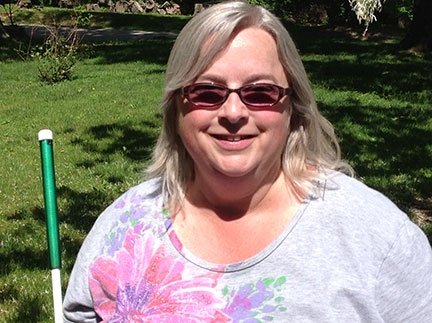 From the Editor: Merry-Noel Chamberlain is a teacher of the visually impaired (TVI) and holds a National Orientation and Mobility Certificate (NOMC) as a travel instructor. Several of her articles on orientation and mobility have appeared in previous issues of Future Reflections. She lives and teaches in Omaha, Nebraska.
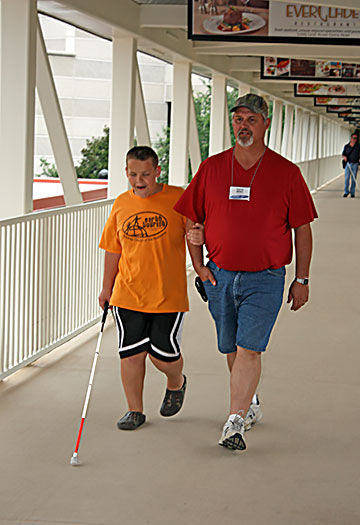
Sighted guide, or human guide, technique is being used when an individual who is blind or visually impaired (the follower) is led by holding the arm, just above the elbow, of another individual (the guide). Years ago most people believed that only persons who have vision can be guides, hence the widely used term "sighted guide." However, as more and more blind people become competent travelers, it is now clear that the guide need not be sighted. Therefore, human guide is a better term. The term guide will be used throughout this article, indicating that the guide may be sighted, blind, or visually impaired.
Two people may choose to maintain contact while traveling for reasons that have nothing to do with guiding. Perhaps both people are unfamiliar with the area, or the area is very congested. For example, two people may decide to maintain contact in order to avoid being separated at Mardi Gras or at a political demonstration.
Sometimes two people may want to walk hand-in-hand because they are a couple or they are very good friends. Children may wish to hold hands when they are hanging out together. A parent, guardian, or preschool teacher may hold the hand of a young child, blind or sighted, on the street or in a crowded shopping mall.
This article focuses mainly on the use of human guide technique with older children and adults. In these situations, the guide is a person who has better travel skills or mental mapping capabilities than the follower.
The Choice to Use a Guide
Some blind people use a guide all the time, some use a guide some of the time, and some never use a guide at all. Perhaps the person who travels with a guide all the time was taught that this was the only safe and reliable method for him to get from place to place. Perhaps she was not introduced to the long white cane until she was in her teens or until she had nearly finished her travel training.
Some instructors unconsciously convey the notion that cane travel is not practical. The instructor may pick up the student at her home, guide her to his vehicle, and drive to the location of the day's lesson. During the lesson, the student may have a simple assignment to complete independently. When the lesson is over, the instructor guides her to his vehicle for the trip back to home base.
Individuals who are taught this way generally feel safer when they travel with a guide. They can become so dependent on the guide that they seldom travel anywhere independently. Some have so little confidence that they will not leave their chair to perform simple tasks outside a familiar environment.
Some individuals may use a guide all the time due to impairments in addition to blindness, such as cognitive limitations. It may be in their best interest to travel with a guide most or all of the time. However, the guide may not need to have constant contact with the individual. For example, a person may be able to travel independently from class to class within one building, but may have trouble traveling from one building to another within the school grounds. Some individuals, regardless of visual impairment or age, may not have the cognitive abilities to know when it is safe to cross a street. A person with visual impairments may travel with a wheelchair due to physical limitations. He may use a guide if he is unable to hold a cane and operate the wheelchair at the same time.
Some blind or visually impaired individuals regard traveling with a guide as an option, depending on the situation. They evaluate the situation and select the method of travel that best fits the circumstances. A person may be quite confident of her independent travel skills, but traveling with a guide may seem her best option due to time constraints.
Some blind people feel that traveling with a guide is strictly against their philosophy of independence. On occasion, these individuals may actually place themselves in dangerous situations. The best independent travelers generally use a guide from time to time.
University O&M Programs
 Students tend to reflect the philosophy of their instructors. Through their actions instructors demonstrate their positive or negative beliefs. Some instructors emphasize teaching students to walk with a guide because that was the focus in their college O&M training.
University programs sometimes focus on guide training from the beginning by having new students wear sleepshades and be led by students without sleepshades. The majority of the training class is spent on teaching travel with a guide, with little time spent on the techniques of the long white cane. The future O&M instructor is taught that individuals who are blind or visually impaired truly cannot travel safely or competently on their own. Instead of teaching confidence in cane travel, this type of training instills new instructors with a fear of traveling without sight. In turn, the new instructors relay this fear to their students.
Teachers of the visually impaired (TVIs) who do not have an O&M endorsement also may influence students to prefer the use of a guide. Sometimes these teachers have had no introduction to O&M beyond a lesson on how to be guides for their students. General education teachers and other professionals in the education system often turn to the TVI for answers about O&M, unaware that there is a distinction between the O&M and TVI professions. The TVI may give a diluted explanation about how to be a guide, much like the telephone game we all played as children. With each explanation, from teacher to paraprofessional to cafeteria worker, the fear grows within the school community and in the blind or visually impaired student.
In some districts where O&M instructors are scarce, a TVI may even be asked to provide O&M instruction from the main classroom to the gym, cafeteria, and other locations within the school. These lessons may do more harm than good. For instance, the TVI may teach the student to find the top of a stairway by feeling with his feet. This improper instruction can lead to increased use of a guide around the school.
On the other hand, some university O&M programs teach that the long white cane is the main tool for independent travel. They view travel with a guide as an extra tool one may select if desired. O&M instructors trained in such programs place high priority on the proper techniques of the long white cane. They provide guide instruction during "teachable moments" when the situation happens to arise. The topic of guide use may be discussed with the student during and/or after the situation transpired.
In this type of O&M lesson, the student learns to meet the instructor at the instructor's office, where they discuss the targeted location of travel. Using the Structured Discovery approach, the student leads the instructor to the chosen location. The instructor is available to provide guidance in problem-solving techniques and proper cane travel skills.
At times it may be necessary for the student and instructor to travel by vehicle to the instruction location. In such cases, the student leads the way to the vehicle, often with some verbal information. When the instructor has a positive attitude about independent travel with the long white cane, the student will, too.
Friends and Strangers as Guides
As a friendship forms, a comfortable understanding can evolve about when the friend may be a guide to the follower. With deep friendship or in the relationship between a parent and child, a natural understanding develops. If the friend or parent senses that he is needed as a guide, he may offer assistance by walking nearby or brushing arms with the follower. The follower can accept the offer by taking the arm, or she may decline by not taking the arm. Parents and children often do this automatically and without awareness of their actions. It is important for the follower not to take advantage of the friendship and treat the friend as a built-in guide. This treatment may harm the friendship, especially if the friend feels obligated to go out of his way in order to provide guidance.
Sometimes a guide may be an acquaintance or stranger, such as a cab driver or store clerk. On these occasions the follower must pay close attention and be especially alert to her surroundings. A short-term guide may not understand the follower's instructions. A stranger may accidentally leave a follower in an unknown location. He may walk the follower into a door frame or fail to inform her about a step. It is in the follower's best interest to use her O&M skills at all times while traveling with a stranger.
How to Teach a Dependent Follower to Be Independent
Teaching the appropriate use of a guide to a student who is dependent on guides is an excellent way for the follower to step into the world of independent travel. The following is a lesson that needs to be overseen by an O&M instructor. As is true with all lessons, students with partial vision need to wear sleepshades.
Guide the student to a specific location where he has never been. Ideally the targeted location is a coffee shop, ice cream parlor, or fast food joint, where the instructor and the student can sit down for discussion and refreshments. The distance to this location depends on the student's O&M skills.
During this part of the travel lesson, maintain a pleasant conversation with lots of questions to help the student lose focus. For more advanced students, include a wrong turn or two and some backtracking. Try a route off the sidewalk, perhaps into a parking lot or onto a patch of grass.
After reaching the destination, have a conversation with the student about the experience. Ask questions about the route you just traveled, but be careful not to provide any clarification. While still under sleepshades, return to the beginning point of this lesson. (This can be done using a guide or taking a different path.)
The student now must walk to the same designated location independently. Be sure to tag along quietly. This task may be somewhat stressful for the student, and some minimal guidance may be necessary. The student may not travel the exact route due to the extra turns. However, the same specific location is the goal.
When the student reaches the destination, praise him for his success. Discuss how long it took him to get there. Discuss landmarks he discovered on this second walk that he didn't notice the first time. Acknowledge the student's growth of knowledge in developing mental mapping skills, such as the route, the terrain, and new obstacles discovered.
Still under sleepshades, return to the beginning location. Have the student lead the way to the final destination again. Discuss the time it took, which will most likely be shorter. Discuss how the student's confidence and pace have improved.
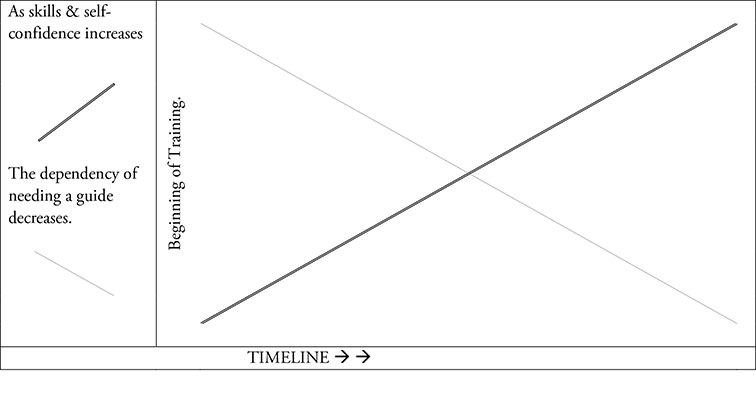
Repeat this sequence three or four more times. With each walk, the travel time will most likely decrease. At the same time the student's self-confidence will grow, especially when he recognizes his own achievement. His dependence upon a guide diminishes. When the student can teach another student the route, the ultimate lesson has been learned.
It is common for a person who is newly blind or visually impaired to depend on using a guide. However, as mobility skills increase, so does the growth of self-confidence. With the growth of self-confidence, the need to use a guide diminishes, as shown in the chart below.
Parents as Guides
As stated earlier, parents and others may prefer to hold the hand of a young child as they travel. However, as the child gets older, such guidance needs to decrease, or else the child will grow up depending on a guide. Young children naturally will be dependent on their parents and older siblings. Later their teachers and friends become their guides. As they reach adulthood, they will turn to their spouse and children as personal guides—that is, unless parents encourage independent travel at a young age.
The transition from having parents as guides to becoming an independent traveler is a slow and lengthy process. Often it is more difficult for the parents than it is for the child, because the parents may have fears for their child's safety. Parents need to remain positive, and they may need to take baby steps themselves.
First of all, parents need to take an active role in their child's O&M instruction. If possible, one parent needs to be present whenever the child receives instruction. It is best for the parent to be within earshot of the lessons so he/she knows what the child has to focus on when traveling with the cane.
Second, parents need to be knowledgeable about the basics of cane travel. They need to understand that the cane is extended out from the belly button, arcing as wide as the child's shoulders. When parents are knowledgeable of the basic techniques, they can encourage the child to use the cane correctly.
Finally, and most importantly, parents need to accept the child's use of the long white cane.
Here are some activities parents can do with their child, beginning at about age five, to help him become an independent traveler:
- Make it automatic to take the cane when leaving home. Just like putting the shoes on, the child needs to take the cane. Let him know that you expect him to remember his cane.
- Encourage the child to walk independently from the house to the car and vice versa.
- When approaching a department store or doctor's office, encourage the child to walk ahead and to find and open the door.
- At a school playground or park, encourage the child to explore as you follow. Gradually widen the distance between you and the child (within reason) to encourage growth in self-confidence.
- Encourage the child to explore ahead on a narrow sidewalk, perhaps up to the front door of a neighbor's house.
- For older children, when going to or leaving a public restroom, tell, rather than show, the child the path.
- At a fast food establishment, ask the child to return to the counter for dessert. Give verbal directions to the counter and back to the table. If the child changes his mind about wanting dessert, don't get it for him.
- On occasion, have your hands full so the child has no choice but to walk independently.
- When walking home from the park, school, or neighbor's house, have the child lead the way as much as possible. Don't make a big deal if the child wants to place his hand on your back or grab your arm from time to time.
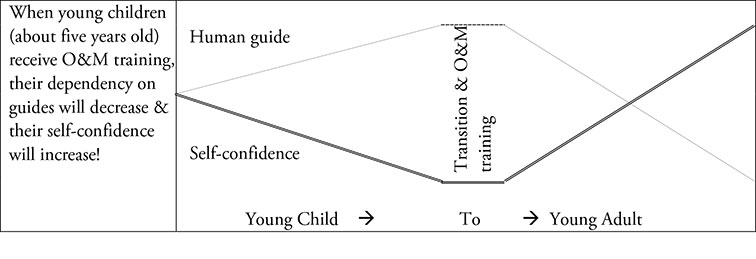
In the beginning parents may notice that the child is very dependent on using a guide. Unless there is a transition period, this dependence will continue throughout adulthood. However, if there is a transition period where the child learns to be an independent traveler, dependence upon a guide will decrease and self-confidence will increase, as shown in the chart below.
Here are some other suggestions to help parents encourage their children to become independent travelers:
- Get involved in local blindness organizations such as the NFB’s National Organization of Parents of Blind Children in your state. Your child will be exposed to positive blind role models.
- Read "The True Story by Owin M," by Merry-Noel Chamberlain, to your child/student.
- Read books involving positive blind role models.
- For more information regarding O&M for children, go to: <http://www.pdrib.com/pages/omcommonquestions.php>
Is There Really, Truly, a Good Time to Use a Guide?
One might suspect that the need to travel with a guide separates beginners from advanced travelers. However, that speculation is incorrect. Whether or not one travels with a guide is not tied to one's ability to travel independently. Rather, it is the given situation that determines whether a guide is necessary or desired. Here are some situations where one may prefer to travel with a guide:
- A follower is at the pool with friends, and the chairs and towels are several feet from the edge of the pool. The area is crowded with other swimmers. The follower may need assistance to and from the edge of the pool. Also, the follower may need assistance to the diving board.
- In the water, a follower may use a guide to remain oriented. Walking in the pool is not the same as walking on land. The follower and guide may develop their own method of travel.
- A follower needs to go to the restroom ASAP.
- There is an emergency for the individual and/or for everyone, such as a fire or an earthquake.
- Time is of the essence, such as running to the boarding gate at the airport to avoid missing the plane.
- The restaurant is crowded, and the path to the selected table involves several twists and turns.
- The situation feels uncomfortable or unsafe to the follower.
- The follower's cane has broken.
- The follower's guide dog or cane are unavailable.
- The follower feels uneasy about the terrain, such as a steep incline to a boat dock or a rocky trail.
It can be a nice gesture for the guide to offer visual insight regarding the surroundings about to be traveled. It is the follower, however, who makes the final decision whether or not a guide is needed. If the situation involves impending danger, the guide may need to give the follower a quick, urgent explanation. Under extreme circumstances, the guide may make it clear that immediate action must be taken; an explanation will be forthcoming.
What Skills Are Necessary for Using a Guide?
Above all, when walking with a guide, the follower needs to continue using the cane as if he were traveling independently. With the cane he may pick up tactual and/or auditory information about which the guide may be unaware. The use of the cane helps to ensure the follower's safety.
The follower needs to make a mental map of her surroundings. It is important that she note turns; remember sounds such as echoes, traffic, and fountains; and pay attention to changes in terrain such as inclines and textures. She may ask the guide the names of the streets they cross. On the next visit, she will be able to travel to the targeted location with more confidence and less assistance.
Followers need to maintain focus when traveling. When the follower allows his mind to drift and permits himself to be dependent on the guide, he may be left totally disoriented in an unknown location, without the ability to return independently. This may even occur when the follower and guide become engrossed in a conversation. Although instructors may highly recommend that the follower maintain focus upon his surroundings, it is easy for him to abandon this safety practice because using a guide is so easy.
The follower needs to know where to hold the arm of his guide (in general, just above the elbow). If the guide is much shorter than the follower, the follower may place a hand on the shoulder of the guide. If the guide is considerably taller than the follower, the follower may hold the guide's arm just under the elbow. The follower must insist on taking the guide's elbow rather than the other way around. This permits the follower to be in control of the situation. The follower can let go whenever she decides to do so. If the guide takes the elbow of the follower, the guide is in total control of the situation and the follower is not easily able to escape should she become uncomfortable or feel that she is unable to use her cane. When this happens, the follower can politely take the guide's hand off her elbow and take the proper location a half step behind the guide. She can explain politely that by walking this way, she is able to follow better. This also allows the follower to be in charge of her own safety, thus relieving the guide of this responsibility.
Followers need to be aware that most guides are members of the general public. Mainly they are concerned with not walking the follower into obstacles such as door frames or parking meters. The follower may need to train the guide as to what works best for her in a particular situation.
It is always important for the follower to thank the guide when the final destination has been reached. All too often, the guide is forgotten once the desired outcome has been accomplished. Even a close friend wants his help to be acknowledged and appreciated.
Classmates as Guides
Unless there is an emergency, it is absolutely not okay for a student to use a classmate as a guide. The student who is visually impaired or blind needs to be able to travel independently using a long white cane. Dependence upon one or two other children as guides can place an undue burden upon those children and interfere with the natural development of friendships.
In an emergency or drill at school, the use of a guide sometimes might be necessary. It may be helpful for an O&M instructor to visit the child's classroom and discuss the basics of human guide techniques with the students. That way, if the follower happens to grab an elbow in an emergency such as a fire or tornado, the unofficial appointed guide will not be startled. Together the classmates can move to the assigned location.
Final Thoughts
A blind gentleman walked up to an intersection and asked the nearest pedestrian for assistance in crossing the street. The pedestrian agreed to help, and the blind man automatically took the pedestrian's arm. When it was time to cross the street, they both began to walk. Only then did the follower hear the long white cane of the helpful pedestrian. Safely they both reached the other side of the street.
Did the blind follower believe that only sighted pedestrians can be guides? Who knows! The point is that he lacked the necessary skills to cross the street independently. He depended on a guide for safe travel. The pedestrian with the cane had the confidence and skills to cross the street independently.
Regardless of how much orientation and mobility training one receives, one may sometimes find oneself in a situation when using a guide would be safer or more convenient than going it alone. Be not afraid to use a guide! Just be careful not to become totally dependent on a guide for travel. One may slowly build a brick wall around oneself, leaving only one exit—the assistance of a guide.
One is not limited to using a guide all the time or none of the time. Instead, it is wise to use a guide some of the time. It is up to the individual to know when the time is right.
Be adventurous. Travel beyond your accustomed boundaries. Isn't it more exciting to travel beyond the walls than to be restrained by them? Travel on!
RESOURCES
Chamberlain, Merry-Noel. The True Story of Owin M. <http://www.pdrib.com/pages/omkids.php>
Louisiana Tech University: <http://www.pdrib.com/pages/orientationandmobility.php>
National Organization of Parents of Blind Children (NOPBC): <https://nfb.org/nopbc-brochure>
Recommended children's books: <http://www.pdrib.com/pages/omrecommendedreading.php>
Media Share
