The Benefits of Immersion Training
by Joanne Gabias
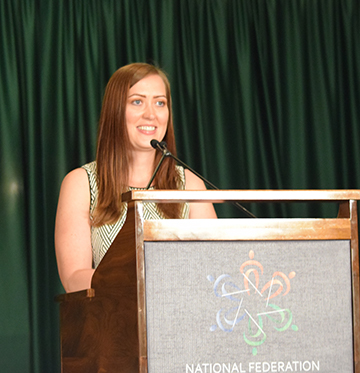 From the Editor: Joanne has written several articles for the Braille Monitor, and her speech about growing up as a child of blind parents was a convention highlight in 2018. Here is what she has to say about the benefits of immersion training, the pluses and minuses that spring from living with people who already had perfected their blindness skills, and the fears of a father who worried about his daughter going out into the world. Enjoy what Joanne has to say:
“What if you go to Louisiana and figure out that you don’t actually want to be an O&M?” These were the words of a worried father who was not ready to let his little girl move to another country and 2,365 miles away from her family.
I knew there was a chance that this career path was not going to be for me, but I knew either way I needed to go and figure it out on my own. With the help of my best friend and her boyfriend, like a life-sized game of Tetris, we packed all of my belongings into my Mini Cooper along with my mattress topper! I set off on the road with my little brother who graciously offered to keep me company along the drive to start this new life path. Although I have travelled all over the US and Canada as well as France, Mexico, and Guatemala, my home address had always been in Kelowna, British Columbia, Canada. For the first time ever, I was going to be completely on my own. For those of you who are reading this, you may or may not know, but when you are part of the Federation Family, you are never truly alone.
Ruston, Louisiana, is the home of the Louisiana Center for the Blind (LCB) and the Professional Development and Research Institute on Blindness (PDRIB) at Louisiana Tech University. These two world-class institutions’ missions are to change what it means to be blind. At LCB, this means training blind people in the skills of blindness so that they can be successful in their personal lives and in their professional careers. At PDRIB, they train individuals seeking careers in the field of blindness to have the proper skills and philosophy to be able to empower blind people and give them the tools for success.
Ruston is a town very different from anything I had ever experienced. It is a small town in the Bible Belt with deep Southern roots and a lot of history. One of my favorite movies growing up was Gone with the Wind. I always thought that it was so different from anything I would ever experience, but when I went to Ruston, I felt like I was in a modern-day Gone with the Wind when it came to culture, tradition, and accent. I almost felt like I went through a time machine! The town I grew up in is very modern, nicknamed “Kelownafornia” because it is like the California of Canada with the beaches, tourists, golfing, and wineries. This might not be important to many people, but when you hear of a college town, you might think of Penn State or NYU. When you think of Louisiana, you might think of New Orleans or Mardi Gras. If those are your expectations of Ruston, you will feel extremely deceived. Many modern things have come to Ruston since I left, but I remember the biggest new thing when I was there was getting a Dairy Queen!
Since I got my undergraduate degree in anthropology, I was excited to get the opportunity to experience a new culture, but this is not why I moved to Ruston. I had decided that if I was going to have to move away from my hometown and my family, I wanted to go to the best program for training orientation and mobility instructors out there. This world-class program just happens to be in Ruston at the Professional Development and Research Institute on Blindness at Louisiana Tech University. I really don’t think the faculty, students, staff, or even the community really realizes what an amazing gem they have at their university. Because of this program, I was given the opportunity to go through three months of immersion training at the Louisiana Center for the Blind, another world-class gem in Ruston. This opportunity is something that some blind people fight for years to receive.
I knew that the skills that they teach at LCB were not difficult. I watched my parents read Braille, use the Jaws screen-reading software, travel around the country with four children, take care of a home, and work fulltime. There was never a doubt in my mind that these skills were attainable. I guess I was at somewhat of an advantage because most students who come to training do not always believe in the capabilities of blind people or at least their own capabilities as a blind person. I was ahead of the curve in that sense.
My difficulty was that I put unrealistic pressure on myself. It took me a long time to get open palm. [Open palm is a cane technique in which the handle of the cane lies in the palm and the cane is moved left and right by the fingers and not the wrist.] I don’t think I ever used my hands like that ever! My hands were weak. I spent my first six hours of O&M class just doing open palm. I remember thinking that “I don’t know if I can ever be a cane travel instructor since I can’t even hold the cane properly.” Reflecting a bit, I don’t think I was that bad, but I believe that my instructor, Marco Carranza, wanted to grill me. If I was going to be an instructor, I had to master everything. He wasn’t only teaching me, but he was teaching all my future students. I will forever be thankful for these trials that he put me through because I would not be the instructor I am today if he didn’t push me personally to be the best traveler I could be.
My instructor also helped me realize that mastery takes time, and it is okay to struggle. When I finally made it outside, I was tasked to walk from the corner of Trenton and Railroad east to the corner of Vienna and Railroad and back. I am a perfectionist, so after letting myself practice the first couple of times, I was no longer happy with my progress. Why am I struggling to walk up and down a sidewalk? I have watched my parents gracefully walk my whole life, and here I am, stumbling around like a drunk person. My instructor noticed my frustration and finally stopped me. He said, “I know you have known blind people your whole life. How long do you think they have been working on their skills?” Well, my parents didn’t get their canes until they were in their late teens because, even though they were totally blind since birth, back then you didn’t give canes to kids or even teenagers until they were “responsible” enough to use them. That being said, they had been using a cane for at least a good twenty years before I came along. Then he asked me how long I had been using a cane? At that point I had only been at the center for two weeks. He said, “How can you expect yourself to be as good as me or your parents in just two weeks? Give yourself time to learn.” After that conversation, not only did I let myself learn, experience, and struggle. I gave myself the permission to thrive!
The next class in which I probably learned the most was in home management. I had already learned how to cook and clean from my mother, so I didn’t really learn many new skills or techniques. But I did learn a lot about the individuality of students and how much your life experiences can affect you. My first day in the kitchen was also the first day that Arlene Hill started teaching kitchen after retiring from decades of teaching travel. We worked together to learn the layout of the kitchen. Arlene did not like how the kitchen was organized and decided that, together with the students, we would organize it in a way that seemed to function better. This taught me that you do not always have to keep the status quo and that you can always make adjustments for the betterment of everyone. As an instructor, you learn the skills and techniques that are to be taught to the students, but you have to make those your own, and give yourself the opportunity to be the best teacher you can be. If students could learn just from a textbook, we wouldn’t need instructors. The instructor’s individuality, dedication, and problem-solving skills are just as important as the skills themselves.
There is always this misconception that visual skills are superior to non-visual skills. This is always expressed by students in home management class, especially if they used to cook before losing their vision. I remember one day Ms. Arlene told me “Okay, I am going to teach you the non-visual way of doing X.” I can’t even remember what it was. All I can remember was my response.
“That is the way I have always done it. What is the visual way of doing it?” Everything I learned to do in the kitchen was from my mother. My mother only knows how to check things non-visually, so this is the way she taught me. I never knew there was any other way. We never talked about the visual or non-visual way of doing things. It was just the way to function in the kitchen. These skills will be what I teach my future children. They have always been efficient for me, and in the end, efficiency is all that matters, no matter if it is visual or non-visual.
In Braille, to be frank, I was always exhausted. I usually had it at the end of the day after all of my other classes, so it was really hard for me to stay alert. My sole interest in Braille at the time of my immersion was to be able to discern all the Braille that was in my parents’ house. I always thought that, when my parents passed away, I would have to hire a Braille reader to come and help me sort through all of it to settle their estate. I couldn’t tell the difference between my dad’s lecture notes, a recipe book, or a love letter. My parents never taught us kids Braille because they were so concerned to teach us print. My grandmother was not happy that my father married a blind woman because she thought that their kids would not learn to do things visually. This is an obnoxious thought since no one teaches people how to use vision unless you are already blind and people are trying to make you use your unreliable vision. Nevertheless, my parents focused on teaching us print. I thought Braille was cool, but I never thought to learn it myself while growing up. You would think that I would’ve learned at least how to read my own name so I could figure out which presents from Santa were for me. Instead, until I went to LCB as a graduate student, I would always shove the present into my parents’ hands saying “what does this one say?”
I wish I had focused more on Braille during immersion because, immediately after I finished my immersion training, I was informed that Louisiana Tech was going to start the rehab teaching program, and I could get dual certified, which I decided to do. If I had focused more during training, I wouldn’t have had to work as hard to learn the whole Braille code in nine weeks during the Braille 1 course while taking two other graduate level classes and teaching orientation and mobility during the day. This really taught me never to take any opportunity for granted because you never know when it will be useful to you.
I remember my first day of computers so vividly. My instructor, Jewels, wanted me to set up my account to be able to access the computer. I turned it on, and JAWS started talking. Jewels asked me a very simple question that I know is the bane of every student’s existence in computer class: “What did JAWS say?” I had been hearing JAWS for as long as we have had a computer in our home. To me, JAWS is the most annoying sound, and I literally taught myself to tune it out. My friends would assume that my mother was listening to her JAWS in French because it was so fast that it was not discernable to the untrained ear. I told my instructor, “I have no idea what it said; I have literally spent my whole life trying to ignore JAWS.” It took me some time to train myself to pay attention to what it was telling me, but I am so happy I did. I wish I had learned to use screen readers in college. I have never been a fast reader, and because I worked full-time while going to school full-time, by the time I sat down to read all the chapters and articles I needed, I was so exhausted that I would fall asleep with my book as a pillow. I would’ve saved so much time and energy as an undergrad if I had learned to use it. To this day, if I get a long email, I usually turn on VoiceOver on my phone to read it because I can read it ten times faster than if I do it visually. I would like to note that I have 20/15 vision, which is above average, but even though it is so good, this non-visual technique is far superior in my life experience.
The class that most people do not understand is industrial arts or shop class. Its functionality especially eludes VR counselors who don’t see its utility and just want students to get job skills. In this class you learn to use power tools and do everything from building something to taking on a bit of home maintenance. Creating something from nothing is such a powerful experience. I had never used power tools or done any type of woodworking before. But the perfectionist in me loved the precision required in using these tools to make things. I loved the fact that it was not only my hands but my mind that created the beautiful Braille blocks that I still have to this day. I have kept every single one of them. This class let me just focus on the task at hand and made me forget about everything else that was happening outside of that moment. As in travel, you have to remain focused.
I did not get to do a final project like most students get to do in their nine- month program, but I was determined to finish all my Braille blocks before the end of my immersion because I wanted to learn the home maintenance piece. My dad has always been of the mindset that you should make enough money that you can pay someone to deal with your maintenance needs. I have always been of the mindset that I want to know how things work, and then I can choose whether or not I want to do it on my own. In my opinion, the lack of knowledge is your worst enemy because it deprives you of choice. Even if you don’t want to do it yourself, you need to make sure that you know enough to know when someone is cheating you. Unfortunately, in this world people pray on the naïve. I am a natural blonde, and the thing I hate most in life are dumb blonde jokes. I even dyed my hair for almost ten years dark brown so that I was not associated with the misconceptions about blondes. In the last year or so, I returned to my natural color. After years of telling my students that the misconceptions about blindness do not have to define you, I realized I was being a hypocrite and needed to own my blonde because blonde does not define me. Also, it was way less maintenance to keep it natural than trying to fake it.
This leads into the last class at LCB, which they call Seminar. Some places call it Business Class; where I work we call it the Positive Philosophy of Blindness Class or Philosophy for short. No matter what you call it, this is the class that really works to get at the root of everything, especially the misconceptions about blindness.
Growing up with competent, independent blind people, I never held the misconceptions about blind people that are all too common. I had to deal with other people’s misconceptions, but I had already lived the truth about blindness every day, so people couldn’t tell me blind people can’t cook when my mom made me my school lunch every day until the day I graduated from high school. People couldn’t tell me that blind people can’t be successful when my dad was a university professor, on the board of trustees for the provincial French school board, and recipient of an honorary doctorate for his advocacy efforts for blind Canadians. This class was extremely interesting for me because it gave me an opportunity to connect with people who did not live through the same life experiences as I have and who were struggling with their blindness or struggling with getting their family or society to accept their blindness. I think this class isn’t only about listening to the subject matter, but the power of this class is to listen to the other students and staff members for their thoughts on the topic at hand. I think we have power in numbers, and being able to talk about the issues of the day, of society, or of the blindness community is so important for the emotional adjustment to blindness. Students might start off as the ones who need to be mentored, but throughout the program the students start becoming mentors to each other.
I am not going to tell you that everything was easy for me. I had my fair share of struggles. A few times my dad said, “why are you putting up with this? Just come home!” First off, I am not a quitter. But, more importantly, the skills I was learning during training were not simply to become a good O&M instructor; they were helping me become a better human being. I was learning how to think critically about situations in ways that I had never done before. I was learning problem-solving skills that I use in my personal life every single day. I was learning how to gather information, filter information, and advocate for what I needed. These skills are not limited only to the blind who want to succeed. These are the skills that all successful people possess. These are skills that I think everyone should gain. Before I went to training, while I was in training, and even to this day, I think that every single person should go through the training that is offered at LCB whether you are sighted or blind because the skills that you learn are the skills to help you succeed at life; the blindness part is just an added bonus.
It has been over seven years since I went to LCB for my immersion training. Currently, I am the deputy operations officer at Southern Arizona Association for the Visually Impaired Services for the Blind in Arizona. I often think back on my experiences during my immersion. These experiences have made me a better teacher, a better mentor, and a better staff trainer. Professionally, the experience was crucial to my success and to the success of my future students. I know so many people who think they want to go into the field of blindness. But when they realize they must move to Ruston for fifteen months to get their graduate degree, they have a tendency to change their mind. Ruston is not the hip town of Los Angeles or fast-paced like New York City. There are not a lot of shopping options, but you have a lot of options when choosing a church. Public transportation is lacking, but the variety of the food you can get is slowly improving. Now I must tell you that if these are the requirements for you to go into the blindness field, choose another profession. But, if working with the blind as a teacher of blind students, a rehabilitation teacher, or an orientation and mobility instructor is your goal, you could not find a better program to help you become the best teacher you can be. None exists anywhere else in the world.