The #NFB25 Convention Roundup
by Chris Danielsen
Introduction
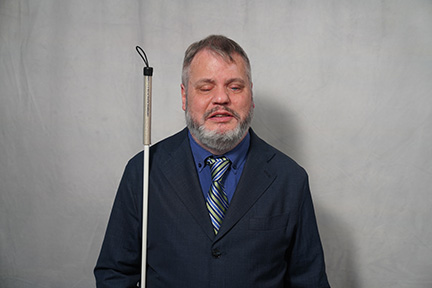 New Orleans, as both a convention site and a city, has a special place in my heart. The very first national convention I attended was held there in 1991. I was twenty years old and had been selected as a finalist in our scholarship program. I have never forgotten then-President Dr. Marc Maurer’s banquet address, “Reflecting the Flame.” As I have often related, the convention also planted the seed for one of the most transformative decisions of my life: to seek training at the Louisiana Center for the Blind. If the convention itself did not draw me irresistibly into our movement forever, my training at LCB completed the process, and I have never looked back.
Since that first convention, I have only missed one of our annual national gatherings: the 1996 Convention in Anaheim, when I thought it would be wise to hunker down at home and continue studying for the South Carolina bar examination, which I passed later that year. That was the first convention attended by Mark Riccobono, now our national President, whom I would not meet until a few years later. This made our 2025 gathering in New Orleans my thirty-fourth convention and his thirtieth. We both attended the 1997 New Orleans Convention but did not meet there.
It is not just about me, or even our President, of course; it is about all of us in the movement. Like other conventions in the Big Easy, the 1997 gathering was historic. To date, the attendance record of that convention, over 3,300 registrants, has not been exceeded, although we hope it will be yet. It was also historic and memorable for Dr. Kenneth Jernigan’s final banquet address to our movement, “The Day After Civil Rights.” Forty years earlier, at the 1957 National Convention in this same city, Dr. Jacobus tenBroek had delivered not one but two seminal addresses: his rousing defense of our right to organize and his classic banquet address “The Cross of Blindness.” He proudly announced in the former the introduction of Senator John F. Kennedy’s legislation to protect our right to organize, along with a companion House bill. Though neither passed, their introduction paved the way for the ultimate vindication of that right. “The Cross of Blindness,” which addressed the many forms of discrimination the blind faced at the time, some of which are virtually nonexistent today, stands as a reminder of how far we have come, and Dr. Jernigan’s 1997 speech celebrated that progress and suggested that our movement was entering a new phase, “the day after civil rights” of his title. In that speech, he told us that we must not simply lean on our minority status and our legal rights in our quest for equality but become people who not only demand but deserve equal dignity and respect. Almost thirty years after that address, we frame that sentiment as raising the expectations of the blind, both society’s and our own.
One more New Orleans convention took place before the one described below. In 2022, the Federation and the rest of the world were tentatively emerging from the prolonged isolation of a historic global pandemic. Because of that pandemic, we had, for the first time in our history, conducted two conventions entirely online, proving once again that we, as a movement, can meet any challenge. The 2022 Convention passed an amendment to our constitution that formalized our new Code of Conduct and its attendant expectations and procedures, a historic move that helps guarantee the dignity and safety of everyone in and around our organization. And because we had not been together in person for three years, new and joyous memories were made as we once again reveled in each other’s company. New Orleans became, more even than in years past, a place of reunion and rejuvenation. We did not know it then, but one more New Orleans convention awaited us this decade.
That convention began on July 8, 2025. It was also destined to be historic, if for no other reason than that our movement faces unprecedented challenges as our nation’s rehabilitation, civil rights, and other government policies are being reconsidered and face retrenchment. At the same time, there were many signs of hope for a brighter future and plenty of evidence of our movement’s continued progress as well. For the first time, the Access Board, an independent federal agency that advises the government on accessibility, held a town hall meeting and breakout sessions as part of our convention, and we were visited by the highest federal official handling Social Security matters.
The observations below are only a sketch of the full convention based on my own participation and observations as well as some provided by others. We can always use more stories to create a fuller picture of the convention, so I cordially invite everyone to continue sending convention-related items directly to me at [email protected] or to [email protected].
.jpg)
Seminar Day and Resolutions Day: The Convention Begins
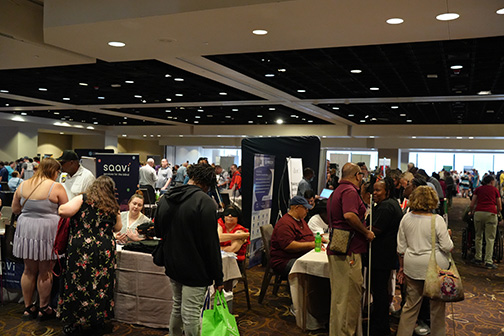
The first day of any national convention is in many ways a day of preparation, with attendees just arriving and exploring the convention site. This year was no exception. Registration opened for the first time, so that attendees could register in person if they had not already done so online or pick up their badges and banquet tickets if they had. The convention Ambassadors Committee, which facilitates efficient movement and navigation through its members’ invaluable service as “talking signs” and helps with innumerable other convention logistics, met early in the morning, as did the Amateur Radio Group, by longstanding tradition, to prepare for emergencies and for its task of distributing assistive listening devices for deafblind members and those who desire Spanish interpretation. The Federation’s DeafBlind Division held a training for support service providers (SSPs) who would not only interpret for deafblind members throughout the convention but also provide them with information about the convention environment. Behind the scenes, our exhibitors and the National Federation of the Blind Independence Market set up shop in the Napoleon Ballroom, located at the New Orleans Sheraton across Canal Street from the headquarters hotel, the New Orleans Marriott. Your correspondent was helping with the task of setting up our free literature area just outside this Exhibit Hall, refreshed for this year with the name “Federation Free Reads.”
This does not mean there was nothing to do when one was not preoccupied with hotel check-in, registration, convention preparation, or just grabbing a quick taste of New Orleans before things really ramped up. Day one of convention is also known as Seminar Day. As the name implies, it featured daylong seminars by the National Organization of Parents of Blind Children (NOPBC), one of our most active divisions, and the National Blindness Professional Certification Board (NBPCB), which is an entity separate from the Federation but one created at our urging and with our assistance to improve rehabilitation for blind people through Structured Discovery and to implement certification standards and procedures that do not discriminate against blind instructors and other professionals.
This year, the parents’ division designated their gathering an Educate Seminar. The numerous breakout sessions included a workshop on the basics of the Individualized Education Plan (IEP) and the process of creating and implementing it, the need for parents to ensure that blind children are engaging in age-appropriate activities and chores, a workshop on helping blind kids recognize and interpret nonvisual social cues, and one intriguingly titled “Don’t Bubble-Wrap Your Child.” In addition to their seminar, the NOPBC kicked off their week-long set of “Youth Track” activities designed for young people too old for NFB Camp. Youth Track includes activities and discussions focused on navigating blindness as a tween, teen, or young adult.
Meanwhile, the Professional Certification Board held its twenty-fourth annual “Contemporary Issues in Rehabilitation and Education of the Blind Conference.” This was both an educational seminar and an opportunity for blind rehabilitation professionals to network and share experiences. Like other activities of the board, it was designed to further inculcate and advance the principles of the Structured Discovery methods of blindness skills training and to emphasize the competence of blind people to teach these skills to each other.
The National Federation of the Blind Center of Excellence in Nonvisual Accessibility was also busy conducting workshops, including an update on the latest developments in artificial intelligence (AI) that could benefit blind people and a comparison of the accessibility features of Apple and Android devices. Attendees could also visit sessions held by some of our sponsors, including technology companies like Vispero and HumanWare, touting their latest device and software features. The American Printing House demonstrated the newest and anticipated features of the Monarch multi-line Braille and tactile graphics display, including improvements to its chess game and an app that displays and allows interaction with the Periodic Table of Elements.
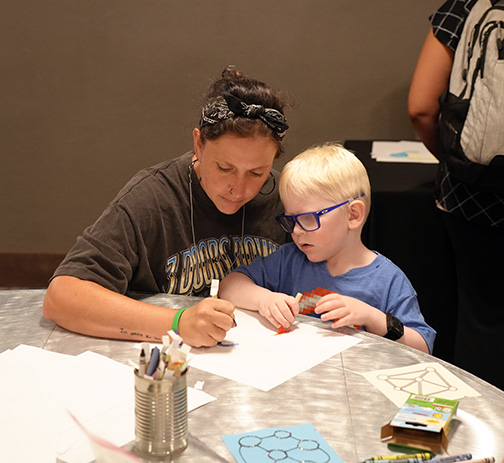
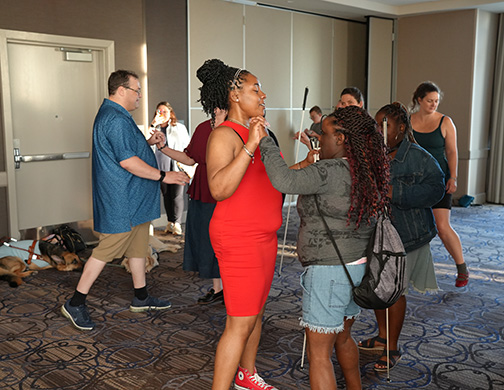 Some committees and divisions were already active, although most would hold their business meetings later in the week. As just a few examples, the National Association of Guide Dog Users (NAGDU), the DeafBlind Division, the Seniors Division, and the Sports and Recreation Division all held seminars or activities. For the first of two days, a “drop-in art room,” facilitated by Anne Cunningham of the Colorado Center for the Blind, was available for folks to stop by and try their hand at various arts and crafts with a focus on nonvisual techniques.
The day concluded for many with the Rookie Roundup, a lively gathering for first-time convention attendees, and many others who just want an early dose of excitement and a preview of what is to come. Hosted by Federation leaders and members of the National Federation of the Blind Jernigan Fund Committee, which provides sponsorships to first-time conventioneers, this popular event was designed to build anticipation for the week and provide first-timers with practical advice on how to wisely plan their convention time, save what money they could, navigate the historic French Quarter (where our hotels were located) and the rest of New Orleans if they desired, and otherwise take full advantage of their first convention experience. Emceed by Pam Allen, who wears more hats than Dr. Seuss’s Bartholomew Cubbins during convention, the event featured presentations from across the movement. President Riccobono kicked things off and presented Pam with a new elephant to add to her collection. The full significance of this particular elephant, whom Pam named Calliope, became apparent later in the convention. The event was capped off by rousing remarks from Immediate Past President Dr. Marc Maurer, with a warm follow-up by Pat Maurer, the immediate past first lady.
Wednesday morning, July 9, brought the first opening of the Exhibit Hall and Independence Market, as well as the second day of registration. Today, Resolutions Day, also began with a historic first: the US Access Board held its annual town hall meeting as part of the convention. The Access Board holds such a meeting in a city other than its home of Washington, DC, each year, but this was the first time to our knowledge that one of its town halls was held in conjunction with our convention, or that of any disability organization, for that matter. A representative from the office of Louisiana Governor Jeff Landry was on hand and read a statement from Governor Landry himself. New Orleans Mayor LaToya Cantrell attended, along with the city’s disability coordinator. The gathering broke little news, as it was primarily a listening session, but members of the Federation along with residents shared feedback and concerns with the board members and staff. Some of the presentations from residents were particularly poignant; one individual said, their voice breaking with emotion, that they were reluctantly moving out of the city because of its slow progress on becoming disability-friendly, particularly in the areas of public transportation and maintenance of navigable sidewalks. Members and staff of the Access Board remained on hand throughout the week conducting various breakout sessions to familiarize convention attendees with its existing accessibility regulations, recommendations, and standards, as well as to receive more feedback.
The Access Board town hall was the first official convention event to be featured as part of the #NFB25 Virtual Experience, which shared more exclusive content and general sessions of the convention throughout the week. Each meeting or session that was streamed as part of the Virtual Experience included a “pre-show” hosted by the co-hosts of the Nation’s Blind Podcastor other helpers.
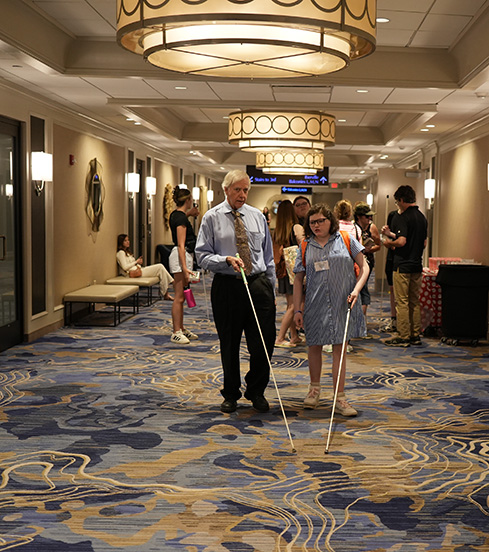 Another event that took place Wednesday morning was the annual White Cane Walk sponsored by the NOPBC. This is an opportunity for children who have never used a white cane before, and their families, to find out more about this powerful tool. The children are taught by certified cane travel instructors employing the Structured Discovery methodology. Canes and “learning shades,” otherwise known as sleep shades, are provided, but this year the event was so popular that the division reported running out of canes. Ramona Walhof, a longtime leader in our movement, told the Monitor that she followed a young blind girl from Arkansas and her grandmother. The little girl, whom we will call Sandy, mastered basic cane technique, as well as going up and down stairs and using an escalator, in a single hour. Sandy’s grandmother was too anxious to watch the stair and escalator exercises, but Sandy was quite pleased with herself; when asked to grade her efforts, she awarded a B plus. This is just one anecdote, but it illustrates the joy that kids experience when they get a taste of the independence that the white cane offers.
Members could also use Wednesday to attend more sponsor sessions, learn more about NFB-NEWSLINE® at its “open house” gatherings (including the service’s long-awaited and brand-new Android app), or participate in more “Youth Track” activities.
As the day’s “convention name” indicates, Wednesday afternoon brought the meeting of the Resolutions Committee, which is tasked with considering policy proposals put forth by members and recommending whether the full convention should also consider them. This meeting is always well attended, and we share it as part of the Virtual Experience so that those who cannot attend convention in person can see the democratic process in action and, if they desire, share their opinions about the resolutions on which the convention will vote with their in-person delegates via email or phone before the floor votes later in the week. Although the audience is usually packed, only committee members and resolution proponents speak at the committee meeting. (A proponent is simply someone who speaks in favor of the resolution, often its author or someone else with knowledge of or interest in its subject matter.) If the committee recommends that a resolution be considered on the floor of the full convention, then other members may speak for or against it at that time. The committee this year considered twenty-two proposed resolutions and voted to send all but one to the full convention for its consideration. As President Riccobono reminded everyone at the beginning of the meeting, the failure of a resolution, either in committee or on the convention floor, does not signify that the Federation is adopting the polar opposite of the policy proposed in the resolution; it simply means that the Federation has not adopted the proposal and consequently, for the time being, either has no official policy at all or still has its past policy if one exists.
A priority of our movement is to increase the employment of blind people, and our Employment Committee is dedicated to that mission. Wednesday afternoon brought one of its most important events, the annual convention Career Fair. A report about this event and the other convention activities of the Employment Committee appears later in these pages.
The latter part of the afternoon featured the annual mock trial presented by and benefitting the National Association of Blind Lawyers, always a popular attraction. The lawyers’ division would like for you to know that recordings of past mock trials are available from their website to support the Scott C. LaBarre Equality and Justice Fund, named in honor of the division’s longtime president, a fierce but cheerful warrior who fought for the rights of blind people of all ages until his untimely death in 2023. You can find the recordings for sale at https://blindlawyers.net. The afternoon also brought more division and committee meetings, as well as sponsor sessions from Selvas BLV (formerly HIMS), Microsoft, Google, and more. Your correspondent dropped by a meeting focusing on accessibility improvements at Amazon Prime Video and a demonstration of Aira’s new AI visual interpreter, which is in a “trusted tester” phase but was shown to session attendees by Everette Bacon, Aira’s vice president of initiatives. The rollout of this beta was discussed on a recent episode of the Access On podcast, which was summarized in the July 2025 issue of this magazine. Speaking of that podcast, one of the evening’s activities was a live episode, with attendees able to participate and ask questions of the Center for Excellence in Nonvisual Accessibility staff and others. The recording of this event is now available as an Access On podcast episode. Several groups of Federationists organized around religion, including the National Federation of the Blind in Judaism and the movement’s Christians and Muslims groups, held meetings as well.
The evening also featured many affiliate caucuses, in which members of state and territorial affiliates gather to discuss convention logistics and issues. Some delegates used these caucuses to discuss the resolutions that had been recommended by the committee. Other caucus activities included the planning of convention drawings and other fundraisers that affiliates use to help raise money for their programs and activities. Banquet tickets were collected for affiliate members who wished to sit together at the convention’s finale. These generic banquet tickets would later be exchanged for tickets with specific assigned table numbers.
The National Association of Blind Students, another of our most active divisions and a historic breeding ground for future Federation leadership, met on Wednesday evening. This meeting was the first opportunity for the thirty National Federation of the Blind scholarship finalists to introduce themselves to members of their Federation family; they would have their second opportunity the next morning. The students also heard other presentations and conducted elections and other business.
The evening also included the first of two “legal office hours” sessions, which were an opportunity for Federationists who have experienced discrimination or other legal issues to speak directly with Federation-affiliated attorneys. Demand for such consultations is always high, so preregistration was required before convention. In 2024, a young woman from California named Mary Azatyan-Witmeyer participated in such a consultation; her story of ultimate victory over low expectations and legal barriers is recounted in the July 2025 issue of this magazine and featured in the Presidential Report that follows this article.
Board Meeting Day and More Division Meetings
Thursday morning was the time for the public meeting of the National Federation of the Blind Board of Directors that takes place at each convention. While some business is conducted at this meeting, it is primarily an initial general session in which many committee reports are received and various convention logistics are announced, sometimes including the locations of future conventions. One of the committee reports is the much-anticipated presentation of the Scholarship Committee, whose chair introduces the thirty finalists who will receive recognition at the convention banquet. The board meeting also sets the stage for the elections that will take place as part of the business session later in the convention.
President Mark Riccobono gaveled the meeting to order at precisely nine o’clock and called the roll. All seventeen board members were present. The President then asked us to remember the members of our Federation family whom we have lost in the past year. He read a list of many names but also urged us to remember those whose names he did not read because he had not received word of their passing. He then led us in the Pledge of Allegiance and the Federation Pledge. After calling on all participating in the convention to maintain a safe, respectful, and helpful environment and to be courteous to guest speakers even in the face of disagreements, the President read the names of those board members currently holding the positions that were up for election this year. Those individuals were Jessica Beecham of Colorado, Marci Carpenter of Washington, Marilyn Green of Illinois, Tom Page of Kansas, Grace Pires of Rhode Island, and Tracy Soforenko of Virginia. None of them declined to seek re-election. The five constitutional officers, including President Riccobono, will be up for election next year, as well as the positions currently held by Shawn Callaway of the District of Columbia, Ben Dallin of Wisconsin, Jim Marks of Montana, Donald Porterfield of Arizona, Jamie Richey of Nebraska, and Shelia Wright of Missouri.
President Riccobono then introduced Pam Allen, in her roles as host affiliate president and host committee chair, to welcome us to New Orleans. Pam presented the President with some New Orleans-themed gifts; thanked her affiliate for its work to prepare for the convention and provide hospitality; and warmly welcomed us all to the Crescent City, another of New Orleans’ many nicknames deriving from its position at a bend of the mighty Mississippi River. The affiliate had arranged an evening riverboat cruise on the Creole Queen, so Pam reminded those planning to attend the Friday-night event of the arrangements so that they were sure to be on the boat.
Following Pam’s presentation, President Riccobono, with the assistance of the amazing convention chair John Berggren and Dan Burke, the cochair of the Ambassadors Committee, shared various convention logistics. (Corbb O’Connor, the other cochair of the Ambassadors Committee, received the blessing of a kidney transplant just prior to convention and stayed home to recover from the procedure. Dan and others told him he was missed and wished him well throughout the convention.) Many of the announcements John and Dan shared concerned in-person participation during the week, so they are no longer applicable. However, a few things of which readers will want to be aware follow: There were both a focus group and an exhibit related to the forthcoming Museum of the Blind People’s Movement during the convention. You can find out more about the museum and some of its planned exhibits by visiting https://museum.nfb.org. Conventioneers could shop at the Independence Market in the Exhibit Hall, but everyone can now shop online by visiting https://nfb.org/ecommerce. And finally, now that we have kept you in suspense as the President did, we learned that the 2030 National Convention will take place in Phoenix, Arizona, from Monday, July 1, to Saturday, July 6, at the Sheraton Downtown. The 2026-2029 conventions were announced last year, and all future convention dates and locations are available at https://nfb.org/convention.
Next came a round of committee reports. Ronza Othman, chair of our Code of Conduct Feedback Committee, reminded everyone that the Code of Conduct is a living process and that the committee wants and needs feedback about how it works. That feedback can be emailed to [email protected] or shared via telephone by calling 410-659-9314, extension 2284. Personal information about those who submit feedback is confidential. Shawn Callaway, chair of our Diversity, Equity, and Inclusion Committee, thanked the committee for its work to plan outstanding convention programming and especially thanked the other co-chair, Kenia Flores. Denise Avant, who chairs the Membership Committee, urged members to use the Member Profile feature available on our national website at https://nfb.org/member. If you have never used the feature before, you will need to enter your primary member email address and then reset your password. If you have set a password, you can log in and change information like your address, email, phone number, demographic information, and the language and format in which you prefer to receive communications. You can also learn how to change your Braille Monitor subscription preferences. By clicking on the Membership tab, you can learn about any member benefits that are available, such as the longstanding special rates for the Aira visual interpreting service. Denise also reminded everyone of the recorded Presidential Release intended to be played at chapter meetings, which is separate from the Presidential Release Live. The latest chapter recording is always available at https://nfb.org/presidential-releases.
President Riccobono followed Denise’s mention of member benefits with the announcement of two new ones available from partners of the National Federation of the Blind, one new and one familiar. First, however, he reminded those interested in serving on national committees that they could express that desire at the information table outside the convention hall or on the web at https://nfb.org/committee-interest. He then introduced Patrick Long, the CEO of Innosearch AI, a company that has created a fully accessible shopping experience for blind people and others using artificial intelligence. Mr. Long reminded us that a special link is available on the Member page of the NFB website through which Federationists can create new accounts with the company and receive a $10 discount on their first order. Next at the microphone was Ayan Kishore, the new CEO of Bookshare, the popular e-book service. Mr. Kishore announced that new Bookshare subscribers who are members of the National Federation of the Blind can now receive a 30 percent discount on the subscription price, and existing Bookshare users who are NFB members and who have let their Bookshare subscriptions lapse can renew for 20 percent off. Details are available at https://bookshare.org/nfb and on the Member web page on the NFB website.
President Riccobono next invited Carla McQuillan to the lectern to present the Distinguished Educator of Blind Students Award. The presentation is reprinted elsewhere in this issue, and we will say no more about it here except to note that, because the winner has also coached sports, this was probably the first time that certain athletic equipment has ever been mentioned in a convention session, and perhaps also the last.
Patti Chang was introduced to discuss our efforts to raise money, which she oversees as our director of outreach. Patti was not in the convention hall, as she sadly broke her foot a while back, but gave an enthusiastic run-down of the many ways that we can support our movement. As she pointed out, most of the information that she provided is available at https://nfb.org/get-involved/ways-give, so we will not repeat all of it here. However, she emphasized our Coast-to-Coast Movement Challenge, which includes our participation in both Maryland’s Bay Bridge Run and the California International Marathon to raise funds through runner sponsorships. You can learn more about this effort and how you can participate at https://nfb.org/movers. Patti also mentioned that the site freewill.com, which provides an accessible service that creates a will for those who do not have overly complicated estates, now includes us as a charity that can be designated. Finally, she thanked all the sponsors of our convention. Here is the complete list of fifty-three sponsors that she read, some familiar and some brand new, presented here in order of sponsorship level:
Platinum
- Meta
- Microsoft
- Vanda - Non-24-Hour Sleep-Wake Disorder
- Wells Fargo
- WhyAmIUp
Gold
- Amazon
- Be My Eyes
- Oracle
- Salesforce
- Target
- Vispero
Silver
- Brown, Goldstein & Levy, LLP
- CVS Health
- Market Development Group
- Uber
- Delta Airlines
Bronze
- American Printing House
- C&P-Chris Park Technology
- Centene Corporation
- Guiding Eyes for the Blind
- HumanWare
- Lyft
- Mobile Voting
- National Industries for the Blind
- Spectrum
- United Airlines
White Cane
- Aira
- AccessAbility Officer
- AGIGA, Inc.
- ABLE today at the National Association of State Treasurers
- American Foundation for the Blind
- AudioEye
- Computers for the Blind
- Democracy Live
- En-Vision America
- Envision-US
- Feeldom, LLC
- Govivid
- IKE Smart City
- Independence Science
- Innosearch AI, Inc.
- Jackson Walker LLP
- Leader Dogs for the Blind
- McGraw Hill
- Mohawk Group
- Penny Forward
- Personal.ai
- PLANETS
- Saavi Services for the Blind
- Sam’s Club
- Selvas BLV
- VitalSource
In keeping with the theme of the financial soundness of our movement, another round of committee reports focusing on funds that support our organization followed Patti’s presentation. Sandy Halverson chairs the Shares Unlimited in NFB (SUN) Fund Committee, and we were all glad to see her in person at the convention this year with her husband John. The couple were unable to attend last year because John was recovering from a stroke. Sandy reminded us that, despite its solar denomination, the SUN Fund is, in effect, our “rainy day” fund for times of emergency. She noted that the fund’s assets currently total a little over 1.5 million dollars but expressed the hope that one day we can retain a reserve of around $10 million. Next, Marilyn Green, president of the Illinois affiliate and member of the board of directors, spoke in her role as chair of our Pre-Authorized Contribution (PAC) committee. The PAC program supports our general fund, also known as the White Cane Fund, through monthly contributions made by members through direct withdrawals from their bank account or automatic credit card payments. Marilyn outlined the incentives for members, affiliates, and divisions to increase their individual and collective PAC amounts and read off the then-current affiliate and division standings to encourage friendly competition for the effort’s mascots: the PAC rat, the PAC mule, and the PAC-aderm. Kathryn Webster, who chairs the Jacobus tenBroek Fund, solicited contributions for the effort that maintains our headquarters facility in Baltimore, the NFB Jernigan Institute.
Finally, board member and Virginia affiliate president Tracy Soforenko spoke about the Kenneth Jernigan Fund, which not only provides scholarships to first-time conventioneers but also supports the Kenneth Jernigan Leadership-in-Service Program, a comprehensive training experience for future movement leaders. He introduced the members of the cohort that just graduated the program. They are Pipi Adams, Daniel Belden, Christina Clift, Christopher I. Crawley, Bree Douglas, Corey Grandstaff, Manahil Jafri, Z’Leah Liburd, Stephanie McGary, Michelle McManus, Timi Olukanni, Steve Sawczyn, Charles Tate, Dana Trahan, and Renee Valdez. Tracy also announced proudly that the fund was able to support sixty individuals and twenty families to attend #NFB25.
It was now time for the Blind Educator of the Year Award, presented by committee chair Robin House. The award presentation appears elsewhere in this issue, so we will not drop any spoilers here.
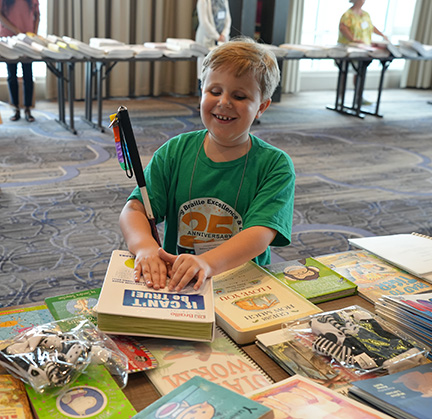 Before the final, much-anticipated presentation, President Riccobono mentioned the activities of our partner organization, the American Action Fund for Blind Children and Adults. He reminded listeners that the afternoon would feature the annual Braille Book Fair that the Action Fund sponsors, one of its many efforts to provide free Braille books of their own to blind children across the country, noting that kids would be let into the book fair early to get first crack at gently-used Braille books and that adults would not be permitted inside until half an hour later. Those who visit this popular annual event do not have to stuff Braille books in their luggage; volunteers box and ship them. The President also announced that the popular Action Fund Braille pocket calendars for 2026 are now available; indeed, these were at that very moment being given away at the Federation Free Reads table just outside the Exhibit Hall where, this writer can attest, they had been going like hotcakes the day before. Affiliates can order up to fifty calendars for their members if they do so prior to August 31, 2025. Individuals can order up to three calendars at actionfund.org or by calling 410-659-9315.
In keeping with his usual good humor, President Riccobono pretended to adjourn the board meeting before pretending to remember that one more presentation was expected. He then introduced Cayte Mendez, chair of the National Federation of the Blind Scholarship Committee. Cayte, in turn, introduced the scholarship finalists, who told us briefly about themselves and their educational and career goals. Again, no spoilers here; a full report of the scholarship proceedings appears later in this issue. With no further business, President Riccobono once again turned the microphone over to Pam Allen for some concluding remarks, and then the board meeting was adjourned.
Many divisions of the National Federation of the Blind held their business meetings Thursday afternoon. Divisions function like chapters and affiliates, in that they have elected officers and boards and can raise funds to conduct programs and activities. Groups, which have appointed chairs, also held meetings. As already mentioned, the annual Braille Book Fair of the American Action Fund for Blind Children and Adults took place.
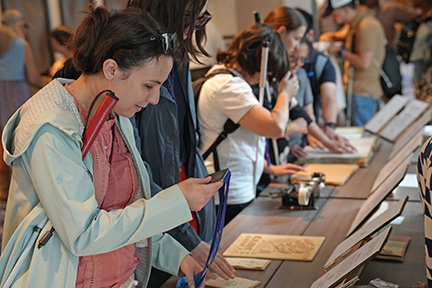
 Thursday evening brought the first of two opportunities for conventioneers to get a glimpse of the kinds of artifacts that might be displayed in the planned Museum of the Blind People’s Movement. Museum project lead Alison Tyler, Braille program manager Jennifer Dunnam, and archivist Nichole Chrissis staffed a hands-on exhibit focusing on the history of Braille and the Federation’s fight for literacy. The exhibit began with examples of other tactile reading methods that were in vogue before Braille became the accepted reading and writing method for blind Americans, as well as artifacts like an early Braille shorthand machine from the 1920s, a tactile profile of Louis Braille, the Louis Braille commemorative coin produced by the US Mint, and more. Alison Tyler told the Monitor that the exhibit was hugely popular, to the point where she was unable to count the number of people standing in line to experience the exhibit. She also shared that the oldest artifact in the exhibit dated from 1889.
General Sessions I and II
By Friday morning the first half of the convention had already sped by, but there was plenty more to come, as the final three days would feature the six general sessions that make up the heart of the convention and its business. Friday morning was the first of these, and some eager conventioneers arrived early to find their seats, even as the crew that sets up the flags designating the seating area for each delegation was still completing its work. Half an hour before the session was set to begin at 9 a.m., the hall was already well on its way to capacity. Dwight Sayer, the past president of the National Association of Blind Veterans who is known, among other fine qualities, for his commanding presence and voice, was summoning all veterans at the convention to the stage, and the affiliate delegations were identifying themselves with loud cheers and chants so that their members could locate and join them. Virtual Experience attendees, meanwhile, were listening to Anil Lewis and Melissa Riccobono, co-hosts of the Nation’s Blind Podcast, preview the morning’s activities.
Precisely at the appointed hour, President Riccobono brought down the gavel and announced that the convention was in order, to thunderous cheers and applause. A door prize of $200 was presented by Kenia Flores, who was handling door prize activities along with Bennett Prows, and then the President introduced Narjis Karimipour, of the faith of Islam, to give the morning invocation. Narjis is a rising eighth grader from the host state of Louisiana and active in her mosque as well as in the Federation. She is the youngest person ever to give an invocation at convention, but her poise and preparation were apparent to all as she offered a beautiful prayer in both Arabic and English.
The invocation was followed by the presentation of colors, the Pledge of Allegiance, and the National Anthem, led by Roy Stinson, the president of the National Association of Blind Veterans. Pam Allen then came to the microphone to welcome everyone to Louisiana. Following her warm words, the Jackson Square All-Stars marched into the ballroom to favor us with some Dixieland jazz numbers. Many conventioneers, already sporting Mardi Gras beads featuring the NFB logo that Louisiana volunteers had been handing out, danced in the aisles and sang along to “When The Saints Go Marching In” when it was played. (Pam told us that the beads were colored purple for justice, green for growth, and gold for power.) Following this performance and a brief presentation about New Orleans history, a delightful gentleman who called himself Captain Louis, and hailed from Jean Lafitte, Louisiana, introduced us to his pet alligator, Elvis. Captain Louis regaled the convention with interesting facts about four-year-old, eighteen-inch-long Elvis and his fellow Louisiana gators, including that they are nocturnal and only have peripheral vision; therefore, they hunt by smell and vibrations created by the movement of their prey. Elvis declined to offer additional remarks, as he was muzzled for safety and probably eager to make his contractually obligated follow-up visit to the children in NFB Camp and then go to sleep for the rest of the day.
The convention then turned from alligators to litigators—NFB and the Litigators—a vocal and keyboard ensemble who presented the newest Federation song, “Who are We? NFB!” The song is now available on all major music services. Roy Stinson then came back to the microphone to introduce the Celebration of Freedom. Veterans attending the convention who had come to the stage introduced themselves and received Freedom Ribbons from the Federation and grateful and patriotic applause from their fellow Federationists.
 It was then time for the Roll Call of States. Each affiliate president introduced themselves and provided the national President with the name of the convention delegate, alternate delegate, and nominating committee member, as well as information about their next planned affiliate convention. Of course, many of them also took a moment or four to brag about their affiliate, particularly if they had scholarship finalists, Jernigan Fund scholarship recipients, or other notable individuals in their delegation or recent successes to announce. Like all of the convention, the Roll Call of States was punctuated with loud cheers and applause, an exercise “fit break,” and door prizes at various moments.
Noon brought the end of the first general session and one of two final opportunities that attendees would have to visit the Exhibit Hall. Conventioneers could also take advantage of grab-and-go lunches provided by the hotel and then participate in other breakout sessions or drop by the Baccus Room on the Marriott’s fourth floor for some quiet time if they did not want to brave the elevators to get to their own private room.
Two o’clock, the afternoon session and the Presidential Report. Again, we will not drop any spoilers here; the full report that President Riccobono gave the convention follows this article. However, we urge those who can to listen to the audio version. It is of course included in the audio edition of this magazine, but if you are instead reading this issue in print or Braille, you might want to visit the Convention Highlights page on the NFB website at https://nfb.org/convention to hear the report in President Riccobono’s voice; it is a particularly powerful and emotional presentation.
Following the Presidential Report and the standing ovation it received, the afternoon agenda was modified to accommodate the schedule of an important guest. This was Frank Bisignano, the Commissioner of the Social Security Administration. While we have often been visited by SSA officials, having the Commissioner himself attend our convention emphasized the importance of the issues facing the agency and its relationship with our community. We have reported in this magazine the concerns that the National Federation of the Blind has expressed about dramatic changes within the agency; indeed, we have joined a lawsuit because of these concerns. The Commissioner was doubtless aware of all this and did his best to assure us that, while staff has been reduced at field offices by 4 percent, service is not suffering. He emphasized that the goal is for the SSA to become a “digital first” agency, arguing that cuts are justified because, whereas many more employees were needed when the agency issued checks EXCLUSIVELY by mail, the predominance of electronic payments and internet interactions these days makes digital management of most claims more feasible and desirable. The Commissioner acknowledged the Federation’s collaboration to make SSA’s self-service kiosks accessible and thanked us for it. He also said that he would reach out to Representative Pete Sessions to see if collaboration was possible with respect to the Blind Persons Return to Work Act. He promised that he would remain accessible to Federation leadership. President Riccobono warmly thanked him for his remarks and promised that the Federation would continue to maintain cordial relations while providing candid feedback. All of this was in keeping with our tradition of respecting our guests even when we have disagreements with them.
Jonathan Mosen was introduced next to provide a report on the activities of the Center for Excellence in Nonvisual Accessibility and some of its future, including a planned redesign of the International Braille and Technology Center. This redesign will divide the facility into modules specific to work, home, school, and the like to better contextualize the various technologies on display. Consistent with much other tech-related content, Jonathan also discussed the role of AI in the lives of the blind, acknowledging that one of our challenges and commitments is to work with the industry to establish an ethical framework so that AI image recognition can be used to help blind people identify individuals known to us in images and real-time video while protecting the right of those individuals to privacy and the integrity of their personal data.
In keeping with the AI theme, Maxine Williams, Vice President and Head of Accessibility Engagement for Meta, the company that owns Facebook and sells the Meta Ray-Ban smart sunglasses, came to the platform to speak about the company’s growing collaboration with the National Federation of the Blind. She was followed by Jenny Lay-Flurrie of Microsoft, who reviewed our collaborations over the years and previewed AI developments that the company is planning. Following these three tech presentations, the afternoon session adjourned.
 Those not headed down the river on the Creole Queen for a Friday evening cruise had a final opportunity to visit the Exhibit Hall before it closed at 9 p.m. The Independence Market was open as well. The NOPBC continued its Educate Seminar, begun on the first day of convention, with more breakout workshops and Youth Track Activities. Sports and recreation enthusiasts could learn about and play blind hockey and tennis courtesy of the Sports and Recreation Division. A two-hour presentation and discussion entitled “Imagining Our Museum: The Museum of the Blind People’s Movement” also took place, facilitated by Alison Tyler, the Federation’s museum project lead. Other sponsors, committees, and groups also held evening work sessions and gatherings. The Communications Committee meeting attended by this writer featured a fascinating discussion on the various ways that AI services like ChatGPT can be used by affiliates as tools to improve marketing strategies and materials.
General Sessions III and IV: Federation Business
Saturday morning’s general session began with a beautiful invocation by scholarship finalist and Student Division Vice President Lauren Altman, an adherent of the Jewish faith. As the day was the Shabbat, or sabbath, Lauren informed us of the traditions associated with this weekly holy day, including the preparation and eating of the braided bread called challah, symbolizing strength through unity. Following the invocation, the first item on the morning’s agenda was the presentation of the financial report covering last year and the first half of this one. The financial picture was at least reassuring, as the Federation ended 2024 in the black by about $2 million and has so far remained there for the first few months of 2025. However, President Riccobono noted that the twelve million dollars in revenue received in the first half of this calendar year was due to a one-time bequest received by the Colorado Center for the Blind and shared with the national organization. Subtracting that revenue, we broke even before considering convention expenses. President Riccobono noted that our household goods donation program through GreenDrop has ended, that our mass mail program (which is also the source of many bequests) continues to see a steep decline in donations, and there is some risk of losing federal funds for NFB-NEWSLINE®. We have some new revenue streams, but overall President Riccobono stressed the urgency of all of us continuing to ask people and organizations outside our movement for donations. He also urged chapters and affiliates to try to help the national movement more to support our legal program, staff payroll, affiliate support, and unanticipated expenses that might arise, such as the Rideshare Rally in October of last year. He noted that we will need a new telephone system soon and stressed that while we are still committed to the Museum of the Blind People’s Movement, that will not supplant other programs, and forward motion will not continue until specific funds for it are raised. The entire report was presented with candor and what is best described as very cautious optimism regarding the near-term outlook.
Elections were next on the agenda. The Nominating Committee, chaired by Pam Allen, recommended that all board members currently holding office be re-elected to their positions. The Convention agreed, accepting the committee’s report and then electing all by acclamation, with only one floor nomination occurring which was declined by the nominee.
John Ciocca, CEO of a new company called Purple, was the next presenter, and he spoke to us about individual financial management. Purple designs financial tools specifically to be used by people with disabilities, and their offerings are meant to be particularly useful to those of us who must manage our money carefully to comply with the rules of SSI, SSDI, and other benefit programs. Mr. Ciocca said that his inspiration to create the company came from his own experiences helping to manage finances for his brother. Purple is a company that the Federation helped get off the ground. For that reason, and because its services seem very useful, we will publish Mr. Ciocca’s remarks in next month’s issue of this magazine. Those wishing to learn more in the meantime can view or listen to the presentation on the Convention Highlights page or visit https://withpurple.com.
Our friends from the National Library Service for the Blind and Print Disabled (NLS) were the next to the platform. In addition to Jason Broughton, the program’s director, we heard from Deputy Director Jason Yasner, who took the microphone first and gave an energetic and upbeat presentation. He told us that the 2026 proposed federal budget still includes funding for NFB-NEWSLINE® (which, he stressed, NLS considers a critical service and remains firmly determined to do everything it can to protect). He further shared that thousands of brand-new wi-fi-enabled digital talking book machines were on their way to network libraries, BARD has been upgraded, new patrons will soon be able to enroll for service online, and the service’s skill for Amazon Alexa-enabled devices will likely feature new enhancements due to the introduction of Alexa+. Director Broughton struck a similarly positive tone. He shared that NLS has moved back to the Capitol complex and that the service has over two thousand Marrakesh titles in twenty-six different languages and emphasized the popularity of the Braille on Demand program, among other things. He stressed the importance of our movement in the face of the challenges of our times and said that “the journey is not only vital but beautiful.” The Federation and this magazine remain alert to changes that may affect NLS and will certainly work with these allies to preserve it.
Having sped through the morning’s business, the session was able to adjourn a few minutes early, following a few more door prizes. President Riccobono reminded us that important business, including the consideration of resolutions, would be done in the afternoon session. Conventioneers then left to take their last shopping excursion to the Independence Market, exchange their banquet tickets, or participate in the other activities scheduled during the lunch break.
The afternoon general session started with a presentation from a blind astronomer. The item was “Building a Constellation of Opportunities: A Blind Astronomer Researching the Cosmos with Multisensorial Perception,” presented by Wanda Díaz-Merced, Astronomer and Director of Science in Braille Global Office of Excellence; Gurabo, Puerto Rico.
Two advocacy-related presentations followed. First, Eve Hill, general counsel to the National Federation of the Blind, outlined the challenges facing blind and disabled Americans as the current administration backs away from enforcement of the laws that protect us. Eve stressed the critical importance of our willingness to act aggressively to protect our rights and the programs that serve us, doing so with a motivational call-and-response presentation. Again, we feel the best service we can provide to our readers is to refer them to the Convention Highlights page to hear the presentation or read the transcript. The convention then received updates from the Advocacy and Policy team that handles legislative, legal, and regulatory issues at the NFB Jernigan Institute, led by John Paré. John and his colleagues, Jesse Shirek, Sanho Steele-Louchart, and Justin Young, provided an update on the status of our legislative and legal efforts while motivating all of us to work harder to achieve positive change.
Then came the consideration of the twenty-one resolutions that had been recommended by the Resolutions Committee for adoption by the Convention. This procedure was briefly interrupted by the hotel’s alarm system; one of the afternoon thunderstorms that had been plaguing us all week was raging outside, and water was leaking into the hotel in at least two locations. Because hotel staff did not immediately notify us that full evacuation of the facility would not be necessary, business stopped, and many began to exit the ballroom. Fortunately, word came to stay put before too many people fled the building, and business resumed. The Convention adopted all twenty-one recommended resolutions, with three requiring roll-call votes by the official convention delegates of each affiliate present. The adopted resolutions appear elsewhere in this issue.
The session adjourned shortly after 5 p.m., but as usual, there was plenty for convention attendees to do Saturday evening. There was a second opportunity for folks to get their hands on exhibits that might appear in the Museum of the Blind People’s Movement in case they missed the crowded session on Thursday night. A memorial service for our departed friend John Cheadle was held by the National Federation of the Blind of Maryland. The Performing Arts Division held the annual Showcase of Talent, which is always very popular.
General Sessions V and VI
The official longest day of the year is usually June 21, that being the Summer Solstice, the day with the most daylight hours. For Federationists, though, the longest day is the final one of convention, as it includes two general sessions and the convention banquet. In this case, long does not equate to dull; the day is full of excitement, with a full day of informative presentations followed by the banquet address, scholarship announcement, and other awards and surprises that might occur during the banquet.
Despite the excitement, the Sunday morning session began with sad news. President Riccobono solemnly announced that Sassy Atwater-Wright, a disability-rights activist known to many of us and more recently a member of the National Federation of the Blind, had passed away the night before. He urged us to keep Sassy, her family, and her partner Bryan Bashin, also a Federation leader, in our thoughts and prayers. This moment of remembrance was followed by a Christian invocation featuring a well-known passage from the New Testament and a thoughtful prayer by Briley O’Connor, the executive director of the Minnesota Center for the Blind. Next was a presentation from Vispero, which is the current name of the company that produces JAWS for Windows, the popular and powerful screen reader, as well as other products. Before Ryan Jones, its vice president of software, described the latest features of JAWS, Glen Gordon, a programmer who was involved with the software when it was first created thirty years ago, shared some memories of his work. None of us, including Glen himself, knew at the time that he had been invited to the convention for another purpose as well, but that came later. Glen’s presentation was full of fascinating history and sound advice, and it will appear in a later issue of this magazine. Ryan Jones then shared improvements that are coming to JAWS, including a new AI feature that will summarize the layout of a web page and answer questions about it so that blind users can get an overview of the page before interacting with its individual elements. This was demonstrated in a brief video, which said that the feature will be available in the fall of 2025.
Sticking with the theme of accessibility, we next heard from Jake Konerza, Senior Director of Digital Accessibility for Target. Those who know their Federation history are aware that we have a long and productive relationship with Target, but that relationship began in 2007 with a lawsuit about its then-inaccessible website. As much as or more than any other entity, Target took to heart what it learned from working with us to resolve that lawsuit, and its accessibility initiatives across its products and services have been outstanding. This now includes fully accessible self-checkout kiosks that will be rolled out by early 2026, which is what Mr. Konerza was at convention to announce, with help from Steve Decker. Many conventioneers had been able to try out the new technology in the Bonaparte Room throughout the week; sadly, this writer was not one of them, so like many of you, I look forward to visiting my local Target to do so. To our knowledge, Target will be the only retail store where blind people can independently scan and pay for the items we purchase without the help of a sighted employee. As President Riccobono said in introducing Target’s presentation, this will be a game-changer.
The convention next heard from Anne Lancaster, Vice President for Innovation and Strategy at the American Printing House for the Blind. As many readers will know, APH is one of the partners who worked with us to produce Monarch, the multi-line Braille and tactile graphics tablet. Anne came to give us an update on the progress of the Monarch, of which she said there are over 1,100 units being used in classrooms around the world, but also to speak about how high expectations are integral to the work that APH does in partnership with the blind. Her heartfelt presentation will be included in a later issue. APH is a leader in education, but we next heard about a different kind of education that is too little discussed: sexual health education and research driven by the blind. The presenter was Mika Baugh, a Federationist from a young age, when she participated in our youth STEM programs. Now fully into her “adulting” phase, she just received her PhD. Mika stressed that the lack of accessible sexual education materials harms blind people not just through denying us knowledge, but in doing so, also transmitting low expectations that feed negative self-perceptions about our ability to have fulfilling relationships. It was a powerful and emotional presentation and will appear in a later issue. So will the final presentation of the morning, which was a panel about the meaning of our planned Museum of the Blind People’s Movement from several perspectives of Federation members and partners, facilitated by the indefatigable Pam Allen. A highlight of this presentation was the participation of Shawn Callaway’s daughter, Camille, whom he calls his “princess.”
After the lunch break, which was the final opportunity to exchange banquet tickets and contained the fewest activities and breakouts of any lunch period during the convention, the afternoon session began with the presentation of the eighteenth annual Dr. Jacob Bolotin Awards. This presentation appears later in this issue. The convention then learned about XR Navigation, a company that has developed a unique audio-based interface for producing and exploring accessible maps, from its CEO, Brandon Biggs, who demonstrated the technology live from the convention platform using maps of our hotels and the surrounding streets.
This writer was humbled to be the next convention presenter, the first time I have ever had such an honor. It is impossible for me to be objective about my own remarks, as it would be for anyone, so I will just say here that I am grateful for the warmth with which my Federation family received them and the many kind words that many of you have since shared with me. I also hope that readers are exploring the new Early Access blog articles that were announced as part of the presentation.
President Riccobono noted that he met the next presenter when this guest was chief executive officer of Guiding Eyes for the Blind, the only guide dog school to financially sponsor our Rideshare Rally in October of 2024 in which we protested continued discrimination against guide dog users by rideshare drivers. Thomas Panek, who is blind, has since the Rally become CEO of the Lighthouse Guild. This is a welcome development, as leadership by blind people of agencies serving the blind is something which the Federation strongly encourages.
The final presentation of the afternoon was entitled “Perspectives on Growing Pains in the Organized Blind Movement: A Panel of Student Leaders.” Anil Lewis, the Executive Director for Blindness Initiatives at the NFB Jernigan Institute, facilitated the discussion. The three student leaders on the panel shared, with courtesy and candor, the difficulties that young people sometimes have in integrating into the larger movement, particularly their affiliates, as they transition from student life into their careers. Their discussion will appear in a future issue of this magazine.
The Convention Banquet and the Elephants in the Room
As John Berggren had reminded us just before the final panel, it was then time for the gathered Federationists to clear the convention hall as quickly as possible so that the hotel staff could prepare the room for our celebratory banquet. During the two-hour break before the banquet began, Federationists who had decided to brave the elevators to get back to their rooms and change into formal wear did so. All had an opportunity to visit the portrait studio during its final session so that they could be photographed in their finery.
There was a slight delay in completing the seating process before the banquet began. Those who were seated early enjoyed more authentic live New Orleans music. The banquet was gaveled to order shortly after 7 p.m., with Pam Allen, still cheerful and energetic as ever, serving as emcee. She began the proceedings by introducing Daphne Mitchell, who delivered an invocation consisting of both song and prayer. After an initial door prize drawing, a video was played thanking the sponsors of the thirty scholarships that would be presented later in the banquet. Pam then introduced Corbb O’Connor, joining us virtually from Minnesota. Corbb announced that the Lead and Drive in 2025 campaign leading up to and during the convention had raised a total of $35,000 and drew the name of the contributor who had won the grand prize—a trip to next year’s convention complete with registration, hotel, banquet ticket, and a thousand dollars in cash. After another door prize drawing and a fifty-fifty drawing from the National Organization of Parents of Blind Children, Marilyn Green announced the winners of the PAC animals and other prizes. The NOPBC took home the Pac Mule; Nevada took home the PACaderm; and the PAC Rat headed to Tennessee. Marilyn announced that total PAC donations were at $472,746.32 as of the end of convention.
After Pam introduced the officers and other dignitaries at the head table, including her new elephant Calliope that President Riccobono gave her at the Rookie Roundup, it was time for our President to give his banquet address. Its theme was truth and its reclamation, the process by which marginalized groups take back control of the narrative about themselves from the culture that marginalizes them. He used the well-known fable of the blind men and the elephant to illustrate the concept. The speech appears in full in these pages, but we encourage those who can do so and who did not hear it presented live to listen to the audio from the Convention Highlights page, as it has unique features that are best appreciated in this format.
Following the banquet address and the audience’s enthusiastic response to it, longtime friend of the Federation Dr. Ray Kurzweil, who worked with us to pioneer groundbreaking print-reading technology and continues to support our scholarship program and other endeavors, offered brief remarks. In keeping with a recurring theme at the convention, Dr. Kurzweil shared some insights about AI. He concluded by telling us that he is writing his autobiography and devotes significant space to his involvement with the National Federation of the Blind. He said that our movement has changed, uplifted, and motivated him more than any other organization with which he has interacted.
Two more award presentations took place before the scholarship winners were announced. The Jacobus tenBroek Award is presented annually, and this year Pam Allen did the honors. The Kenneth Jernigan Award is presented when a deserving individual is identified, and Curtis Chong made the presentation. Both presentations are included in this issue.
Pam then handed over the microphone to Scholarship Chair Cayte Mendez so that she could complete the process of turning the scholarship finalists into scholarship winners. Cayte first called the finalists to the stage in alphabetical order and then announced which scholarship each would receive. The recipient of the Kenneth Jernigan Scholarship then addressed the banquet. An article describing all the scholarship proceedings at the board meeting and banquet appears elsewhere in this issue.
Pam then gave a way a few more high-dollar door prizes. In keeping with tradition, the top prize was $2,025, reflecting the convention year. She then turned the convention back over to an undoubtedly tired but still exuberant President Riccobono, who asked us to close the proceedings with an elephant-sized Federation cheer. We did so, and the banquet was adjourned.
Conclusion
The 2025 New Orleans Convention will be our last in that city for a while, but it will doubtless echo through our history as past New Orleans conventions have. In the meantime, there are conventions in new and old venues to look forward to, and much work to be done before we convene in Austin, Texas, next year. President Riccobono reminded us several times that our movement is more critical now than it has been since our founding in 1940. Our vigilance and willingness to lead courageously and champion collective action is urgently needed to protect what we have and to lay the groundwork for an even brighter future. Nonetheless, we all took to heart the repeated New Orleans cry of “Laissez les bon temps roullez!” (“Let the good times roll!”) in 2025, and our love and hope will doubtless continue to bring us joy moving forward.