American Action Fund for Blind Children and Adults
Future Reflections Special Issue on Ethnic and Cultural Diversity BUILDING UNDERSTANDING AND FORGING CONNECTIONS
Educating Blind English Learners: A Conversation with Conchita Hernandez Legorreta
 From the Editor: Latinx students and students from other immigrant backgrounds comprise a significant portion of public-school enrollment in the United States. It is imperative for teachers of the blind to forge strong partnerships with children and families from immigrant communities. It is critical to build encouraging and collaborative relationships in order to support the unique needs of blind/low-vision English-language learners, as these combined designations can leave students vulnerable to decreased academic and social success.
This article begins with a blog post by educator Conchita Hernandez Legorreta. It is followed by Rosy Carranza's interview with Conchita, exploring and elaborating upon ideas expressed in the blog.
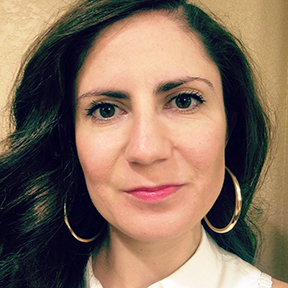
In "Growing Up at the Intersection of Disabled and Immigrant," Conchita Hernandez Legorreta writes about her educational pathway as a blind, undocumented, English learner. Today she occupies the roles of education champion and community change-maker. The piece that follows first was published in "Rooted in Rights," https://rootedinrights.org/growing-up-at-the-intersection-of-disabled-and-immigrant/.
I am an immigrant with a disability. When I was five years old my parents decided to move our whole family from Mexico, including five kids, two of whom have a disability, to the United States. My mother still talks about the decision: having children with disabilities. She dreamed of something bigger for us, but immigrants are not eligible for many services, including rehabilitation services and outside therapy services for children.
My siblings and I were enrolled in public school. We were thrown into a world in which we did not know the language or culture and had no way of expressing our concerns or asking questions. I remember not being able to participate in what was occurring at school, and it took me longer than usual to learn my alphabet because I could not see the board or understand what the teacher was saying.
At five years old I did not have any advocacy skills, and I did not know about the Individuals with Disabilities Education Act (IDEA) or my right to a Free Appropriate Public Education (FAPE). And other than explaining that we lived in poverty, I could not tell my classmates why I could never leave the country or participate in certain activities.
I think the driving force that kept me focused and persevering through all of this was the support of my family. While the idea of disability as something to pity was present in my family, the support from my family, which I lacked in school, was everything. My siblings would help me with homework and chores. We came up with modified games so that I could play and participate. My siblings taught me daily living skills such as how to tie my shoes and how to dance all the latest moves. They became the service providers that I could not receive out of school due to lack of money and immigration status. Overall, my family had my back, because what else do you have when you know that at any minute everything can be taken away?
There was always a fear of deportation back to a place that I vaguely remembered, where "people like me" didn't go out in public alone, where the only opportunity was to be a beggar or live with your family your whole life.
Eventually I received services through an Individualized Education Program (IEP), but I now realize how low-quality those services were. At the time California had healthcare services for undocumented children. This was a much-needed service for my family, but it meant if I got sick, I would have to take a whole day off from school to account for the wait time at the understaffed, overcrowded free clinic designated for our care. Once I learned English, I’d also have to take days off from school to translate for my parents.
It wasn't until my senior year in high school that I came to realize what being undocumented and having a disability really meant. Due to my status, I was told I would not be able to get financial aid, or get accepted to college. My teachers knew about vocational rehabilitation services but decided not to inform me of them because I was not eligible.
Many of my friends who were in a similar situation had alternatives, as they could be employed doing labor that I could not do because of my disability. I had nowhere to turn, and I was beyond frustrated.
It felt like pure fate that I received my green card in the middle of my senior year in high school. By this time most college applications had been turned in, but there were private schools that had later application dates. I ended up applying to a private school and getting in. It was not easy for me, being at the intersection of being an immigrant and having a disability, because of all the obstacles to services and programs that would have benefited me, but it made me who I am today. My life is what it is because my parents decided to make a very difficult choice, and I am bearing the fruit of that decision.
Rosy Carranza: I had an opportunity to talk more extensively with Conchita about the education of blind English learners (EL), a population that she taught as a public-school teacher in Washington, DC and that she continues to serve via her work as the Maryland Statewide Blind and Low Vision Specialist. Here are some highlights from our conversation:
Rosy Carranza: Conchita, what is the first step that a teacher of blind/low-vision students should take when an English learner is assigned to their caseload?
Conchita Hernandez Legorreta: They should get to know the family and their specific situation. The teacher should ask about language, access to information, and the best method to communicate. Inform the parents about services you provide in an easy-to-understand vocabulary. Many parents do not understand the basic services that are being provided. Often they are left out of having any follow-up at home, not because they do not want to help, but because there is a lack of communication by providers on what parents can do.
RC: We know that teachers of blind students often enter the field with minimal training to address the unique needs of English learners. What are some actions that teachers can take to up their knowledge in this area?
CHL: There is a lot of research and best practices out there for working with English learners. I would really recommend Colorin Colorado https://www.colorincolorado.org. This site houses research-based information and lots of resources to help teachers understand the issue and how to support families and students. As TVI's, we put a lot of pressure on our students to learn new skills. We should be doing the same ourselves, since our educational training is not enough and did not teach us how to work with this population.
RC: Are there any misconceptions that you want to clear up regarding teaching the blind/visually impaired English learner population?
CHL: We need to move from a deficit model in both of these categories. Blind students are not by nature deficient because they cannot see. Likewise, English learners are not deficient with their lack of understanding English. If anything, research has shown how English learners develop brain patterns and thinking processes that help them in other areas due to their bilingual abilities. I also think that family engagement is often viewed as a barrier. Most parents of EL students want to be engaged, and they are often the biggest proponents of educational attainment for their children. I hate seeing the proliferation of the idea that these parents just aren't interested! In most cases they are not engaged because you as a provider have not found a way to involve them. Perhaps you don't call them by their name, put effort into pronouncing their name correctly, use their language to invite them to school events, or provide translations of basic forms. I encourage teachers to be creative and proactive.
RC: In presentations and trainings you talk about the importance of developing a communication plan with each of your EL families. What are some key components of such a plan, and why is one necessary?
CHL: A communication plan is key to working with EL students. It lays out all the information that will be useful in communicating with families. This includes determining the primary language spoken at home, the grade level in which parents can read that language, the mode of electronics available at home (many families rely exclusively on smartphones), and the best way to contact parents with important information. How will parents communicate with you? How will you make sure the student is not serving as an interpreter between providers and the family? How will the family be notified of school functions? How will parents request translation and interpreting services? Who is the point of contact in the family for any other information that must be communicated effectively—it cannot be the child!
Each family is different. Some may prefer a Watts App message, some may prefer a paper to be sent home, and some may prefer a phone conversation. The communication plan should be individualized, and it should be implemented for each child from Day One.
RC: What should teachers of the blind know about EL students and IEPs?
CHL: First of all, the law requires that families receive all information in their preferred language. Families have a right to an interpreter for all IEP meetings. Parents should be a part of the decision-making process and should feel like experts in the life of their child. They should not merely attend an IEP meeting in order to sign a document. When holding IEP meetings, make sure parents understand the lingo being used. The fact that the discussion is being translated does not ensure that it is meaningful to the parents.
Your contact with the parent cannot take place solely at the IEP meeting. Parents should be viewed as valuable allies.
RC: You've provided wonderful insight for teachers. What is one piece of advice that you offer to blind students who share a background similar to yours?
CHL: I grew up as an English learner, and from my personal experiences and my work in education I know that our families are not being served in the way they should be. The most important thing you can learn to do is advocate for yourself and your family. Ask all the questions, ask about all the services. Having to navigate two very different worlds can seem like a burden at times, but it is going to prepare you to be powerful and invincible. Give back by using your personal experiences to demand better for our communities.
Media Share
