American Action Fund for Blind Children and Adults
Future Reflections Special Issue: The Federation in Partnership TEACHERS AS PARTNERS
Creating Possibilities: Partnerships in STEM Education for Blind Students
Based on an Interview with Seth Lamkin
From the Editor: For nearly twenty years the National Federation of the Blind has upheld a serious commitment to STEM education for blind and low-vision students. In this article Seth Lamkin, grant writer for the Federation's STEM programs, shares how the NFB and its partners are working to open new opportunities for blind youth.
In the summer of 2004 scientists from the National Aeronautics and Space Administration (NASA) teamed with the National Federation of the Blind to bring twelve blind high school students to Baltimore for a program christened Rocket On! After a week of planning, discussions, and meticulous calculations, the students launched a ten-and-a-half-foot rocket from the Goddard Space Center in Maryland. The rocket soared to an altitude of 4,902 feet before it plunged into the ocean.
The Rocket On! program send a NASA rocket into the atmosphere, but it also dramatically launched the Federation’s ongoing effort to develop opportunities for blind students in STEM (science, technology, engineering, and mathematics). Many educators have long considered the STEM fields to be out of reach for blind and low-vision students, largely because these subjects usually are taught using inaccessible tools and graphics. Blind students tend to be sidelined in lab courses, told to “just listen and take notes,” while their classmates are busy with beakers and Bunsen burners. With the generous support of NASA, the National Science Foundation (NSF), a team of science educators, and a group of dedicated blind scientists, the NFB is working to open the STEM fields to blind students.
Beginning with Rocket On! We at the NFB Jernigan Institute hosted a series of programs that encourage blind students to explore their interests in the STEM fields. In 2017 we received a generous five-year grant from the National Science Foundation to hold a series of science and engineering programs for blind high-school students. A team at the Columbus Center for Science and Industry in Ohio evaluates our project activities, and we built an ongoing partnership with the museum as we developed our STEM programs.
The first programs in this NFB EQ series took place in Baltimore in 2018 and 2019, with thirty students taking part. Each student was invited to imagine and design a unique building. The students gained hands-on experience with structural engineering as they calculated such factors as earthquake resistance and the capacity of the roof to withstand the weight of five feet of snow. On the final day of the program the students displayed models of the buildings they had designed and answered questions from visitors.
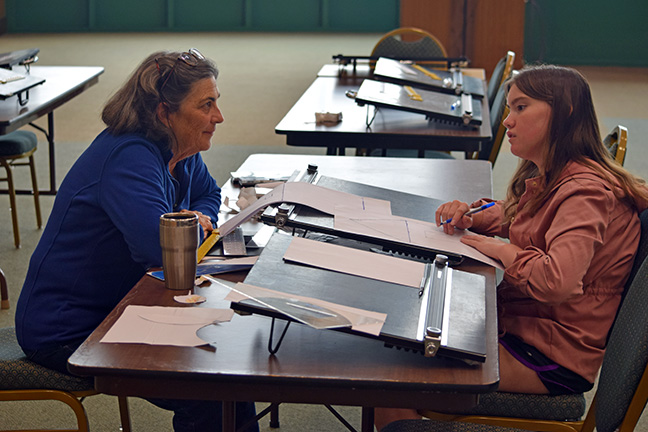
The COVID-19 pandemic derailed plans for face-to-face STEM programs in 2020 and 2021. However, coordinators switched gears and planned virtual programs that were available to students from across the United States. The programs continued to focus on activating critically important spatial reasoning abilities and developing tactile fluency. Students studied raised-line diagrams, made tactile drawings, experimented with origami, and built constructions with LEGO blocks. All of these activities lay the groundwork for meeting more complex scientific and engineering challenges.
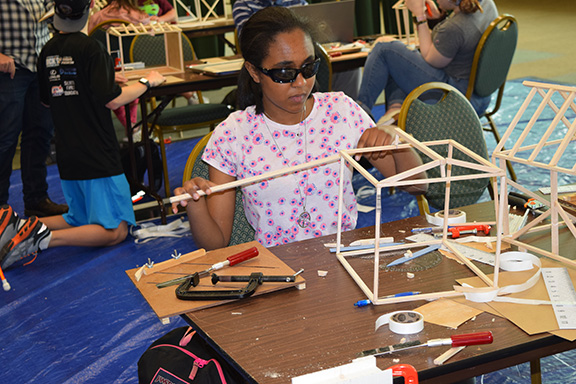 At the 2022 NFB National Convention in New Orleans, fifteen past participants in these STEM programs continued to build their knowledge of key STEM concepts in the STEM EQ Suite. Activities included building a roller coaster with paper and devising a heating system for low-energy housing. In the exhibit hall and the art room the students introduced visitors to an assortment of STEM-related activities. For example, convention-goers were invited to construct buildings with blocks after examining tactile drawings that showed the building from various angles. The STEM EQ participants met and interacted with members of the 2022 NFB Scholarship class, many of whom are pursuing studies in the STEM fields.
Building upon the experiences of blind students in the STEM programs over the years, the NFB and its scientific and academic partners are developing a set of STEM materials to be used by teachers, parents, and science museums. These materials will be available for free download on the NFB STEM website by the spring of 2023. All images will have descriptive alt tags, and files for printable tactile graphics will be included.
One of the leading collaborators on the NFB’s STEM initiatives is Dr. Wade Goodridge, a professor at Utah State University. Dr. Goodridge had no experience working with blind people before he got involved with the Jernigan Institute, but his prior research focused on spatial reasoning. He welcomed the chance to learn how people develop and use spatial abilities without relying on sight, and he embraced the challenge of making STEM activities accessible to blind/low-vision students.
The Mental Cutting Test (MCT) is a widely used test of spatial abilities that was developed in the 1930s. Students look at a series of pictures and try to imagine how they would appear from various angles. In collaboration with the NFB, Dr. Goodridge designed a version of this test that uses tactile graphics and 3D-printed objects. By working with these materials, students can strengthen their spatial reasoning skills. Input from blind people has been crucial at every stage of this project.
The NFB’s next STEM initiative will be a series of activities for middle-school students. "STEM lunchboxes" will contain materials to be used in experiments and educational games. Leaders in NFB affiliates will be trained to conduct STEM sessions at state conventions and student seminars in 2022 and 2023.
Opening opportunities for blind students calls for a multipronged approach. The NFB and its partners in the science community are trying hard to teach science educators about working with blind/low vision students. Dr. Goodridge, program coordinator Natalie Shaheen, and others have published articles in the journal Technology and Engineering Teacher. Papers have been accepted for publication at several conferences, including the American Society of Engineering Education Zone IV Conference and the 2021 and 2022 American Society of Engineering Education Conferences.
STEM EQ and other NFB STEM programs involve much more than science lessons and experiments. When they take part in these programs, students are introduced to the NFB philosophy. They are involved in discussions and activities that challenge their attitudes toward blindness. Blind mentors help them recognize that they can live the lives they want, that blindness need not hold them back.
"Back in their home communities most blind students have to fend for themselves,” explains Natalie Shaheen. "When they come to our programs we show students what it is like to learn STEM in a place that is inherently accessible to blind folks and in a classroom community where everyone supports each other in the work of learning. In our programs blind students don’t have to waste time and energy fighting for access to learning; their nonvisual access needs have been incorporated into the design of the learning. Students also learn that STEM subjects aren’t visual, they are spatial. We need to represent information in two and three dimensions, and there are many nonvisual ways we can make that happen.”
In the NFB we know that science isn’t about physical vision. It's about asking questions, testing hypotheses, and searching for answers.