American Action Fund for Blind Children and Adults
Future Reflections Special Issue on Technology GETTING STARTED
Training Is the Key: An Interview with Raúl and Stacie Gallegos
by Deborah Kent Stein
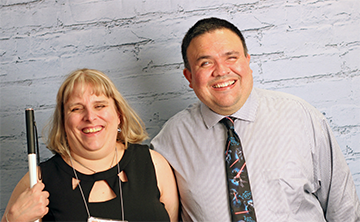 From the Editor: Raúl Gallegos has been active in the NFB since the 1990s, when he joined the Colorado affiliate. Today he serves as first vice president of the NFB of Texas and president of the National Association of Guide Dog Users (NAGDU). A native of Texas, Stacie Gallegos is president of the NFB of Texas Houston Chapter and serves as NAGDU secretary. Raúl and Stacie both teach access technology to blind and deafblind clients. They shared their ideas and experiences in an interview for Future Reflections.
DEBORAH KENT STEIN: Tell me about your teaching. Who do you serve, and what training do you offer?
RAÚL GALLEGOS: Stacie and I run a small business called RGA Tech Solutions. We provide consultation and training in access technology for private clients. We also do technology training for a program called ICanConnect (ICC).
DKS: How did you get started in this work?
RG: I started training blind people to use access technology in 2005. I worked for GW Micro, providing training and tech support for a text-to-speech program called WindowEyes. I got involved with ICC in 2016.
DKS: What exactly is ICanConnect? How does the program work?
RG: ICC is a program run by the Federal Communications Commission, or FCC. It teaches deafblind individuals to use communication tools such as smartphones, Braille displays, and computers. In Texas, the program is managed through Perkins School for the Blind.
STACIE GALLEGOS: We almost always work face-to-face with our ICC students. Depending on their mode of expressive and receptive communication skills, we will often communicate verbally, through a sign language interpreter, or through written communication. There are times when we will communicate by typing while the student communicates back to us verbally. If the student knows Braille, this mode of communication is also used. Because the ICC program is specifically designed for distance communication needs, we are limited in what we can teach. For example, we can teach a person how to use email and social media, but we cannot teach them how to write a résumé. The purpose of the program is to make sure deafblind people can use the relay systems for telecommunication that were created under the Americans with Disabilities Act.
RG: We’re not allowed to teach Braille or any other technology through ICC. If someone needs other kinds of training, they have to get approval through their rehabilitation counselor.
SG: I’ve learned how to coach parents so they can write to Vocational Rehabilitation for approval. Usually, it’s pretty straightforward.
RG: When the parent of a deafblind or blind student reaches out to us, we do an assessment to find out how much the child knows and what their needs are. We also find out what the parents know about IEPs (Individualized Education Plans) and IDEA (the Individuals with Disabilities Education Act). We try to get the school district to hire us to do training, so the parents don’t have to pay out of pocket. Sometimes we contract directly with the school district.
DKS: Do you visit the child in school, or do you work with them remotely?
SG: Mostly we work with students remotely. We do Zoom sessions with the student and the teacher, and sometimes with a parent, too.
RG: Mostly we work with the student, and the teacher observes and takes notes. Sometimes we just work directly with the teachers, and they formulate their own lesson plans. That’s especially true with younger kids. You can’t do a full lesson on tech with kids five and six years old. They just haven’t got the attention span yet.
SG: With older students it’s easier to have longer sessions and really cover a lot of material.
RG: After a lesson I follow up by writing a training report for the teacher and the school district, showing the work we did. I also encourage teachers and parents to record the call so they can listen again later on. Usually people take notes during the session, and I also send them notes about the things we covered.
DKS: How did the COVID lockdown affect your work?
RG: I remember before the pandemic I was working face-to-face with a twelve-year-old student. Then we switched to working remotely when the lockdown happened. The student had a Braille device with JAWS. I felt that the training was pretty successful, but I never had a chance to connect with the teacher. I think that would have helped reinforce what the student learned.
DKS: Do any other experiences with students stand out for you?
RG: I remember working with a high school student who was really a natural with technology. The kid’s mother was very, very overbearing. She was extremely protective toward her kid, and she’d get explosively angry with the teachers when she felt they weren’t doing the right thing. When I worked with this kid, Mom was always hovering in the background. I tried to be very careful, laying out my goals and giving her detailed notes.
I’ve worked with students of all ages, from five to eighty-five. About half of my adult students are employed.
DKS: Is there anything in particular that you want parents and teachers to know?
SG: I want them to recognize the importance of Braille, even for students who have some vision. Using Braille limits eye fatigue; a lot of students get terrible headaches from straining to read print. Sure, there’s a learning curve with Braille, but it can make life and work much more efficient in the long run.
RG: Students need to learn there are always alternative ways to do things. What do you do if your Braille display fails? How will you get your work done? I try to hammer in the importance of problem solving.
SG: Another thing: I want parents to learn that it’s okay for students to fail at times. They don’t always have to get everything right. The same holds true for sighted kids. They make mistakes, and they can learn from that experience. Don’t give kids a free pass just because they’re blind.
RG: Sometimes I share stories about my own struggles and the things my teachers did to help me. For instance, I might mention how in high school I had only five minutes to get from one class to the next, but my teachers wouldn’t allow me to leave class early. They showed me I could get through the halls like everybody else. I don’t ask parents whether their own child is leaving class early. I just show them that there are other options. I might even expand the conversation and mention that you can’t expect special concessions from employers. When I get to know the parents, they usually receive that message pretty well.
SG: When it comes to technology, no two blind people will use all of the same programs and devices. Everyone learns differently. Some consumers think they need the exact same Braille display their friend uses, but it might not work for them. I do an assessment, and I find out they don’t know how to type. That eliminates a bunch of options!
RG: Technology has evolved tremendously, and it really helps level the playing field for blind people. Now we have AI, and that opens possibilities that didn’t exist before.
SG: But it doesn’t mean we should forget about our low-tech options. Some people think the Perkins Braillewriter is obsolete. I say it’s still a great tool for notetaking and labeling things. There will never be anything better!
RG: Parents of blind kids need to learn the basics of screen readers and other equipment. Really, it’s no different from working with their sighted children and learning about the equipment they use. I love working with parents who take notes and use cheat sheets. It shows that they want to learn and help their child. The more they know, the more they can help their kids when the teacher isn’t around.
You can reach Raúl Gallegos at [email protected]. Stacie can be reached at [email protected].