American Action Fund for Blind Children and Adults
Future Reflections Summer 2025 ART
From Amoebas to Monuments: The World at Our Fingertips
by Julie Deden
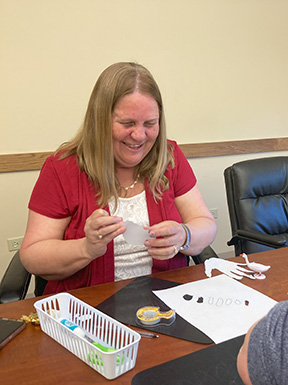 From the Editor: Julie Deden is the director of the Colorado Center for the Blind (CCB), the NFB training center in Littleton, Colorado. The CCB has long included courses in tactile art as part of its curriculum. In this article Julie Deden describes the Teach-In, a three-day conference to promote tactile literacy.
The flicker of a butterfly floating away. The V formation of wild geese overhead. The Washington Monument rising in the distance. As a blind child, I could not visualize any of these phenomena. What does a butterfly look like, I wondered. How big are those noisy geese? What is the shape of the Washington Monument, and how could I tell it apart from the Lincoln Memorial?
The world around us is rich with sights, sounds, textures, and so much more. As blind children and adults we want to experience everything and know the world as everyone else does. Much that we cannot perceive visually can be available to us through touch, as long as we have the opportunities we need for tactile exploration. Touch affords us the knowledge base that sighted people gain primarily (though not exclusively!) through vision.
However, some actual objects can never be available for hands-on exploration. Amoebas and bacteria are too tiny; hummingbirds aren’t about to hold still; and monuments are, well, too monumental for us to examine top to bottom with our hands. In such cases we need access to tactile representations in the form of 3-D models and raised-line drawings.
Blind and sighted children need the opportunity to explore the world. While sighted kids can explore by studying objects that are physically out of reach or by examining printed pictures and diagrams, blind children learn through tactile exploration. Tactile literacy is an essential skill for blind children, and, like any other skill, it must be encouraged, developed, and strengthened. Like Braille instruction, the development of tactile literacy skills is critical for learning, and it should begin early. When we encourage blind kids to explore with their fingertips, we bring the world to life for them. Quite literally, we bring it within their reach.
On May 1st, 2nd, and 3rd, more than forty people from all over the US and Canada gathered for the Teach-In, a unique event held in Littleton, Colorado. They came to teach, learn, explore, and experience. Sponsored by the American Action Fund for Blind Children and Adults, the Teach-In was held at the Colorado Center for the Blind (CCB).
Ann Cunningham and Chancey Fleet facilitated and coordinated the conference. Ann, a stone carver, began working with blind people more than thirty years ago. She wanted to make art beautiful, exciting, and wondrous. From the beginning she believed in blind people, empowering them to explore and create. As her career evolved, Ann worked with others to pioneer the use of tactile pictures and graphics through her books and other media.
Chancey Fleet works as the assistive technology coordinator at the New York Public Library. She is dedicated to making all things accessible. Her love of learning, her passion, and her creativity are reflected in her work, and her enthusiasm for teaching is contagious.
Most of the conference participants wanted to develop methods for teaching others. During the first two days they received in-depth training from renowned and experienced tactile art advocates and educators. Workshops focused on teaching concepts about perspective, gaining spatial awareness, and understanding what things look like through tactile drawings. Participants created tactile images using the Sensational Blackboard, a drawing tool developed by Ann. Many of the sighted participants wore learning shades so they could focus exclusively on tactile feedback.
Each participant learned to create recognizable tactile images. Perspective was a key element used to help participants learn about foreground, middle ground, and background. A grasp of perspective provides spatial integration and an understanding of scale. Each participant learned these concepts as they constructed a picture using the Flip-Pic, a multi-layered set of images.
On the third day of the Teach-In, the brand-new teachers taught a group of enthusiastic students. This innovative workshop began with eight instructors, who taught fifteen other people. Those fifteen people went on to instruct fifteen more.
As blind people, we want to be active learners. For us this means getting our hands on things so we can see them through our fingertips. Understanding pictures and images and learning about what things look like visually is invaluable for us. We can pick up a Sensational Blackboard and begin drawing and doodling, just as a sighted person might.
Tactile literacy provides us with the ability to understand maps, graphs, and tables. It gives us a knowledge of things around us—a butterfly, a wild goose, the Washington Monument. Anything we want to see can be represented tactually and understood through our sense of touch.
The concept of a Teach-In works beautifully. By spreading our passion and knowledge to others we create a ripple effect. The Teach-In participants will work in their communities to teach others, ensuring that blind people of all ages have equal access and understanding of our world. We can compete equally when we have the tools and the knowledge we need.