American Action Fund for Blind Children and Adults
Future Reflections Summer 2025 ART
Puzzling Challenges
by Maureen Handwerker
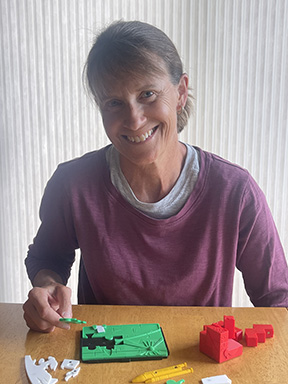 From the Editor: When I visited the Art Room at the 2025 NFB National Convention, I noticed that one table was especially busy. In fact, it attracted so much attention that people were waiting in line to explore its offerings. The table displayed a series of three-dimensional puzzles designed by Maureen Handwerker. In this article Maureen explains how she began designing three-dimensional puzzles that are fully accessible and challenging for blind people of all ages.
I started my professional life as a biomedical engineer, working in orthopedics. I designed implants and instruments for surgery, first for spinal surgery and later for work on the hand. I really loved my work; it was kind of a dream job!
That phase of my life lasted until my husband and I had three children. Not being great at multi-tasking, I decided to become a stay-at-home mom. Once the kids were basically launched, I decided to get back into the workforce, but I wanted to do something new. I went back to school to become an occupational therapy assistant, which requires a two-year degree.
The areas of occupational therapy (OT) that most interested me were assistive technology and hand therapy. I shadowed a hand therapist to learn more about the field, and at the same time I decided to look for some volunteer opportunities. In my search for volunteer work I discovered Ignite Adaptive Sports. The organization is based at Eldora Ski Mountain in Colorado, not far from where I live. Ignite introduces people with disabilities to snow sports, including downhill skiing, crosscountry skiing, and snowshoeing.
 I volunteered with Ignite for a season, mostly on Fridays. On many Fridays a busload of people came up from the Colorado Center for the Blind (CCB). This was the first time I had ever worked with blind people, and I loved it! The CCB students were a great group!
One day after the ski season was over I was out biking, about an hour away from my house. I began to notice serious floaters in my vision, and I knew something was very wrong. It turned out that my retina was detaching. The doctors were able to repair the damage, but the experience got me thinking about what my life would be like if I lost my sight.
I’ve always loved to do jigsaw puzzles. At the time of my detached retina, I was working on a very challenging puzzle with two thousand pieces. I thought that if I lost my vision I probably could figure out a way to fit the pieces together, but would I be motivated without being able to see the picture?
I had a 3-D printer at home, and I loved working in CAD (computer-aided design). CAD is one of the tools engineers use when they develop designs for projects. I decided to design a puzzle in CAD and print it with a 3-D printer. Then I reached out to the people at the CCB to ask if I could show my prototype to some of the students there. They were wonderfully receptive! I am forever grateful to them for the welcome they gave me!
I had no idea whether my puzzle project would be worthwhile, and I didn’t even know where to start. I didn’t know how many pieces to make, or how big they should be. It was all trial and error.
 Dan Hlavinka is the art teacher at the CCB. He invited me to spend a day at the art room and show my puzzles to each group of students that came in. I met people with a whole range of experience levels. Some people were very familiar with the way puzzle pieces fit together, and there were people who never had been exposed to puzzles in their lives. I realized I needed to address the whole range of levels of experience and ability. I wanted to create puzzles that could be challenging to people at very different levels of expertise. I decided to incorporate magnets into each puzzle, since magnets would hold the pieces once they snapped into place. I put magnets in the base frame, and they connect with the pieces when they are laid on top.
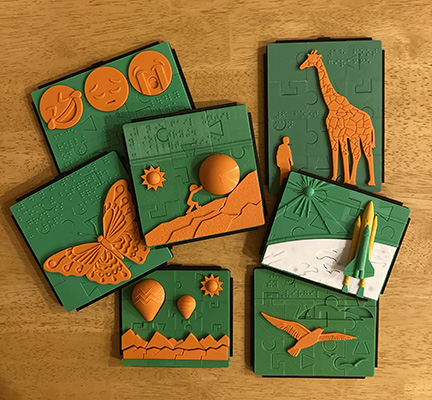
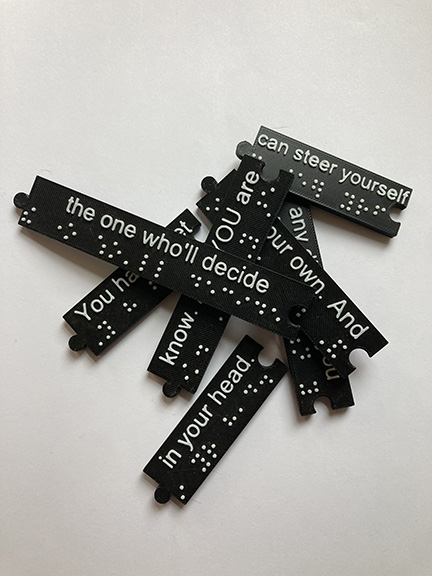
Sighted people get to look at a picture on the puzzle box. I tried to create a similar experience for blind users by creating a prototype 3-D image. On the suggestion of some of the CCB students, I also incorporated Braille into my puzzle designs. People were very pleased that the puzzles encouraged both Braille literacy and tactile literacy.
I know there are a lot of amazing apps out in the world. Blind and sighted gamers can play all sorts of games on their phones. I think that’s great, but I’m more of a low-tech person. Assembling puzzles can be a social activity that people enjoy together in real time.
I remember one student at CCB, a guy who had been blind from birth. He worked on a puzzle that had a Braille quote at the top. Below the quote was a picture of a bird, and I also put a couple of smaller birds in the distance. They were just little M shapes. When this fellow put the puzzle together, he recognized the image of the close-up bird, but he didn’t know what the little M shapes could be. Dan told him, “Those are birds, too. That’s what birds look like in the distance.” The guy doing the puzzle said, “Wow! I didn’t know that’s how birds look when they’re far away!” It was very interesting for me to hear that. When I design puzzles now, I think about incorporating perspective in ways people will understand.
So far I’ve designed four puzzles that I call shape puzzles: a horse, a rabbit, a dog, and a jeep. Each puzzle is in the shape of the object itself. I also have seven layered puzzles. With those you construct one puzzle initially, and other pieces fit on top. I’ve also branched out into cube puzzles. When I started out with the cubes they were just plain, but then I decided to add graphics. Now I have one cube that depicts animals and one that depicts modes of transportation—things like a train and an airplane. The cubes have either five or six pieces, but they’re more challenging than they appear to be at first.
Finally, I have a puzzle on my website that’s based on a quote from Dr. Seuss. All of the pieces fit together, but for the words to make sense, the pieces can only go together one way. You have to read the Braille words to make that happen.
So far I haven’t applied for any grants to help cover my costs. I’m working on my own and hoping the puzzles will catch on. Since Convention, more orders have started to come in.
Meanwhile, I have lots of ideas. I’m designing a perspective puzzle. I’d like to create a volcano puzzle and a puzzle with an underwater scene. I’d like to roll out new puzzles around holidays as they come up. I also would like to do more quote puzzles like the Dr. Seuss one.
So much learning can happen through puzzles! They can teach spatial relationships. They can teach perspective. And they’re fun! Puzzles are a low-tech option with lots of possibilities.
You can learn more and order puzzles at InsightAblePuzzles.com, or you can contact Maureen Handwerker at [email protected].