Future Reflections
Volume 34 Number 1 Winter 2015
A magazine for parents and teachers of blind children published by
the American Action Fund for Blind Children and Adults in partnership
with the National Organization of Parents of Blind Children.
Deborah Kent Stein, Editor
ISSN-0883-3419
Copyright © 2015 American Action Fund for Blind Children and Adults
For more information
about blindness and children contact:
National Organization of Parents of Blind Children
200 East Wells Street at Jernigan Place, Baltimore, MD 21230 • (410) 659-9314
www.nfb.org/nopbc • [email protected] • [email protected]
Orlando Site of 2015 NFB Convention
The 2015 convention of the National Federation of the Blind will take place in Orlando, Florida, July 5-10, at the Rosen Centre Hotel at 9840 International Drive, Orlando, Florida 32819. Make your room reservation as soon as possible with the Rosen Centre staff only. Call (800) 204-7234.
The 2015 room rates are singles, doubles, and twins, $82; and triples and quads, $89. In addition to the room rates there will be a tax, which at present is 13.5 percent. No charge will be made for children under seventeen in the room with parents as long as no extra bed is requested. The hotel is accepting reservations now. A $95-per-room deposit is required to make a reservation. Fifty percent of the deposit will be refunded if notice is given to the hotel of a reservation cancellation before June 1, 2015. The other 50 percent is not refundable.
Rooms will be available on a first-come, first-served basis. Reservations may be made before June 1, 2015, assuming that rooms are still available. After that time the hotel will not hold our room block for the convention. In other words, you should get your reservation in soon.
Guest-room amenities include cable television; in-room safe; coffeemaker; hairdryer; and, for a fee, high-speed Internet access. Guests can also enjoy a swimming pool, fitness center, and on-site spa. The Rosen Centre Hotel offers fine dining at Executive Chef Michael Rumplik’s award-winning Everglades Restaurant. In addition, there is an array of dining options from sushi to tapas to a 24-hour deli. The hotel has first-rate amenities and shuttle service to the Orlando airport.
The schedule for the 2015 convention is:
Sunday, July 5 Seminar Day
Monday, July 6 Registration Day
Tuesday, July 7 Board Meeting and Division Day
Wednesday, July 8 Opening Session
Thursday, July 9 Business Session
Friday, July 10 Banquet Day and Adjournment
Contents
FEATURE
Hands On? Hands Off!
by Carlton Anne Cook Walker
BRAILLE
From No Access to Full Access
by Sheena Manuel and Leesa Wallace
Ode to the Code: How One Student Came to Love Braille
by Kaitlin Shelton
Let BELL Ring Forever
by Amy Albin
The Joshua Project
by Christie Goldenberg
TRANSITIONS
From Pediatrics to Adult Health Care: Making the Transition with a Child Who Has Special Health Care Needs
by Diane Frazee
COMMUNICATION
Our Journey Continues
by Barbara Hammel
NONVISUAL ACCESS
The Tactile Graphics Revolution: Year Two
by Al Maneki
LibraryLyna: Bringing 3D Printing into the Classroom
by Kevin Yang
TRAVEL
Sighted/Human Guide: One Instructor's Perspective
by Merry-Noel Chamberlain
Over There
by CathyAnne Murtha
ADVOCACY
In the Event of an Emergency
by Sandra Bishop
IDEAS AND PERSPECTIVES
Calibration
by Jennifer Dunnam
PROGRAMS
The Slate Pal Opportunity
by Deborah Kent Stein
REVIEWS
All the Light We Cannot See
by Anthony Doerr, Reviewed by Molly Faerber
Blind
by Rachel Dewoskin, Reviewed by Deborah Kent Stein
My Three Best Friends and Me, Zulay
by Cari Best, Reviewed by Janna Stein
ANNOUNCEMENTS
ODDS AND ENDS
Why Join the NOPBC?
Are you the parent of a blind or visually impaired child? Don’t know where to turn?
Founded in 1983, the National Organization of Parents of Blind Children (NOPBC) is a membership organization of parents, educators, and friends of blind children reaching out to give each other vital support, encouragement, and information. We have thousands of members in all fifty states plus Washington, D.C., and Puerto Rico.
The NOPBC offers hope, encouragement, information, and resources for parents of blind or visually impaired children. NOPBC provides emotional support and a network of other families dealing with the same challenges you are facing. We also provide information, training, and resources to empower you to take an active role in guiding your child’s development and education. We can provide information on your child’s rights and on the laws and legislative issues that will enable you and your child to become strong and effective advocates.
Have you ever wondered what your blind or visually impaired child will be capable of when he or she grows up? The answer to that question is that blindness/visual impairment does not have to stop your child from doing anything he or she wants to do. We can connect you with other families and blind adults who can serve as positive mentors and role models. They can teach you the attitudes and techniques that will enable your child to become independent and to succeed in life.
What is different about the NOPBC?
Our status as a division of the National Federation of the Blind (NFB), the largest and most influential organization of blind people in the world, provides many benefits. Our members are well informed about the societal, legislative, and technological issues that affect blind people. We also enjoy the resources, support, and expertise of fifty thousand blind people who can serve as mentors and role models for us and our children. Finally, as our children grow up, they have the Federation to belong to.
No other organization for parents of blind/visually impaired children offers more programs, activities, and training to families, children, and youth. One of our most exciting activities is our annual conference. Every year since it was established, the NOPBC has conducted an annual conference for parents and teachers of blind children as part of the national convention of the NFB. The program has grown to include five exciting days of workshops, training sessions, activities for all family members, including sighted siblings, and countless opportunities to meet blind adults and other families and children from around the country.
What is the mission of the NOPBC?
The purpose of the NOPBC is to:
• create a climate of opportunity for blind children in home and society.
• provide information and support to parents of blind children.
• facilitate the sharing of experience and concerns among parents of blind children.
• develop and expand resources available to parents and their children.
• help parents of blind children gain understanding and perspective through partnership and contact with blind adults.
• function as an integral part of the National Federation of the Blind in its ongoing effort to achieve equality and opportunity for all blind persons.
Most states have an NOPBC affiliate chapter. You can find your state chapter at <www.nopbc.org>. If your state does not have a chapter and you would like to start one, please contact us. We may be able to offer training and other assistance to start a state NOPBC chapter.
What are the programs, activities, publications, and resources of the NOPBC?
• National and State Parent Seminars and Conferences
• Future Reflections Magazine
• NOPBC Website
• Books and Videos
• Blindkid & Other Listservs
• Early Childhood Conferences
• Pop-Up IEP Website
• Slate Pals Pen Pal Program
• AAF Free Braille Books Program
• Share Braille Book Exchange
• Writing Contests
• Junior Science Academy
• Youth Slam High School Science Academy
• National Center for Blind Youth in Science Web site
• NFB-NEWSLINE® Newspaper Service
• Where the Blind Work Website
• Free White Cane Program
• Blindness 411 Facebook Group for Teens
• NFB-LINK Mentoring Program
• Scholarship Program
• Straight Talk about Blindness Video Series
• Parent Leadership Program (PLP)
Contact Us:
National Organization of Parents of Blind Children
[email protected]
<www.nopbc.org>
Hands On? Hands Off!
by Carlton Anne Cook Walker
From the Editor: Carlton Anne Cook Walker serves as president of the National Organization of Parents of Blind Children (NOPBC). She is an attorney, a teacher of the visually impaired, and the parent of a blind daughter. In this article she tackles the highly important topic of person-to-person contact in the teaching of blind and multiply disabled children. The article is based on a presentation Carlton gave at the NOPBC conference during the 2014 NFB national convention in Orlando, Florida.
When I trained to become a teacher of the visually impaired (TVI), I discovered that a great deal of teaching was done using hand-over-hand technique. Hand-over-hand is the technique in which a teacher or other adult places his or her hands on the hands of a child and moves the child's hands through the activity that is being taught.
I began to ask myself, "Why am I putting my hands on someone else's hands?" Maybe I'm a bit more sensitive than most people, but I really don't like people to touch my body without asking me first. Now that I've gotten to know so many blind adults, I have come to find out that uninvited touch is part of their daily experience. People put their hands on full-grown blind adults, people who are making their way in the world. I find it very strange and troubling.
Person-to-Person Contact
The Individuals with Disabilities Education Act (IDEA) is very clear that students with disabilities must be educated in the least restrictive setting that meets their needs. We all know there are outliers and true horror stories of under-inclusion (and, sometimes, over-inclusion). Nevertheless, for the most part schools are following federal and state law in terms of educational placement.
However, the placement of the student is only one part of the story. It is the part that is covered under federal and state law and is monitored by state education auditors. Another chapter in the inclusion story is not written into law, and too often it is missing from practice in the schools. In many ways, students with IEPs (Individualized Education Plans) are treated very differently from students without IEPs. A major difference in the instruction of these two groups is the amount of physical contact, what I'll call person-to-person contact, that they receive from adults in their lives, both at school and at home. Part of being educated with children who are not disabled should include being educated like students who are not disabled.
Hand-over-hand is only one form of person-to-person contact. In the case of blind and visually impaired children, person-to-person contact is used to show, to teach, to guide, or to protect. When a child has additional disabilities, person-to-person contact may be used in many other ways. A child with poor muscle tone may need back support in order to sit on the floor, neck support to prevent injury, or arm support to reach out for a toy. Students with poor muscle control may need person-to-person contact to help them keep their limbs from making unintended movements. Some students have positional limitations--they may not be comfortable or functional in certain positions. Person-to-person contact may be necessary to help such students achieve optimal positioning. In all of these instances, person-to-person contact may help a student participate more fully in activities at school and at home. However, overuse of person-to-person contact can lead to problems.
Not surprisingly, parents tend to be more hands-on with all children than schools are. When an infant is born, we move his/her body around a great deal--for feeding, diapering, dressing, and of course, for cuddling. For a typically developing child reared in a typical environment, the amount of person-to-person contact lessens as the child increasingly engages with the environment. A parent may use person-to-person contact to initiate new activities, such as teaching the child to stir cake batter in a bowl. The typically developing child will demand more and more independence as he gains skills. In a typical family environment, the child will be allowed to take responsibility for the new task as he is ready to do so.
Of course, when the atypical arises, the natural progression of learning may be disrupted. As noted above, some children do not have the physiological capability of performing certain tasks. Other children may need to grasp the concept of the task differently due to a physical, intellectual, or sensory disability, or due to a combination of these factors. A child who is blind/visually impaired may need to learn the steps to a task through touch and/or verbal instruction. A child with additional disabilities may need special accommodations to perform the task. She may need more time to learn the task and its components, or she may only be able to perform a portion of the entire task.
Attendance at school helps push most typically developing children toward greater independence in the tasks of learning and living. Yet some schools do not hold the same expectations for students with disabilities. When this occurs, the school may actually encourage a parent to continue with person-to-person contact, even when such contact is no longer needed. Thus, the entire life of the child with a disability, at school and at home, becomes unduly restricted.
Measures of Success
The time factor is one reason why teachers and parents tend to overuse person-to-person contact. "We're running late!" is a refrain in our daily lives. When a deadline is bearing down, most parents will simply tie the shoes or button the shirt rather than allowing the child to work through the task on his own. Frankly, it is easier and faster for us adults to do the task instead of waiting for the child to get it done. Yet it is crucial for the child to have the opportunity to grow in his capabilities and responsibilities as he gets older. Extra time is not always available, but attention must be paid to making time whenever possible.
Another reason we tend to engage in person-to-person contact is to achieve what we think of as "success." At home, a parent may help the child hold a spoon to reduce the mess that will result from the child's first attempts at feeding herself. At school, a teacher's aide may cut, paint, and even draw a picture to ensure that the child's artwork is pretty. While this help is well-intentioned and understandable (who wants a messy floor? shouldn't a student's project look nice?), it does not help the student grow in skills or self-confidence.
For all children, success looks different at different times. Imperfection is a natural and necessary step on the journey of learning and self-discovery. Failures help us understand how to achieve success later on. A child who is not allowed to fall will never learn to walk. As parents and teachers, our job is to support a child or student, but not to prevent failure or guarantee success.
The Downsides of a Hands-On Approach
When an adult provides too much support, the student may not learn to complete the task in question. She may not reach her full potential to become independent.
Another problem resulting from too much physical contact with a child is the child's loss of self-determination. When someone moves the child's body without warning and without engaging the child in the purpose of the movement, the child has two options. The first, and most reasonable, is resistance. Indeed, I would resist if someone grabbed me, with or without warning, and tried to move a part of my body. I am an independent human being. I expect others to respect my body and my right to control it.
The other option for a child who is moved by another person is the passive acceptance known as learned helplessness. When children respond in this way, they show that they do not believe they have the choice to refuse or to engage in the activity. This passivity may make it easier for adults to complete a task, but it is potentially dangerous for the child. In the short term, the task is completed, but the child has learned nothing. He is simply a passive participant in the activity. In the long term, such passivity may render the child susceptible to physical and emotional abuse, and even sexual assault. The child feels powerless to object at the moment of the abuse or to report the abuse later in a safe environment.
The Purpose of the Contact
How can a parent or teacher determine whether too much support is being provided to a child? A first step is to question why the support is being given. While this sounds complicated, it really isn't. In fact, it's a process each of us uses daily in a variety of settings. For example, when I leave my house each morning, I must determine whether I need the support of a coat or jacket. I assess the current weather situation and perhaps check the weather forecast. I will wear a coat if it is cold, a jacket if it will be cool. I do not need the support of a winter coat on a hot day. Indeed, such support would actually have negative consequences.
Determining the proper level of person-to-person support for a child or student is no different. Here are some questions to consider:
- Is this contact tailored to the student's area of need?
- Does this contact even minimally meet the student's area of need?
- Can we increase the student's level of independence by reducing the level of person-to-person contact?
- What is the purpose of the task? To be completed quickly? To be completed with minimal mess? To be attempted or mastered by the student?
Once we have determined the why of person-to-person contact for a particular student, we are better able to determine the what, when, where, and how. Person-to-person contact can be active or passive. Typically, passive support is less likely to have the negative effects discussed above. An example of passive person-to-person contact is the positional support of sitting on the floor behind a student with poor muscle tone. The adult's support serves as a "chair," enabling the student to maintain the posture needed to engage in activities. Certainly, providing passive support when it is not needed could hinder the student's progress somewhat. However, when the support is relatively passive, the student has the choice to accept it or not.
In the "human chair" example, a student who cannot sit up easily without support will lean on the adult. If the student develops more trunk and neck strength, he will be better able to sit up without assistance. The "human chair" can continually assess the student's need for support by getting into position and increasing or decreasing the level of contact, based upon the student's ability to sit up and engage in the desired task. The amount of support may vary, depending on the task, the time of day, or other factors.
Active Support
Active support takes many forms. A common form of active person-to-person contact used with blind children in the school setting is the hand-over-hand technique mentioned earlier. An adult's hand is placed on top of the child's hand, and the adult moves the child's hand in an action. For example, an adult might place a toothbrush in the child's hand. The adult then covers the child's hand with his own and brushes the child's teeth as if the child's hand were not even there. The child's hand is being manipulated by the adult's hand to perform the action.
As noted above, active support is commonplace with typically developing infants and toddlers. It is used less often as the child grows. At school, it is rare to find active support, such as hand-over-hand, used for teaching activities. Instances of active support are usually very short and infrequent. For example, a teacher might show a kindergartener how to clap by moving the child's hands together and apart a few times, but the teacher is not likely to do so every day with every child.
In stark contrast, active support is used a great deal in special education settings. Not only is it used with greater frequency, but its use is of longer duration. Each instance of active support may last for several minutes, and instances may be repeated over many days, weeks, months, and years. Perhaps due to its popularity in the schools, hand-over-hand technique is used at home more often for children with disabilities than it is for their nondisabled peers.
We should question this discrepancy. Why is the hand-over-hand technique used so very much with children with disabilities? Are we overusing it? Are we using it for noneducational purposes, such as speed? If hand-over-hand is a way to teach skills, why do children continue to need this support for years on end? At what point can we expect the child to learn the skill without hand-over-hand assistance?
A New Approach
As an educator, I have come to the conclusion that hand-over-hand assistance is too restrictive to constitute an effective learning practice. When the active support of hand-over-hand is used, the child/student is reduced to a passive participant in the learning process. The hand-over-hand technique does not allow the child to understand the motor movements necessary to perform the task.
We learn best from activity occurring under our fingers. Our fingertips and palms are far more sensitive to tactual information than are the backs of our hands. Hand-over-hand technique requires the adult's hand to make the movement for the child. The child's hand is controlled by the adult, not by the child himself. When this technique is used, the child needs an immense amount of time to learn a given task.
Furthermore, hand-over-hand creates an environment that pits the child and adult against one another for control. When an adult places her hand on the hand of a child, the child cannot readily resist the activity. The child must either resist or passively accept the activity in question. Typically, strong resistance is met with disapproval by the adult, who uses more strength in the hand-over-hand motion. The child who resists is scolded, manhandled, and punished. The child who does not resist has taken another step on the road to learned helplessness.
In order to teach our children more effectively, another option is needed. For students who need additional support in gaining information about a task and learning new skills, a great option is the hand-under-hand technique. Hand-under-hand is not very prevalent in the school setting, but its popularity is growing, particularly in the education of blind and deaf-blind students. Hand-under-hand involves the adult's hand performing the activity with the child's hand on top, feeling the movement of the adult's hand. The adult performs the activity naturally, although maybe a bit more slowly, and verbally describes what is going on. This technique allows the child to feel the movements necessary for the task and to mimic the movement himself. A child who is resistant can easily pull away from the task. The child has choice and can use it. The adult can respond to the child's feelings, just as she would with a typical child who refuses to put on a pair of gloves or a hat.
In some cases, the child is willing to participate in the activity but has difficulty controlling muscle movements or is easily distracted. Minimal restriction may be helpful, such as looping a finger or thumb over the student's hand or providing a "hand wall" to keep the student's hand from moving too far from the area of activity.
Hand-under-hand technique lends itself easily to reducing the amount of support given. When I use this technique to encourage tactile exploration, I simply pull my hand further back and allow the student's hand to touch more and more of the surface being examined. When I use this technique with a child who is learning to grasp a crayon or use a Brailler, I gradually reduce the presence of my hand on the tool and increase the amount of work for which my student is responsible.
Does it work? Yes! The results take a little longer to show up, but they are real and long-lasting. Students who receive hand-under-hand assistance become active participants in their learning lives. They reach out more, and they are less passive or not passive at all. It may take them longer to finish an art project, and that art project may not look as perfect as one done with hand-over-hand assistance. However, the student has performed the task. In time, the amount of hand-under-hand assistance can be reduced. The assistance can become more passive, and the student will be able to transfer skills to new areas of his/her life.
Hand-under-hand is not the only type of passive assistance that adults can provide. The adult can provide supported assistance, such as supporting a student's elbow to allow for greater independent movement. Side-by-side modeling of an activity is great for gross motor skills such as learning the “Hokey Pokey.” Step-by-step tactual prompts or cues, step-by-step verbal directions, and step-by-step verbal cues or questions such as "What's next?" all allow the child to learn while maintaining his autonomy. Over time, the adult provides tactual or verbal assistance only when the student requests them. Such an environment allows the child true success, the sense of being capable and empowered.
Respecting the Individual
Let your child know what's going on. Instead of taking his hand, announce, "It's cold outside, and I am going to put on your mittens. Right hand first!" Instead of just feeling someone take his hand and put a mitten on it, your child knows what is coming and why.
Another important element in empowering your child is giving her a voice and respecting that voice. Children who do not have the right to disengage from an activity will probably not be fully engaged with the activity—they don't have a stake in the outcome. Moreover, granting your child the right not to participate, at least at first, helps to stave off learned helplessness and foster increased self-worth.
How can you make this happen? All learning starts at home. Choose an activity for which you would like to start implementing a more hands-off approach. It is usually best to choose one activity at a time, so as to allow the child to concentrate effort and focus on that activity. In addition, choosing an activity in which the child is highly motivated can ease the process for all concerned. For example, for teaching the use of an eating utensil, choose a food the child enjoys and can be successful with more easily. Eating applesauce with a spoon probably should precede eating broccoli with a fork.
An important part of including your child is verbalizing what is going on. Tell him what you are doing and why. Exhibit excitement for her learning without creating fear of failure. "I really enjoy feeding you this applesauce. But you know what? I shouldn't have all the fun. Let's practice using a spoon together!"
Staff members at your child's school might or might not be excited to engage in this new method. Changing habits and attitudes can be difficult, but it will be worth the effort. Share this information with your child's school. Tell the teachers and aides how important it is to you to have your child be more in control of her world. Emphasize the need for your child to gain actual skills, not for adults to complete tasks on her behalf. If IEP team members are resistant, keep track of your progress at home. Bring in concrete information about how your child has grown in skills when provided the opportunity to do them without hand-over-hand.
Call an IEP meeting. Ask for the IEP to state (typically in the accommodations and modifications area): "Due to Sarah's need for assistance to perform classroom tasks with a growing level of task independence, no staff members working with her should support/utilize hand-over-hand technique," or, "Due to Brandon's need for assistance to perform classroom tasks with a growing level of task independence, all staff members working with him should use hand-under-hand technique or a lower form of support."
Guiding Principles
Slow down! Lifelong learning is a marathon, not a sprint. A student may need additional processing time or additional time for practice. Avoid rushing to get an activity done. If you are in a real time crunch, just do it yourself.
Be flexible! Pick your battles. Think first—practice before doing.
Determine the real purpose of the activity. Focus instruction on the areas in which you want to see growth. Pick one area to concentrate on at first. Clearly communicate the purpose of the activity to the student. If portions of the activity are being put aside to focus on one area, explain this to the student.
Determine how much assistance is truly needed for the activity. Begin by using the minimal level of support you believe is necessary. Engage in constant assessment of the student's need for support. Drop back to less restrictive support whenever possible, but be willing to ramp the support back up if needed.
Understand that support needs may vary. Needs may be different from day to day, during different days of the week, and at different times of the day. They may also vary from task to task, and even within a task, particularly at the beginning of the task or when the student has reached a saturation level for the activity.
Preview the activity with the student verbally. Remember to engage with a running commentary. Preview any items with textures the student may dislike (such as shaving cream, a sandbox or water table, a sponge used in sponge painting) before utilizing that item.
Honor the student's individuality. Allow the student to say no. Of course, there may be consequences, but everyone else has the right to say no.
Accept imperfection. As the parent of a student with special needs, I can assure you that I would much rather have a piece of artwork that reflects my daughter than one that reflects her teacher. All students need the opportunity to make mistakes. By learning what didn't work, they are in fact learning a great deal.
All students need to feel valued and valuable. Let them have ownership in the task. Don't rob them of accomplishment.
Share the knowledge! Parents are a child's first teachers. Prepare a guidebook documenting what you have learned about your child. Share it with school staff and other family members. They can use it to engage with the student. Teach them to be successful. Include information about approach, positioning of student, positioning of materials, verbalization, and anything else you have found helpful.
From No Access to Full Access!
by Sheena Manuel and Leesa Wallace
From the Editor: Sheena Manuel and Leesa Wallace are teachers of blind students (TBSs) trained at Louisiana Tech University. In this article they describe how they taught Braille to one of their students in a year, allowing her to participate as an equal with her sighted classmates in her second-grade classroom.
Allonah--smart, funny, and charismatic--is a second grader who loves reading Braille to her sighted classmates. Allonah started to learn Braille in August of 2013. Up to that point she spent most of her time in the regular education setting bent over her desk. She needed to get closer and closer to her paper to complete her assignments. After assessing Allonah, using the National Reading Media Assessment among other assessment tools, it was determined that Braille would be her primary reading medium.
All children experience uncertainties during their education, and Allonah was no exception. She was concerned when we told her that she needed to learn Braille. After all, no one else in her class had to learn it. As we developed ways to motivate her, however, she began to see the benefit of learning this new way of reading. With incentives and interactive bulletin boards, Allonah learned the entire Braille code in only a year.
As teachers of blind students and graduates of Louisiana Tech's Teaching Blind Students master's program, we learned about a new method of teaching Braille from Dr. Ruby Ryles. Dr. Ryles introduced us to the Natural Order of Contractions method, which was later revised by Casey Robertson West. We agreed that Allonah, and all blind children, should be taught the code as they experience it through reading.
We taught Allonah by using the Mangold Developmental Program of Tactile Perception and Braille Letter Recognition, Dolch words, and leveled readers from the Reading A-Z online leveled reading program. (Dolch words are frequently used words that are divided into lists based on grade level. These are words that children generally learn by sight.)
After completing the Mangold program by the end of October, we moved on to the Natural Order of Contractions. Taking the Dolch words and leveled readers, we created activities and assignments in a format similar to that of the Mangold program. Before Allonah began reading a story, we introduced contractions and words she would encounter. For example, if we knew that the word the or the ea sign and the ed sign were in the story, we prepared sheets focusing on one word or contraction per page. The sheet would have the word or contraction at the top and a helper line below. Sentences or words containing the contraction would follow under the helper line. Allonah read these sheets before reading the story. As she read the story, we simply gave her any word that she did not know.
The interactive bulletin board played a major part in motivating and reinforcing Allonah's skills. The interactive board had a word wall with words and contractions that were introduced and seen in the story. As she learned new words and contractions, she earned rewards. This interaction created snow princesses, queens of Braille, and smarty girls. This practice aided Allonah in learning the literary Braille code in a year while having fun at the same time.
Now in the second grade, Allonah experiences life in the fast lane. She receives all of her materials in Braille and is able to participate fully with her class. She does whatever her classmates are doing. From the beginning, she has learned that she is expected to do whatever her sighted classmates are expected to do.
This approach is beneficial in teaching blind children skills, independence, and a strong philosophy about blindness. As we hold our high expectations and have a positive outlook for all blind children, Allonah's teachers and sighted peers understand that it is okay to be blind. Allonah reminds us and shares with others that learning Braille is easy.
REFERENCES
Dolch Words: <http://www.dolchword.net>
Mangold Developmental Program: <http://exceptionalteaching.net/rk8.html>
Reading A-Z Online Program: <http://www.readinga-z.com>
Ode to the Code
How One Student Came to Love Braille
by Kaitlin Shelton
Reprinted from Braille Monitor, Volume 57, No. 11, December 2014
From the Editor: Kaitlin (Kaiti) Shelton is the president of the Ohio Association of Blind Students. She won a national scholarship in 2013, and she has won two scholarships from the NFB of Ohio. In this article she offers her perspective on Braille and Braille literacy.
Today I am an avid Braille reader. I love reading novels on my BrailleSense or in hard copy, and I can't imagine life without literacy. Some would say I'm even a bit too stern about Braille. I tend to avoid other forms of reading such as audiobooks and live readers, since a part of me considers using those methods of reading to be cheating. You really can't replace Braille and the independence that comes along with it. From the way I talk, you're probably assuming that I've had a Braille-filled childhood and parents who fought long and hard to secure the privileges of reading for me, but that wasn't the case.
One day in pre-K I was pulled out of class by a woman from the county for an assessment. We sat in the hall, and she introduced me to the Perkins Brailler for the first time. We Brailled a few letters, and I was starting to get the hang of it, but she took me back to class, and I never saw her again. County officials determined that I saw well enough that reading Braille might not be my best option. When I was sent along to kindergarten, my parents had the notion in their heads that I would read large print.
Kindergarten came and went, and I started first grade in the fall of 2000. My teacher, a creative and wonderful woman named Mrs. Murphy, noticed right from the start that there were a few problems with my academic performance. For one thing, I could read print, but it was painfully slow and tedious. Since I have nystagmus and a very small focus in the one eye that has vision, I had to scan each letter individually before I could identify the word I was reading. I was also missing out on a lot of the incidental learning that the sighted students gained from seeing things such as alphabet posters, number charts, and other visuals on the walls of the classroom. Mrs. Murphy decided that this needed to change. She researched the problem and decided that it was time for me to switch from reading print to reading Braille.
This idea terrified my parents, especially my mother. She had been told that, since her child had vision, everything should be done to allow that vision to be used, and that using it would help me be more like my peers. In a roundabout way she had been told that reading anything other than print would make me look blind. Under these conditions, she was against the idea of my learning Braille. She thought, "Who does this teacher think she is?"
But Mrs. Murphy followed her instinct and fought for me to learn Braille. She sat my mom down and told her that I was a bright student; there was no reason for me to be reading below grade level and falling behind my peers if it didn't have to be that way. She explained that for me Braille would be the great equalizer. The books would grow longer and more complex, I'd be expected to read more for my classes, and without Braille I would continue to function at a lower level than my sighted classmates. She also made the point that the doctors had no idea how long I would have usable vision, and that it would be much harder for me to learn Braille as a middle school or high school student than it would be at six years old, when reading instruction was part of the curriculum. My mom finally agreed that I should start learning Braille, and my instruction began.
But that wasn't the half of my struggle to become Braille literate. By that time the idea that reading print was what made me the same as my friends had already wedged its way into my six-year-old brain. When they took away my books that had pictures on the covers and looked just like everyone else's, I was absolutely distraught. The Braille books I was given in their place were bland, bulky, and very different. I didn't like being the only one in my class to have books like them, so I resisted the instruction.
The Perkins Brailler was also something I came to despise. Before I used the Perkins, I used a grease pencil to write. I'd often lift my face from the page with black grease smeared all over myself, but I figured that at least I was doing what my friends did. The Brailler was heavy, bulky, and loud. We were supposed to be very quiet during spelling tests, and using the noisy machine made me feel self-conscious. Many of my spelling tests were not completed because I would get frustrated or upset and begin to cry or throw a temper tantrum in the middle of class. I remember being carried out of the room into the hall by my aide, sobbing out, "I hate Braille!" Though I laugh about it now, it was a serious self-esteem issue for me at the time.
As the year went on, I started to devise other methods for avoiding the Brailler. Once, when my aide had left me alone in our Braille room to grab something, I shoved everything I could get my hands on into the Brailler. Pencils, paper clips, and thumbtacks were among the items that the aide tried to fish out of the machine, but it had to be sent off to be repaired. Unfortunately for me, the county brought a spare Brailler to the school for me to use while the one we had was being fixed. I think that's when I realized that I wasn't going to avoid Braille. It was clear to me that it would now be a part of my life, and I would just have to deal with it.
In second grade, after I had been reading Braille for a year, my attitude began to change. My skills had improved to the point where I could start reading the same stories as my classmates. Even though I still didn't have my pictures, at least I could read the same Junie B. Jones and Magic Treehouse books. My mother had become a staunch supporter of Braille. She began purchasing the print copies of books I read so she could read with me. Each Christmas after that, until I became a member of Bookshare and NLS, I received several Newberry Award-winning books in Braille from Seedlings Braille Books for Children. Soon I started reading books above my grade level, and by third grade my favorite books included The Trumpet of the Swan, Matilda, Charlotte's Web, James and the Giant Peach, and some books in the Goosebumps series.
Over the next several years I began to advocate for Braille along with my mother. Together we established a Braille book library for blind children throughout Ohio, and several of my Seedlings books are in that library today. Whenever I hear the parent of a blind child say that he or she uses audio and the computer to read, I always ask, "What about Braille?" And then I try to educate them about how Braille has enriched my life and the lives of other blind people. As Mrs. Murphy said, for blind people Braille is the great equalizer. It is what makes us literate. Although technology and audio can certainly be useful and do serve their purposes, they can't replace Braille.
Without Braille I know that at best I would have struggled through high school and performed less successfully than I have. At worst I might not have finished high school and might have found some small job that doesn't require literacy skills. Fortunately, I can say that, not only am I well versed in the literary code, but I also use the music Braille code for my studies as a music therapy major. I know the scientific and Nemeth codes as well.
In the Federation we hear all the time about parents fighting their school districts for Braille instruction. My situation was the opposite, and I shudder to think where I would be today if my parents had never changed their minds about Braille. I am glad that my parents and I have come to see Braille, not as something that makes me different from my sighted friends and classmates, but as something that lets me compete and perform to the same standards. I consider myself to be extremely lucky, not only because I learned Braille at all, but because so many kids like me with usable vision are denied the right to receive a comparable education to that of their sighted peers. If it weren't for Mrs. Murphy's insistence, I would never have discovered the necessity and joy of Braille literacy.
It is fitting that my birthday is the same as Louis Braille's, January 4. I owe so much to him--as we all do--for the code that has made me who I am today.
Let Bell Ring Forever
by Amy Albin
Reprinted from The Sounding Board, A Publication of the NFB of New Jersey, Fall 2014
From the Editor: The NFB BELL program (Braille Enrichment for Literacy and Learning) has proved a highly successful tool for teaching young blind students. In addition, BELL can be a life-changing experience for the volunteers who assist with the program. In this article, Amy Albin relates the value of her experience with the New Jersey BELL program. Amy is a tenth grader who enjoys reading, writing, and music. She plans to attend college, where she will study math or psychology.
On the first day of an experience that would give anyone tremendous joy, one of the first questions the boys asked me was, "What should your name be?"
"I'd feel really awkward if you call me Miss Albin," I joked. "I'm hardly an adult."
We decided on Miss Amy.
When Joe Ruffalo, president of the New Jersey affiliate of the NFB, and Barbara Shalit, the head teacher for the New Jersey BELL program, asked me to volunteer, I was grateful for the opportunity. I worked with the students for a total of thirty hours last summer. Before the program began, I had written a paper and composed some passionate speeches on the importance of nationwide Braille literacy. I had done a great deal of talking, but here was my chance to take practical action.
Running for two weeks, this program, which took place at the Puerto Rican Association for Human Development in Perth Amboy, was designed to teach Braille, daily living skills, and positive attitudes toward blindness to blind students ages four to twelve. I did not teach those lessons, but I observed the students taking part in such activities as pouring liquids and making sandwiches. They were also exposed to different ways of folding paper money.
During the first week, three boys, ages five to seven, came to the program. A seventh-grade girl joined them the following week. On the first day when I met the boys, I was drawn to their youthful energy and eagerness to learn. I know they learned a great deal, and I hope I was instrumental in contributing to that end.
In the weeks and months before the BELL program started, I eagerly anticipated my role as a teacher and mentor. I expected that I would teach Braille and have discussions with the students. For the most part, I was right. Many of the activities were group-based. But a crucial aspect of the program was to allow each student to work one-on-one with a teacher or volunteer to learn concepts appropriate to his or her level of understanding. I enjoyed working with the students in this way. Ms. Shalit often emailed me the lesson in advance so I would know with whom I was working and what material we would cover that day. I took turns teaching different students.
While I was helping the BELL kids learn, I remembered how I disliked learning Braille as a young child, so I did my best to make the lessons entertaining. The strategy worked beautifully, and my students truly seemed to enjoy what they were doing. Recognizing the needs of each individual student was a key component that made BELL successful.
I also assisted the teachers by reading short stories to the students. If I had to guess, their two favorites were about Helen Keller and Louis Braille. The students loved those books so much that I read them aloud on multiple occasions. While reading stories, I tried to instill positive attitudes about blindness by saying that it is not bad to be blind.
I love the fact that the kids were so enthusiastic and eager to learn. I find that some students in middle and high school are just getting by, thinking, "Why do I need to be here? When will I ever need to know this subject?" The children at BELL were different; they were still at that young age where every new experience was wonderful and exciting. One boy, to my knowledge, had received no Braille instruction before he entered BELL. At the end of the first day when his family came to pick him up, he passionately demonstrated how to put paper into the Perkins Brailler and write the first letter of his name. He got his mom excited to teach him and learn Braille herself. I loved the entire program, but if I had to choose one favorite moment it would be the end of that first day when I knew we at BELL had started a new, exciting chapter in a student's life.
I feel immensely rewarded that I taught something to the BELL students, but they taught me as well. For one thing, I can better empathize with elementary-school teachers. The students at BELL reminded me how short kids' attention spans can be. I said to myself, "If four kids are this energetic, imagine teaching twenty rambunctious kids five days a week, year after year!" Teachers deserve much more credit than American society bestows on them.
Once again, I feel greatly privileged by the opportunity to make a difference in the lives of young blind people. I am tremendously grateful to Ms. Shalit and Mr. Ruffalo for asking me to contribute to the BELL program. In addition, I thank the wonderful teachers and the NFB as a whole for making BELL what it is—a truly remarkable success.
The Joshua Project
by Christie Goldenberg
From the Editor: Christie Goldenberg is a single parent who works as a special education paraeducator. She is also co-owner and board member of The Joshua Project Foundation. In her spare time she enjoys reading, crafting, writing book reviews, and blogging. Her dream is to write a book about her life experiences and help others to see things differently by changing their perspective. Her son Joshua was honored in 2014 with a Gloria Barron Prize for Young Heroes for his efforts to make Braille more available in stores.
During an ultrasound when I was twelve weeks pregnant, I heard the terrifying words, "I think that your baby's right eye didn't develop." About a month later at my next prenatal appointment, the doctor's concerns were confirmed. It was my decision, they said, whether or not to continue with the pregnancy.
The next couple of weeks were filled with tests and intensive ultrasounds. Every bone was measured to track my baby's growth. The doctors worried that the pregnancy was going wrong, that the baby wasn't developing properly.
Throughout this period of fear and uncertainty, I knew I already had made my decision. No matter what, I was keeping my baby. Other people in my life, however, didn't always feel the way I did. A man at my husband's workplace came up to me and said, "It isn't fair for you to even consider keeping that baby. He is deformed, and his whole life will be difficult. You need to abort, and then you can try again." Unfortunately, he was not the only person who felt it necessary to hand out unsolicited opinions.
The ultrasounds and tests showed that the baby had no problems beyond his undeveloped eye. I did research on the internet to learn what difficulties my child would have to deal with. I was determined to help him live a full life, unlimited by his disability. I looked forward to the day when those people who didn't think my son deserved to be here would eat their words!
When Joshua was born he looked perfect. He always looked as though he just had one eye closed. His left eye was a gorgeous shade of blue. From the beginning he was a happy baby, curious and smart.
But something began to nag at me. "I don't think he is looking at me," I would say to my husband and friends.
"Oh, you're being ridiculous!" they told me. "There's nothing to worry about."
When Joshua was three months old, we went for an appointment at the Jules Stein Eye Institute in Los Angeles. It was time to check on the micro right eye and see if it required any attention. At the end of the long appointment, the news hit us like a Mack truck. Our son was totally blind and had been since birth. His optic nerves had never developed. He had never seen anything and never would. The diagnosis was bilateral microphthalmia.
For a time I felt as if we were moving through Vaseline, hazy and thick. What had happened? We wanted answers. My husband and I each blamed ourselves. We saw a geneticist who ran tests and told us she had no answers for us. Then, a geneticist at Children's Hospital in L.A. said the words that changed my life. "Stop looking for reasons and answers," she told us. "Stop blaming yourselves. It won't do you or your son any good. Accept what is and move on. Treat him like a normal child, and he will be normal. Raise him with the same love and expectations you have for your daughter."
At last I was free!
Now it was time to get down to the work of parenting. I was given the number of a mom who had a blind child. I gave her a call, hoping for advice and encouragement. What I received was a smack of the reality to come. As she described medical appointments, therapies, O&M sessions, Braille lessons, and a host of other challenges, I heard an inner voice screaming, "I can't do this!"
I hung up the phone, hating that mother. How could she say those things to me? Today I realize that, although her delivery left a lot to be desired, she was preparing me for my future and all it would indeed entail.
At only six months old, Josh had his first surgery on his right eye socket. It was followed by another when he was twelve months old. At the age of eighteen months, Josh became very agitated and cranky. Suddenly he began to bang his head against the walls and floor. A few days later, at Children's Hospital, an ocular oncologist informed me that Josh had severe glaucoma in his left eye. The eye would have to be surgically removed right away.
I was shattered. To me, that eye had seemed the only tiny window into my son's soul. I could read his emotions and thoughts by looking into that eye. If they took that eye away, how would I know what he was feeling? I felt I would have nothing to go by. In some ways this loss was even more devastating to me than anything else we had experienced up to that point.
My husband and I were inconsolable. Our pain ran so deep that we couldn't even be together while we waited during Josh's surgery. But it was during Josh's stay at Children's Hospital that we had the major epiphany that began our healing. The morning after the surgery, we ate breakfast at the McDonald's located inside Children's Hospital. As we sat there, we watched dozens of children with many different diseases and disabilities. We saw that their conditions did not define them. They were children first. Their joy and laughter were overwhelming and contagious. As we looked around at their parents, we realized that many of these children might not enjoy a full life span. Some would never even go home from the hospital.
We looked at each other and realized how lucky we truly were. I thought to myself, "This is nothing. I can do this." What if we stopped asking, "Why me?" and "Why him?" Perhaps our job was to understand that this life experience was actually a gift. Change your perception, change your life!
The emotional toll of the surgery set back much of the progress Josh had made with his occupational therapist. For a time he stopped eating and talking. His joyous, easygoing personality seemed to have been marred. The recovery was long and slow for all of us.
After Josh recovered from the effects of the surgery, the next step was to continue the process of getting his prosthetic eyes. Up to this point, Josh had a spacer in his right eye, a clear plastic piece with a tiny handle sticking out. The purpose of the spacer was to expand his eye socket in order to prepare it for the prosthesis, but it made for some tough times. Once at a neighbor's party, a child walked up to Josh, looked at him and yelled out, "AWWW! MONSTER!"
The child ran to his mother, who was standing about twenty feet from me. As he cried to her and pointed, I tried to get her attention. I smiled and waved her over to me. I thought that perhaps I could turn this negative event into a learning moment. The woman looked at me and Josh, turned to her son, and said, "Stay away from him." I couldn't believe what I had heard!
Our next step was to get services for Josh through our school district. We began with a weekly "Mommy and Me" class for parents of special-needs children. I met many parents of children with developmental and/or physical disabilities, but none of them had a blind child. Sometimes the class left me feeling more alone than ever.
Finally I began to work with a specialist from an organization that serves the blind and visually impaired. She answered some of my questions and pointed me to a variety of resources. Nevertheless, she conveyed the message that no matter what I did, I would never get the services Josh required from our school district. She encouraged me to hire an advocate to help me with our IFSP (Individualized Family Service Plan) and to hire an attorney if needed. None of this advice did anything to reduce my stress level! I felt pressured to get ready for a war against an invisible enemy that I hadn't even met.
It didn't take long for me to map out a strategy. I realized that the only way to win was to get these people to know and care about Josh. If they met him, they would fall in love with him and feel compelled to help. Now I bring Josh into all of our meetings, either at the beginning or at the end. He says hello to everyone on the team, gives hugs, offers input, and asks whatever questions are on his mind. His presence helps to remind everyone that he is a person, not a case file.
Fast forward a few years. Josh is six. He is in kindergarten, attending our neighborhood elementary school in a regular classroom. The other kids love him, and he makes friends easily. He has been studying Braille after school for the last two years, and he is a proficient reader. The teacher loves him, and he has a wonderful aide.
One day Josh and I go grocery shopping together. Josh begs me to buy him some triple A batteries, but I see that they are out of stock. When I tell him, he says, "Well, show me."
I put his hand on the empty space where the battery packages would usually be hanging. "Where is the Braille, Mommy?" Josh asks.
"Josh, there is no Braille in the grocery store," I explain.
"Why not?! How am I supposed to shop, then? Mommy, make them put Braille up so I can shop, too."
I am perplexed. With everything I have tried to plan for, I never thought about my son grocery shopping. As always, I jump on the internet for answers, but what I see disturbs me greatly. I tell Josh that when he is older and goes shopping by himself, he will have to ask someone who works at the store to take him around and help him pick out his items. Josh doesn't like this answer one bit, and frankly, neither do I.
The next time I visit our local grocery store, I talk to the manager. I ask if he would let me put a few clear Braille labels on the shelves that have Josh's favorite items, i.e., popcorn, waffles, and cookies, so that he can have the experience of shopping when he comes to the store with me. The manager likes the idea and says he will call me later that day. But the phone call is disappointing; the answer is no.
My husband is furious. He goes to another store, part of the same chain, across the street from where he works. The manager at this location is thrilled to help us and agrees to let us put up as many labels as we want to. My husband tells a friend who is a local newscaster. She gets approval to film us for a segment on the evening news, which airs a week later. The response is amazing.
I decide to write to another local grocery store and ask if we could put up labels in their store, too. But meanwhile my husband goes into the first store, and they rudely inform him that all of the Braille labels have been taken down. They will not be allowed back up, by instruction of the corporate office.
We are devastated. Josh cries and keeps asking "Why?”
A few days later I receive an answer from the store I had written to. Not only are they willing to let us put up a few labels, they want to Braille the entire store! The manager calls it “The Joshua Project.” The newscaster comes back out and films another story to follow up on the first one. At this point one of my husband's friends says to us, "You need to turn this into a nonprofit. I will give you the money to get it off the ground. My lawyer will call you to get you started."
Four years later, The Joshua Project Foundation is a 501(c)3 with seven amazing board members. We have put Braille labels into seven stores in locations including Westlake Village, Tarzana, and Santa Barbara, California; as well as Boston and Canada. We have just held our second annual fundraiser at the famous Palm Restaurant in Los Angeles, where seventy-five people ate a four-course, five-star meal, in the dark, under sleepshades.
Our work has gone beyond Braille labels. We have developed Braille aisle markers, Braille maps, and even a talking Braille scanner. It is Josh's dream "to Braille the world, and Target, too!"
Josh is our greatest gift. He teaches everyone valuable life lessons. When people see him or hear about him and feel sorry, I laugh and say, "Don't spend one second feeling sorry for him! He is a superhero. Spend one day with him, and you will know that you are the one who is disabled."
From Pediatrics to Adult Health Care
Making the Transition with a Child Who Has Special Health Care Needs
by Diane Frazee
From the Editor: Discussions of transition for young people with disabilities generally focus on life skills, education, and job readiness. A topic that is seldom addressed is the move from the pediatrician to the adult health care system. In this article, Diane Frazee recounts how she and her daughter negotiated this challenging transition. Diane Frazee directed a parent-to-parent program in Ohio for twenty-five years, and she has presented workshops on a variety of disability-related topics statewide and nationally. Although officially retired, she works part-time for Family Voices of Ohio. She continues to find inspiration through her adult daughter, who has multiple disabilities.
Transition! The very word puts a fear of the unknown into all of us. We become so comfortable with what we already know that even moving on to something wonderful can create anxiety.
When children have special needs, early transitions for the parent and the child occur in quick succession. First you leave the early intervention system and start preschool. Before you know it, there's kindergarten, and right after that comes first grade. Then you move on to junior high and high school—and the next thing you know, your child is graduating, and a whole new world is on the horizon.
For those of us whose children have come this far, the school initiates a transition plan as part of the Individualized Education Program (IEP). Federal law requires this planning process to begin at least by age sixteen, and some states start as early as age fourteen. Most plans focus mainly on education, employment, and living arrangements. These are all important things to think about. However, one aspect of transition that is seldom addressed is the move away from pediatric care and into adult health care. For most of us, that's a scary thought!
As the parent of a young woman with multiple disabilities, I had developed a wonderful relationship with the pediatrician and the entire office staff. They had known and cared for my daughter since birth. Like most children with special health care needs, my daughter had many more visits to the doctor than the average child without disabilities. She was very familiar with the office surroundings and the procedures the staff put in place. I wanted to stay with the pediatrician forever! I was comfortable there, and so was my daughter. However, as my daughter grew and matured, I began to realize that it would be necessary for her to receive medical care from providers trained to treat adults.
Now the questions started popping into my head:
- How would I find a doctor knowledgeable about my daughter's special health care needs?
- Would the new physician accept our health care plan?
- Would she or he be willing to take extra time with us during an office visit?
- Would he or she be on staff at the hospital we use?
- Would the new doctor be willing to listen and learn about our history and previous experiences?
Whew! There was a lot to think about!
To get started, we had an honest conversation with our pediatrician about the need to begin searching for and using adult health care. We were quick to point out how satisfied we had been with the care he had provided, and we explained that we hoped to find someone that we liked just as well.
Our pediatrician was very helpful in assisting us with referrals, and he gave us some questions to ask during our search. He encouraged us to think of some of the more practical aspects that we hadn't considered:
- Where would the new office be located?
- Would the office be wheelchair accessible?
- What would the office hours be, and how would we contact the doctor at other times?
The list of questions and things to consider was growing rapidly. I needed an organized approach for this effort. Fortunately, I came across an excellent website with exactly the resources I needed. Children with Special Health Care Needs (<http://www.cshcn.org>) has information for parents and for teens who are able to take an active role in managing their own health care needs.
Since my daughter is nonverbal and is limited in her ability to make certain decisions, I wanted to be sure I made good choices on her behalf. By law, when a child turns eighteen, parents no longer have automatic access to her personal health information. It may be necessary to consider options that range from signing release of information forms to establishing legal guardianship.
Having good information available at my fingertips changed the whole transition process from scary to exciting. My daughter was growing up. Although a part of me longed for the sweet innocence of her babyhood, I was now getting ready to prepare her (and myself) to launch into adulthood. I wanted to celebrate each new milestone with her, whether it was graduating from high school, getting a job, or finding adult health care that would meet her needs. Having good resources available made the whole process something to look forward to and not to fear.
My daughter is now a young adult, and the adult health care providers we have encountered along the way have been wonderful. I attribute part of this success to the preparation that we did, beginning in her teen years. We did our research, utilized an informal support network of other families, and made gradual changes along the way. I have enjoyed meeting new professionals who have been just as kind, caring, knowledgeable, and respectful as the pediatrician I was so fearful of leaving.
I am now employed as a health information specialist with Family Voices of Ohio. Family Voices is a national nonprofit, family-led organization that promotes quality health care for all children and youth, particularly those with special health care needs. The goal of Family Voices is to ensure that families receive high quality, comprehensive, affordable, community-based, culturally competent, family-centered care. As part of this organization, I have the opportunity to help other parents find resources and learn about services that can enhance their lives and the lives of their children.
For more information about transition, visit our website at <www.familyvoicesohio.org> and click on the Youth and Young Adults tab. There you will find several publications that may help you in the process of moving from pediatric to adult health care. These resources can go a long way toward preparing you for this transition. Instead of being frightening, it will be an exciting part of your young one growing into adulthood. Enjoy the ride!
Our Journey Continues
by Barbara Hammel
From the Editor: The Spring 2010 issue of Future Reflections included an article by Barbara Hammel entitled "Down a Different Road." Her article introduced readers to her twin sons, Paul and Jesse, who were adopted from China. Both boys are blind and on the autism spectrum. Now Barbara has written a follow-up article, updating readers on the challenges and gains of the past five years.
In many ways things have not changed much in the Hammel household since I wrote my previous article in 2010. Jesse is still being fed, though we are slowly moving him toward picking up a loaded spoon and putting the empty one back in the bowl. Paul's language has made some gains, but he is still unable to express everything he'd like to say. Nevertheless, we have learned many valuable lessons.
For starters, let's talk about Namenda. Namenda is a medication that is sometimes prescribed for patients with Alzheimer's disease to help them keep their thoughts together. A psychiatrist here in our metro area is one of a handful scattered throughout the country who have begun to use this drug with autistic children. For some children Namenda has been a miracle drug, bringing them out of their own worlds and into ours. Some have begun to talk or to express themselves more clearly. Namenda has helped the autistic son of a friend of mine determine when he needs to use the toilet. Before Namenda he had many accidents.
For about nine months we tried this drug with Paul. At first we thought it would be his answer to communication, but as the dosage was increased he began to shut down. Even when we lowered the dose again, he was unable to regain the language he had when he began the medication. When we took him off it completely, we had a nonverbal child with so much physical aggression we were in danger of losing the services of respite and Supported Community Living (SCL). He was putting holes in our walls with his hands and/or his head.
Another medication, Risperdone, has helped Paul calm down tremendously. Now he is definitely too lethargic. He does not play anymore or jump around. He either sits on the couch under a blanket or stands and twists from side to side.
Seeking help from a new psychiatrist, we have begun to give Paul a supplement that provides his body with sulforaphane. Sulforaphane is a chemical most commonly found in broccoli, but he'd have to eat way too much broccoli to get the amount that a capsule provides. It has been discovered that when some autistic kids have a fever, their language and behavior improve. Sulforaphane is a natural substance that simulates what happens in the brain during a fever. While it has not made Paul a chatterbox who talks about everything under the sun, it does make him a chatterbox about what is important in his world—his schedule.
Jesse, on the other hand, is still taking Namenda. No, it has not been the miracle for him that it has been for some, but it has pulled him out of his shell. He now wishes for people to sit with him when he's rocking on the couch, or rocking on the "crash pad" in our basement, or playing at his sensory wall. (The crash pad is just a king-sized mattress the kids can lie on or jump on.)
Jesse also responds more to things that are said to him. The other day I told him we were going to buy gloves for him in order to protect his hands. (He has multiple sores where he comes in contact with the strap fasteners on the helmet he wears.) I told him he needed to think about what kind of gloves he would like, and even whether he wanted gloves at all. When he came home from school I told him the same thing again.
By the time we got to the store after supper, Jesse was reaching for everything his hands came in contact with—clothes, bicycles, more clothes—and when we finally found the gloves, he couldn't wait to get them on. He even indicated which of two pairs he wanted. He has worn them most of the time for the past two days.
Jesse also takes Risperdone to help decrease his negative behaviors. Both boys are now rarely considered a hazard to others, though they still are aggressive toward their poor heads—thus the helmets.
Like people with celiac disease, many autistic children have problems processing gluten, which is mainly found in wheat. This is one reason the gluten-free diet has become so popular. For Jesse, no gluten spells the difference between a very uncomfortably gassy child and a happy boy. After we finally got the school onboard with the gluten-free diet, Jesse is no longer "the crabby one," as he was described to us on the day we met him in China. Also, he has finally gotten rid of his pesky friend, the H. Pylori bacteria. It was discovered in the 1990s that Helicobacter Pylori is the root cause of stomach ulcers. Mainly the bacteria is acquired by eating contaminated food or drinking contaminated water. It is believed that 40 percent of adults over the age of sixty have H. Pylori. Of that 40 percent, 20 percent actually present with it. Symptoms can include ulcers, indigestion, gassiness, and reflux.
We assume Jesse came to us with this bacteria in his system. He went through three or four rounds of the standard antibiotic treatment to no avail. Finally last year we were referred to an infectious disease specialist who recommended six weeks of two antibiotics together; previously Jesse had taken each of them for two weeks, one after the other. The heavy dose kicked the bug, FINALLY!
In terms of education, Paul is on the verge of having a cane reintroduced to him. When he was younger he tossed the tip in the air and swung adapted mobility devices (ADMs) around, so the O&M instructor took the cane away altogether. Now Paul can walk around his elementary school without teachers clapping to guide him, and he generally knows left from right.
From three choices, Paul can tell you who a story is about, where it is set, and what is happening in it. He has demonstrated for a few years that he remembers events. If something happens on a certain day one week, he puts it in the schedule for the next week on the same day. And just the other day when I asked him what he had for Thanksgiving dinner, he volunteered, "Stuffing and pumpkin pie and cookies."
Jesse is working his way back into doing tasks that are functional, such as putting dry washcloths into a basket as the first step to putting wet clothes in the dryer. (His classroom has a washer and dryer, and he loves the dryer vent.) Another task is putting spoons in a container, the beginning step of sorting silverware.
Last year, because Jesse's self-injurious behaviors were off the chart, all academics were removed from his day. He just made choices between preferred activities to encourage his communication and interaction with people. This year, because of a school closure, Jesse has moved to another building. It is filled with ninth-graders, though he's still a sixth-grader. Our school system has Level 3 special education kids skip the junior high and move straight to this building, where they generally spend three years—Jesse will spend four. Whether it's maturity, a male teacher, or the lack of little children's voices, Jesse is doing much better this year. (The elementary principal remarked a few times that Jesse hated the voices of the kindergartners.)
Paul's teacher (a male this year, too) is making him responsible for cleaning up the messes he makes. It's working to decrease the number of messes. We told the school all along that this would help! Sometimes it takes the school a while to get with the program that we've found works at home.
I know today's theory is that blind kids learn better with hand-under-hand technique, resting their hands on the hand of an adult to observe an activity. I guess I'm old-school. My kids are used to hand-over-hand. We use it at home. When I use hand-under-hand, I end up doing everything they should be trying, while their hands are occupied by hitting heads and faces or just hanging down at their sides.
As I think back over the past five years, I realize how much all of us have learned and grown. We still have many unanswered questions, and many steep and rocky paths lie ahead. But we continue to make fresh discoveries on our life journey.
The Tactile Fluency Revolution
Year Two
by Al Maneki
From the Editor: Al Maneki has had a distinguished career as a mathematician. In his retirement he has devoted himself to improving the education of blind children by addressing the issue of tactile drawings. His work with E.A.S.Y., LLC, was introduced to readers of Future Reflections in his article "Can We Erase Our Mistakes? The Need for Enhanced Tactile Graphics," which appeared in the Special Issue on Technology, Volume 32, No. 2. Here is his update on the accomplishments of E.A.S.Y., LLC, during the past year.
Welcome to the second year of the tactile fluency revolution. The National Federation of the Blind proclaimed the start of this revolution at the tactile graphics workshop held at our 2013 convention in Orlando, Florida. As a cornerstone of this revolution, we adopted Resolution 2013-08, committing us to teaching Braille and tactile graphics simultaneously.
Despite a number of production delays, during the past year E.A.S.Y., LLC, brought the inTACT Sketchpad and Eraser to market just in time for sale at the 2014 NFB Convention. E.A.S.Y. representatives spent the past year promoting the tactile fluency revolution to people in the field of work with the blind. Our case for the need for tactile graphics was met with nearly unanimous support. Under the sponsorship of the 2013 resolution, E.A.S.Y. participated in NFB state conventions in Illinois, Texas, Utah, New Jersey, New York, Maryland, Virginia, Pennsylvania, and Louisiana. They held exhibits and workshops, and they spoke in some of the general sessions.
In the summer of 2014 E.A.S.Y. conducted tactile graphics sessions at the NFB BELL summer programs held in Ohio, Utah, Pennsylvania, Maryland, District of Columbia, Virginia, and Texas. At the 2014 National Convention, E.A.S.Y. representatives conducted a tactile graphics workshop for the NFB Jernigan Institute, and they spoke briefly at the NFB Board meeting. They also spoke at the NOPBC and Science and Engineering annual meetings. For the second consecutive year, E.A.S.Y. introduced tactile graphics to the youngsters in NFB Camp.
In the summer of 2014 I personally conducted tactile graphics sessions in three NFB BELL classes, two in Maryland and one in the District of Columbia. I found it most refreshing to work with NFB BELL students, roughly ages five to ten. While we received comments from blind adults such as, "I've never done this before," or "I'm not going to be very good at this," the children took up the Sketchpad with enthusiasm and glee. As soon as we showed them how it worked, they were off and running.
I developed a simple lesson plan for these three classes. When I arrived to teach, the students were already well drilled in basic Federation classroom procedures, such as speaking out their names loudly and clearly in order to be recognized. Although there were a few complaints about using sleepshades, everyone complied with this requirement.
After the round of introductions, the students examined their Sketchpads. Each contained a simple tactile image that they were asked to identify. We showed them how to use the drawing stylus and had them practice drawing random designs on fresh sheets of plastic. We then showed them quarter-inch-thick foam sheets in which we had cut out various simple shapes. These sheets were trimmed to fit snugly over the plastic sheet inserted in the Sketchpad. The students were asked to trace around the edge of each cutout. They then exchanged pads to practice tracing different shapes.
As a further exercise, we handed out various geometric shapes: circles, triangles, etc., which students were asked to identify and trace. Unlike the foam sheets, these did not fit snugly over the Sketchpad. The students had to hold the shape firmly in place in order to trace around it. We had previously glued strips of rubber shelf liner on the back of each shape to help keep it in place as it was being traced.
If time permitted, we allowed students to finish the session by drawing anything they wished. While some of these drawings were not recognizable to us, we appreciated their unrestrained creativity. Students took home all of their drawings. In these NFB BELL classes we did not show the students how to use the Thermal Eraser.
In the appendix we describe by brand name and manufacturers' links all of the materials we used for the NFB BELL classes. We also tell you how we constructed or adapted these products for use with our Sketchpads. We are giving you this information in the hope that it will inspire you to develop other aids and tools to teach tactile graphics. Please tell us about your successes, and also don't hesitate to share with us the things that didn't work for you.
In the coming year we hope to participate in more NFB affiliate conventions, to hold workshops and exhibits, and to speak in the general sessions. We plan to teach tactile graphics at as many NFB BELL classes around the nation as possible. We will develop augmented demonstrations of Braille and tactile graphics.
Also in the first year of the tactile fluency revolution, we began the development of an interactive workbook to teach tactile drawing to students of all ages. It is being written to be used by teachers in the classroom or by parents to teach their children at home, or even by students for self-study. Both the print and Braille editions will include a set of tactile worksheets, some of which are meant to be read-only, but also many with pre-drawn exercises to be completed by the student. The exercises will range from the elementary, teaching the drawing of basic lines, curves, and shapes; to the more advanced, in which objects are drawn by combining the elementary lines and shapes into figures, such as houses and cars. From the beginning this book is intended as a truly multimedia effort. The book will incorporate templates or stencils to aid in learning and drawing shapes by feel.
Eventually we anticipate the development of other learning tools for the inTACT Sketchpad. As I am writing this article, the company is developing a set of plastic overlays to fit snugly over the top of the Sketchpad. To introduce blind students to the different types of triangles and quadrilaterals, each overlay contains cutouts of the different shapes. Each shape will have a Braille label to identify it. We will accompany these overlays with a study guide containing a set of definitions for each type of triangle or quadrilateral (e.g., equilateral, scalene, acute, rhombus, trapezoid, etc.). Students will learn to identify each form by examining the corresponding shape in the overlay. To reinforce learning, students may draw the border of each shape on the Sketchpad and shade in the area of that shape if they wish.
After mastering the definitions of the various shapes of triangles and quadrilaterals, we will provide students with an unlabeled set of overlays. The study guide will ask students, for example, to pick out a particular shape such as a scalene triangle or rhombus. They will mark their choice by tracing what they think is the right cutout in the unmarked overlay. For additional self-study, students will be asked other questions such as, "Is it possible for an equilateral triangle to be a scalene triangle?" "What is the difference between a rhombus and a trapezoid?"
This workbook is intended for demonstration only and not for general classroom use. Our overlays may be used with any teaching units on triangles and quadrilaterals.
After students master these overlays, they will learn to construct triangles and quadrilaterals with the use of a ruler and protractor. Then they will be able to engage in activities of self-discovery, e.g., figuring out formulas for the areas of triangles and quadrilaterals and using triangles to build arbitrary polygonal shapes. These analytical efforts are in keeping with the goals of the Common Core State Standards for mathematics.
We plan to develop other learning aids and tools to accompany our Sketchpad. I have found to my disappointment that I cannot draw a neat circle with a compass. I have since learned that using a compass requires dexterity that is beyond the abilities of many people. We at E.A.S.Y. are giving serious thought to building a tool for drawing circles on our Sketchpad. This tool will be extremely valuable, enabling blind students to perform geometric constructions requiring arcs and complete circles, as well as Venn diagrams. A Venn diagram, consisting of a set of intersecting circles drawn inside a rectangle, is used to display relationships between sets of objects such as intersections, unions, set-differences, and complements. Too often the best that a blind student can do in place of a Venn diagram or other geometric construction is to render a cumbersome verbal description.
With the superior design of our Sketchpad and its forthcoming digital functionality, it's not surprising that E.A.S.Y. is currently getting the lion's share of attention in tactile graphics. Yet, like other movements that apparently spring up overnight, the tactile fluency revolution has its share of progenitors. The Sewell Raised Line Drawing Kit and the APH Draftsman Tactile Drawing Board have been around for a very long time. Although some teachers of the visually impaired are using them, they have not had much impact on tactile fluency. In particular, Susan Osterhaus at the Texas School for the Blind and Visually Impaired has been a fierce advocate, but gives us full credit for coming up with the term "Tactile Fluency." Ann Cunningham at the Colorado Center for the Blind has been actively engaged in teaching tactile art to blind people since 2009 with her Sensational Blackboard. When I saw her in Orlando, Ann told me that she is writing a book to teach art to blind people of all ages. We eagerly anticipate the publication of her book. On the academic side, Dr. Paul Gabias, Assistant Professor of Psychology, University of British Columbia, Okanagan, has performed extensive research on tactile perception and its comparison with visual perception.
We are at an opportune moment for significant advances in tactile graphics. Several independent events highlight the need for a unified approach for Braille and tactile graphics. These events are exactly what we need to stimulate major advances in tactile fluency. For example, in Orlando we heard from Christopher Downey, an architect who lost his vision suddenly in 2008. He continues to work as an architect by using improvised tactile systems. As a blind person he served as an architectural consultant to designing a rapid transit bus system for the Alameda-Contra Costa Transit District in California. He served as a contract architect to the design of a 170,000-square-foot Polytrauma and Blind Rehabilitation Center for the Veterans Administration in Palo Alto. He is currently starting to design new offices for the Lighthouse for the Blind in San Francisco.
As we listened to Downey's presentation, it became very clear to us that he would benefit immensely from the digital features that we plan to incorporate into our Sketchpad. Downey's story further reminds me of successful blind scientists I heard of in my youth. I was told back then that these folks were successful because they lost their sight after attaining their scientific reputations. By implication, there was no possible way to attain scientific stature when starting out blind. Today we know better. We accept Christopher Downey's success story with the understanding and the belief that, if he made it, success in his field is possible for any of us.
In Year Two the tactile fluency revolution is alive and well. It has been an unqualified success. Our greatest impact can be seen in the successes we have had with our NFB BELL students. This is the generation that will have boundless opportunities as engineers, scientists, mathematicians, and designers of all types. I'm convinced that computer-aided design software will be as useful to them as text-based applications are to us today. Even more encouraging, as they grow into adulthood, these students will be well versed in all of the skills of blindness as well as in living the Federation philosophy. This will enable them to compete on terms of equality.
There is still much work to be done in reaching the goal of tactile fluency for everyone. We need all the help we can get. If you would like to join us, please get in touch with me: by email at <[email protected]>, or by phone at (443) 745-9274.
See you on the barricades!
APPENDIX: What Worked for Us
Here are the items we used in our NFB BELL classes and in two sessions of NFB Camp. We have not tested other items. When we found something that worked, we stopped looking and used it. This list is just to help you get started in teaching tactile graphics. We encourage you to look for other items and develop other teaching techniques. If you find anything you would like to share with us, either good or bad, please contact me, [email protected].
The quarter-inch foam sheets were purchased at Michaels Craft Store: <http://www.michaels.com/ M10390268.html?dwvar_M10390268_color=Black#product-description>. Although this link refers to black sheets, when ordering the color may be changed to white. We chose white over black due to odor and texture differences.
The Craft Knife and extra blades: <http://www.michaels.com/10450829.html#q=craftingknife&start=16>. Used to trim the cutouts on the foam sheets, this item was also purchased at Michaels Craft Store.
Geometric Shape Templates are made by Learning Resources, <http://www.learningresources.com/ product/primary+shapes+template+set.do?sortby=bestSellers&sortby=&&from=fn> and were purchased from eNasco: <http://www.enasco.com/product/TB24928T>.
The Con-Tact Brand Nonadhesive Shelf Liner, Grip Prints Liner, 12 in. x 10 ft. Almond <http://reviews. homedepot.com/1999/202499887/con-tact-12-in-x-10-ft-almond-print-grip-shelf-liner-4-per-pack-reviews/reviews.htm> was purchased at Home Depot.
Tombow's Xtreme Adhesive was purchased at Michaels Craft Store but is also available online through Amazon.com. <http://www.amazon.com/Tombow-usa-Permanent-Performance-Applicator/dp/B00HLY0K9E>
Animal Zoo Foam Play Puzzle was purchased at Amazon.com, <http://www.amazon.com/animal-Educatioal-Foam-Puzzle-Squares/dp/B0093P0QDO> but is probably available elsewhere.
Geometric Shapes from Learning Resources, <http://www.learningresources.com/product/large+geometric +shapes.do?from=Search&cx=0> was purchased from Amazon.com. This is a set of ten three-dimensional shapes, inviting students to explore geometry. Shapes have a common three-inch dimension to illustrate relationships between area, volume, shape, form, and size. Plastic shapes include cone, sphere, hemisphere, cube, cylinder, rectangular prism, hexagonal prism, triangular prism, square pyramid, and triangular pyramid. Although we did not use these shapes in our NFB BELL classes, they appear to be a useful way to teach blind children about three-dimensional objects.
Librarylyna:
Bringing 3D Printing into the Classroom
by Kevin Yang
From the Editor: Until recently, the cost of equipment and materials for 3D printing has kept this technology out of reach for most parents and teachers of blind children. Furthermore, the printing process has been too slow and complicated to be practical. Nonetheless, 3D printing has the potential to become an invaluable tool for the blind community. In this article, Kevin Yang describes his family's program to put 3D printed materials into the hands of blind students.
My name is Kevin. I am seventeen, and my dad has been blind for sixteen years. As a child, I was always accompanied by my dad—running around the house playing hide and seek, banging random keys on the piano, and putting on puppet shows. I forced him to listen to my comedy stand-ups, which actually were just stand-ups, minus the comedy. I couldn't have asked for more.
My dad has a PhD in material science and is working to create a full-page Braille display. In 2003 he developed a novel idea for creating cheaper and more efficient refreshable Braille cells. With the help of my mom, he created a very large scale model based on his Braille cell idea. I was only six at the time, and for me it was like getting a new toy. However, the implications of that first 3D model symbolized the disparities between my father and me.
It was clear to me that my mom could translate my father's words into a physical 3D object, but I could not. When my dad tried to describe his sophisticated idea to my six-year-old mind, all I heard was gibberish. It was incredible to me how my mom was able to understand.
Years later, as a temperamental fifteen-year-old, I found that describing 3D concepts with mere words left much to be desired. Information is almost always lost in the translation, and this frustrated me to no end. I had many ideas for improving upon my dad's current designs. Verbally I tried to explain how this was that and that would do this. My dad didn't get it. Granted, sometimes I didn't even get what I was trying to say myself! Even with the help of tactile graphics, I still was not able to describe to him accurately what I was thinking. It was my dad's turn to feel confused.
What we needed was what we had years ago--a 3D model. The 3D model of the Braille cell my mom built not only showed me what my dad was thinking; it also allowed my mom to show my dad how certain parts of the cell might need rehashing. Our solution to the issue of communicating 3D concepts was to create 3D models of them. As a result, I took up 3D modeling.
Although the learning process took some time, 3D modeling opened up many doors. It facilitated the transfer of my ideas into computer-aided designs. With the help of 3D printing services, my ideas turned into real, holdable, physical objects.
The first time my dad felt a 3D model of one of my ideas, his eyes actually seemed to brighten. With a touch, he understood what I had in vain been trying to describe with words.
Fast forward to 2014. The topic of 3D models came up casually at a family dinner in January. We wondered if there was any website or service that used 3D printing to create tactile materials for blind students. After dinner we Googled the topic, and sadly found out that no such site existed. To us this was shocking news. With dropping prices for 3D printers and a growing number of 3D designers, a website tailored to educational 3D models ought to exist. Just as quickly as Google returned the dismal results, LibraryLyna was founded.
With our experience from 3D modeling Braille cell concepts, my father and I began working on a 3D printing hub for teachers and blind students. We designed LibraryLyna with accessibility in mind, from the screen-reader accessible framework to menus that are split into logical categories and metadata descriptions of models to give an idea of what might be expected from a print. Moreover, all models available have been handpicked to guarantee high quality. And there are no distracting ads; the website is completely funded by users through donations.
Since January 2014, LibraryLyna has grown to host 144 3D models in the categories of chemistry, biology, and mathematics. Recently we launched a service for teachers of the visually impaired. If a teacher has an idea for a 3D model that he/she cannot purchase or create, it can be requested on our website. We will design and print the model for free. The only caveat is that the teacher needs to write a report on how the model was used in the classroom and whether it was effective.
The goal of LibraryLyna is to increase the graduation rate for blind students. We hope to accomplish this by increasing the number and range of tactile materials available.
How does the process actually work? The 3D models that are available at <librarylyna.com> are what are called STL files. This file type can be compared to a PDF file. When a Word file is published into a PDF, the PDF is in its final form and cannot be edited. The same is true with our STL files. These files are in their final form and cannot be edited or changed. All editing occurs at LibraryLyna with trained 3D modelers so that the process is optimized for end user ease-of-use. Downloading an STL file from LibraryLyna is as easy as finding the model and clicking the "download" button. After downloading a desired model, the user sends the STL file to a 3D printing slicing application. Examples of this application include MakerWare for MakerBot 3D printers and XYZware for XYZ 3D printers. These applications receive the file and automatically prepare it to be printed. At this step, all the user has to do is connect a supported 3D printer with a USB cable and hit the "print" button.
If a 3D printer is not readily available, users can take the file that they downloaded from our website and send it directly to a 3D printing service such as Shapeways, i.materialise, or Sculpteo. These services take care of the 3D printing process and ship the 3D printed model directly to the user. The downside of this process is that it is more expensive, per print. After approximately twelve prints, the cost of a 3D printer is financially smarter.
Wait! Isn't 3D printing complicated and expensive? 3D printers are becoming more and more domestic. I like to compare them to computers. During the early 1940s, when computers were still in their infancy, no rational person would spend a couple hundred thousand dollars to buy one. No individual thought that he or she could tackle the messy electric switches, mechanical relays, and electronic circuitry involved. But lo and behold, after years of refinement, computers can now be found in homes, libraries, and schools. 3D printers are the same. In 1992 the first stereolithographic 3D printer was used to build parts layer by layer. It was exorbitantly expensive to the ordinary consumer. However, as of 2014, many types of 3D printers are available for no more than five hundred dollars, about the current price of many computers. Moreover, 3D printers, like computers of the current age, have become very easy to use. One-touch processing allows end users with no experience to print predesigned models.
Today 3D printing is completely feasible for the classroom and home. It is the future of education.
Dr. Marc Maurer, Immediate Past President of the National Federation of the Blind, has said, "Equal access to education 100 percent of the time is what we want and what we intend to get." We hope that blind students will never be at a disadvantage compared to their sighted peers due to a lack of tactile material.
LibraryLyna is proud to be at the forefront of reforming the education industry with 3D printing for blind students. Imagine having a 3D model to demonstrate every single STEM concept, from kindergarten through twelfth grade, at the click of a mouse or the touch of a key! The era of 3D printing is now!
Feel free to contact me with questions, requests, or assistance. Here is my contact information.
Email: [email protected]
Phone: (480) 316-0382
Website: <http://www.LIBRARYLYNA.COM>
Twitter: <http://twitter.com/librarylyna>
Facebook: <https://facebook.com/librarylyna>
Sighted/Human Guide
One Instructor's Perspective
by Merry-Noel Chamberlain
From the Editor: Merry-Noel Chamberlain is a teacher of the visually impaired (TVI) and holds a National Orientation and Mobility Certificate (NOMC) as a travel instructor. Several of her articles on orientation and mobility have appeared in previous issues of Future Reflections. She lives and teaches in Omaha, Nebraska.
Sighted guide, or human guide, technique is being used when an individual who is blind or visually impaired (the follower) is led by holding the arm, just above the elbow, of another individual (the guide). Years ago most people believed that only persons who have vision can be guides, hence the widely used term "sighted guide." However, as more and more blind people become competent travelers, it is now clear that the guide need not be sighted. Therefore, human guide is a better term. The term guide will be used throughout this article, indicating that the guide may be sighted, blind, or visually impaired.
Two people may choose to maintain contact while traveling for reasons that have nothing to do with guiding. Perhaps both people are unfamiliar with the area, or the area is very congested. For example, two people may decide to maintain contact in order to avoid being separated at Mardi Gras or at a political demonstration.
Sometimes two people may want to walk hand-in-hand because they are a couple or they are very good friends. Children may wish to hold hands when they are hanging out together. A parent, guardian, or preschool teacher may hold the hand of a young child, blind or sighted, on the street or in a crowded shopping mall.
This article focuses mainly on the use of human guide technique with older children and adults. In these situations, the guide is a person who has better travel skills or mental mapping capabilities than the follower.
The Choice to Use a Guide
Some blind people use a guide all the time, some use a guide some of the time, and some never use a guide at all. Perhaps the person who travels with a guide all the time was taught that this was the only safe and reliable method for him to get from place to place. Perhaps she was not introduced to the long white cane until she was in her teens or until she had nearly finished her travel training.
Some instructors unconsciously convey the notion that cane travel is not practical. The instructor may pick up the student at her home, guide her to his vehicle, and drive to the location of the day's lesson. During the lesson, the student may have a simple assignment to complete independently. When the lesson is over, the instructor guides her to his vehicle for the trip back to home base.
Individuals who are taught this way generally feel safer when they travel with a guide. They can become so dependent on the guide that they seldom travel anywhere independently. Some have so little confidence that they will not leave their chair to perform simple tasks outside a familiar environment.
Some individuals may use a guide all the time due to impairments in addition to blindness, such as cognitive limitations. It may be in their best interest to travel with a guide most or all of the time. However, the guide may not need to have constant contact with the individual. For example, a person may be able to travel independently from class to class within one building, but may have trouble traveling from one building to another within the school grounds. Some individuals, regardless of visual impairment or age, may not have the cognitive abilities to know when it is safe to cross a street. A person with visual impairments may travel with a wheelchair due to physical limitations. He may use a guide if he is unable to hold a cane and operate the wheelchair at the same time.
Some blind or visually impaired individuals regard traveling with a guide as an option, depending on the situation. They evaluate the situation and select the method of travel that best fits the circumstances. A person may be quite confident of her independent travel skills, but traveling with a guide may seem her best option due to time constraints.
Some blind people feel that traveling with a guide is strictly against their philosophy of independence. On occasion, these individuals may actually place themselves in dangerous situations. The best independent travelers generally use a guide from time to time.
University O&M Programs
Students tend to reflect the philosophy of their instructors. Through their actions instructors demonstrate their positive or negative beliefs. Some instructors emphasize teaching students to walk with a guide because that was the focus in their college O&M training.
University programs sometimes focus on guide training from the beginning by having new students wear sleepshades and be led by students without sleepshades. The majority of the training class is spent on teaching travel with a guide, with little time spent on the techniques of the long white cane. The future O&M instructor is taught that individuals who are blind or visually impaired truly cannot travel safely or competently on their own. Instead of teaching confidence in cane travel, this type of training instills new instructors with a fear of traveling without sight. In turn, the new instructors relay this fear to their students.
Teachers of the visually impaired (TVIs) who do not have an O&M endorsement also may influence students to prefer the use of a guide. Sometimes these teachers have had no introduction to O&M beyond a lesson on how to be guides for their students. General education teachers and other professionals in the education system often turn to the TVI for answers about O&M, unaware that there is a distinction between the O&M and TVI professions. The TVI may give a diluted explanation about how to be a guide, much like the telephone game we all played as children. With each explanation, from teacher to paraprofessional to cafeteria worker, the fear grows within the school community and in the blind or visually impaired student.
In some districts where O&M instructors are scarce, a TVI may even be asked to provide O&M instruction from the main classroom to the gym, cafeteria, and other locations within the school. These lessons may do more harm than good. For instance, the TVI may teach the student to find the top of a stairway by feeling with his feet. This improper instruction can lead to increased use of a guide around the school.
On the other hand, some university O&M programs teach that the long white cane is the main tool for independent travel. They view travel with a guide as an extra tool one may select if desired. O&M instructors trained in such programs place high priority on the proper techniques of the long white cane. They provide guide instruction during "teachable moments" when the situation happens to arise. The topic of guide use may be discussed with the student during and/or after the situation transpired.
In this type of O&M lesson, the student learns to meet the instructor at the instructor's office, where they discuss the targeted location of travel. Using the Structured Discovery approach, the student leads the instructor to the chosen location. The instructor is available to provide guidance in problem-solving techniques and proper cane travel skills.
At times it may be necessary for the student and instructor to travel by vehicle to the instruction location. In such cases, the student leads the way to the vehicle, often with some verbal information. When the instructor has a positive attitude about independent travel with the long white cane, the student will, too.
Friends and Strangers as Guides
As a friendship forms, a comfortable understanding can evolve about when the friend may be a guide to the follower. With deep friendship or in the relationship between a parent and child, a natural understanding develops. If the friend or parent senses that he is needed as a guide, he may offer assistance by walking nearby or brushing arms with the follower. The follower can accept the offer by taking the arm, or she may decline by not taking the arm. Parents and children often do this automatically and without awareness of their actions. It is important for the follower not to take advantage of the friendship and treat the friend as a built-in guide. This treatment may harm the friendship, especially if the friend feels obligated to go out of his way in order to provide guidance.
Sometimes a guide may be an acquaintance or stranger, such as a cab driver or store clerk. On these occasions the follower must pay close attention and be especially alert to her surroundings. A short-term guide may not understand the follower's instructions. A stranger may accidentally leave a follower in an unknown location. He may walk the follower into a door frame or fail to inform her about a step. It is in the follower's best interest to use her O&M skills at all times while traveling with a stranger.
How to Teach a Dependent Follower to Be Independent
Teaching the appropriate use of a guide to a student who is dependent on guides is an excellent way for the follower to step into the world of independent travel. The following is a lesson that needs to be overseen by an O&M instructor. As is true with all lessons, students with partial vision need to wear sleepshades.
Guide the student to a specific location where he has never been. Ideally the targeted location is a coffee shop, ice cream parlor, or fast food joint, where the instructor and the student can sit down for discussion and refreshments. The distance to this location depends on the student's O&M skills.
During this part of the travel lesson, maintain a pleasant conversation with lots of questions to help the student lose focus. For more advanced students, include a wrong turn or two and some backtracking. Try a route off the sidewalk, perhaps into a parking lot or onto a patch of grass.
After reaching the destination, have a conversation with the student about the experience. Ask questions about the route you just traveled, but be careful not to provide any clarification. While still under sleepshades, return to the beginning point of this lesson. (This can be done using a guide or taking a different path.)
The student now must walk to the same designated location independently. Be sure to tag along quietly. This task may be somewhat stressful for the student, and some minimal guidance may be necessary. The student may not travel the exact route due to the extra turns. However, the same specific location is the goal.
When the student reaches the destination, praise him for his success. Discuss how long it took him to get there. Discuss landmarks he discovered on this second walk that he didn't notice the first time. Acknowledge the student's growth of knowledge in developing mental mapping skills, such as the route, the terrain, and new obstacles discovered.
Still under sleepshades, return to the beginning location. Have the student lead the way to the final destination again. Discuss the time it took, which will most likely be shorter. Discuss how the student's confidence and pace have improved.
Repeat this sequence three or four more times. With each walk, the travel time will most likely decrease. At the same time the student's self-confidence will grow, especially when he recognizes his own achievement. His dependence upon a guide diminishes. When the student can teach another student the route, the ultimate lesson has been learned.
It is common for a person who is newly blind or visually impaired to depend on using a guide. However, as mobility skills increase, so does the growth of self-confidence. With the growth of self-confidence, the need to use a guide diminishes, as shown in the chart below.
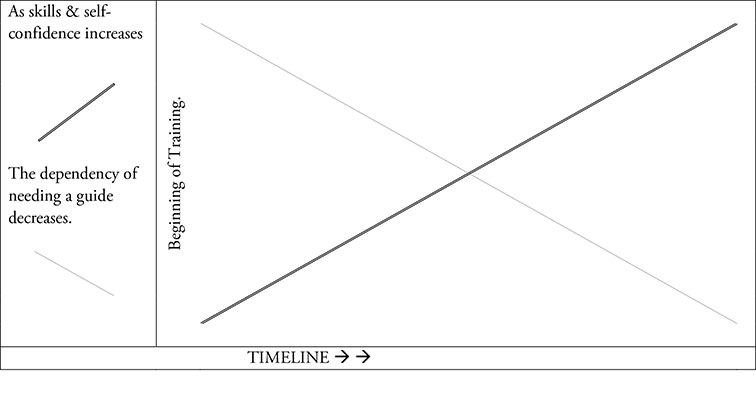
Parents as Guides
As stated earlier, parents and others may prefer to hold the hand of a young child as they travel. However, as the child gets older, such guidance needs to decrease, or else the child will grow up depending on a guide. Young children naturally will be dependent on their parents and older siblings. Later their teachers and friends become their guides. As they reach adulthood, they will turn to their spouse and children as personal guides—that is, unless parents encourage independent travel at a young age.
The transition from having parents as guides to becoming an independent traveler is a slow and lengthy process. Often it is more difficult for the parents than it is for the child, because the parents may have fears for their child's safety. Parents need to remain positive, and they may need to take baby steps themselves.
First of all, parents need to take an active role in their child's O&M instruction. If possible, one parent needs to be present whenever the child receives instruction. It is best for the parent to be within earshot of the lessons so he/she knows what the child has to focus on when traveling with the cane.
Second, parents need to be knowledgeable about the basics of cane travel. They need to understand that the cane is extended out from the belly button, arcing as wide as the child's shoulders. When parents are knowledgeable of the basic techniques, they can encourage the child to use the cane correctly.
Finally, and most importantly, parents need to accept the child's use of the long white cane.
Here are some activities parents can do with their child, beginning at about age five, to help him become an independent traveler:
- Make it automatic to take the cane when leaving home. Just like putting the shoes on, the child needs to take the cane. Let him know that you expect him to remember his cane.
- Encourage the child to walk independently from the house to the car and vice versa.
- When approaching a department store or doctor's office, encourage the child to walk ahead and to find and open the door.
- At a school playground or park, encourage the child to explore as you follow. Gradually widen the distance between you and the child (within reason) to encourage growth in self-confidence.
- Encourage the child to explore ahead on a narrow sidewalk, perhaps up to the front door of a neighbor's house.
- For older children, when going to or leaving a public restroom, tell, rather than show, the child the path.
- At a fast food establishment, ask the child to return to the counter for dessert. Give verbal directions to the counter and back to the table. If the child changes his mind about wanting dessert, don't get it for him.
- On occasion, have your hands full so the child has no choice but to walk independently.
- When walking home from the park, school, or neighbor's house, have the child lead the way as much as possible. Don't make a big deal if the child wants to place his hand on your back or grab your arm from time to time.
In the beginning parents may notice that the child is very dependent on using a guide. Unless there is a transition period, this dependence will continue throughout adulthood. However, if there is a transition period where the child learns to be an independent traveler, dependence upon a guide will decrease and self-confidence will increase, as shown in the chart below.
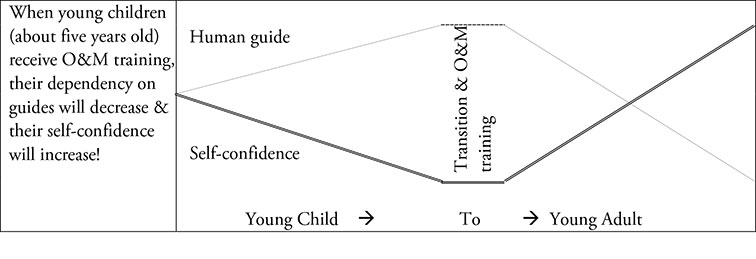
Here are some other suggestions to help parents encourage their children to become independent travelers:
- Get involved in local blindness organizations such as the NFB’s National Organization of Parents of Blind Children in your state. Your child will be exposed to positive blind role models.
- Read "The True Story by Owin M," by Merry-Noel Chamberlain, to your child/student.
- Read books involving positive blind role models.
- For more information regarding O&M for children, go to: <http://www.pdrib.com/pages/omcommonquestions.php>
Is There Really, Truly, a Good Time to Use a Guide?
One might suspect that the need to travel with a guide separates beginners from advanced travelers. However, that speculation is incorrect. Whether or not one travels with a guide is not tied to one's ability to travel independently. Rather, it is the given situation that determines whether a guide is necessary or desired. Here are some situations where one may prefer to travel with a guide:
- A follower is at the pool with friends, and the chairs and towels are several feet from the edge of the pool. The area is crowded with other swimmers. The follower may need assistance to and from the edge of the pool. Also, the follower may need assistance to the diving board.
- In the water, a follower may use a guide to remain oriented. Walking in the pool is not the same as walking on land. The follower and guide may develop their own method of travel.
- A follower needs to go to the restroom ASAP.
- There is an emergency for the individual and/or for everyone, such as a fire or an earthquake.
- Time is of the essence, such as running to the boarding gate at the airport to avoid missing the plane.
- The restaurant is crowded, and the path to the selected table involves several twists and turns.
- The situation feels uncomfortable or unsafe to the follower.
- The follower's cane has broken.
- The follower's guide dog or cane are unavailable.
- The follower feels uneasy about the terrain, such as a steep incline to a boat dock or a rocky trail.
It can be a nice gesture for the guide to offer visual insight regarding the surroundings about to be traveled. It is the follower, however, who makes the final decision whether or not a guide is needed. If the situation involves impending danger, the guide may need to give the follower a quick, urgent explanation. Under extreme circumstances, the guide may make it clear that immediate action must be taken; an explanation will be forthcoming.
What Skills Are Necessary for Using a Guide?
Above all, when walking with a guide, the follower needs to continue using the cane as if he were traveling independently. With the cane he may pick up tactual and/or auditory information about which the guide may be unaware. The use of the cane helps to ensure the follower's safety.
The follower needs to make a mental map of her surroundings. It is important that she note turns; remember sounds such as echoes, traffic, and fountains; and pay attention to changes in terrain such as inclines and textures. She may ask the guide the names of the streets they cross. On the next visit, she will be able to travel to the targeted location with more confidence and less assistance.
Followers need to maintain focus when traveling. When the follower allows his mind to drift and permits himself to be dependent on the guide, he may be left totally disoriented in an unknown location, without the ability to return independently. This may even occur when the follower and guide become engrossed in a conversation. Although instructors may highly recommend that the follower maintain focus upon his surroundings, it is easy for him to abandon this safety practice because using a guide is so easy.
The follower needs to know where to hold the arm of his guide (in general, just above the elbow). If the guide is much shorter than the follower, the follower may place a hand on the shoulder of the guide. If the guide is considerably taller than the follower, the follower may hold the guide's arm just under the elbow. The follower must insist on taking the guide's elbow rather than the other way around. This permits the follower to be in control of the situation. The follower can let go whenever she decides to do so. If the guide takes the elbow of the follower, the guide is in total control of the situation and the follower is not easily able to escape should she become uncomfortable or feel that she is unable to use her cane. When this happens, the follower can politely take the guide's hand off her elbow and take the proper location a half step behind the guide. She can explain politely that by walking this way, she is able to follow better. This also allows the follower to be in charge of her own safety, thus relieving the guide of this responsibility.
Followers need to be aware that most guides are members of the general public. Mainly they are concerned with not walking the follower into obstacles such as door frames or parking meters. The follower may need to train the guide as to what works best for her in a particular situation.
It is always important for the follower to thank the guide when the final destination has been reached. All too often, the guide is forgotten once the desired outcome has been accomplished. Even a close friend wants his help to be acknowledged and appreciated.
Classmates as Guides
Unless there is an emergency, it is absolutely not okay for a student to use a classmate as a guide. The student who is visually impaired or blind needs to be able to travel independently using a long white cane. Dependence upon one or two other children as guides can place an undue burden upon those children and interfere with the natural development of friendships.
In an emergency or drill at school, the use of a guide sometimes might be necessary. It may be helpful for an O&M instructor to visit the child's classroom and discuss the basics of human guide techniques with the students. That way, if the follower happens to grab an elbow in an emergency such as a fire or tornado, the unofficial appointed guide will not be startled. Together the classmates can move to the assigned location.
Final Thoughts
A blind gentleman walked up to an intersection and asked the nearest pedestrian for assistance in crossing the street. The pedestrian agreed to help, and the blind man automatically took the pedestrian's arm. When it was time to cross the street, they both began to walk. Only then did the follower hear the long white cane of the helpful pedestrian. Safely they both reached the other side of the street.
Did the blind follower believe that only sighted pedestrians can be guides? Who knows! The point is that he lacked the necessary skills to cross the street independently. He depended on a guide for safe travel. The pedestrian with the cane had the confidence and skills to cross the street independently.
Regardless of how much orientation and mobility training one receives, one may sometimes find oneself in a situation when using a guide would be safer or more convenient than going it alone. Be not afraid to use a guide! Just be careful not to become totally dependent on a guide for travel. One may slowly build a brick wall around oneself, leaving only one exit—the assistance of a guide.
One is not limited to using a guide all the time or none of the time. Instead, it is wise to use a guide some of the time. It is up to the individual to know when the time is right.
Be adventurous. Travel beyond your accustomed boundaries. Isn't it more exciting to travel beyond the walls than to be restrained by them? Travel on!
RESOURCES
Chamberlain, Merry-Noel. The True Story of Owin M. <http://www.pdrib.com/pages/omkids.php>
Louisiana Tech University: <http://www.pdrib.com/pages/orientationandmobility.php>
National Organization of Parents of Blind Children (NOPBC): <https://nfb.org/nopbc-brochure>
Recommended children's books: <http://www.pdrib.com/pages/omrecommendedreading.php>
Over There
by CathyAnne Murtha
Reprinted from Braille Monitor, Volume 57, No. 11, December 2014
From the Editor: Every blind traveler can tell stories about asking for directions from a sighted acquaintance or passerby and being told that the desired location is "over there." In this essay, which she wrote as a college student, CathyAnne Murtha brings out the humor in these sometimes frustrating moments. Ms. Murtha is the owner and operator of the Access Technology Institute and the website <www.blindtraining.com>.
As my guide dog and I stood in line at the checkout of the River City Market at CSUS, I asked the cashier what I considered a simple question. "Where are the napkins, please?"
Her response was hurried but sincere. "Over there."
Emerging from the light rail for the first time, I managed to catch the attention of a passerby. "Please, sir, can you tell me where I might catch Bus 63?"
A kind voice offered a pleasant response before disappearing into the cacophony of the early afternoon. "You can catch it ... over there."
So many things reside "over there"—napkins, bus stops, pencils, pens, clothing racks, department stores, and even my shoes! A never-ending supply of important and indispensable items and locales all reside in this place that is shrouded in mystery and intrigue.
I stand in perplexed silence after learning that something is "over there." It's a place I have never been and have no hope of finding on my own. My guide dog is skilled at finding chairs, stairs, elevators, and escalators. She helps me cross streets, and she can even find me the Diet Pepsi display at Food Town. However, when I tell her to find "over there," her little bottom hits the floor, and a small whimper tells me that she is as confused as I am. We will not be going "over there" today. "Over there" has caused me a bit of vexation, a lot of confusion, and, on occasion, made my heart race.
I have discovered that "over there" can be a dangerous place. One day, while crossing a street, I heard a driver's irritated voice shout out a warning that a truck was bearing down on me from "over there." Shadow artfully dodged the oncoming vehicle and pulled me to the safety of the curb; our hearts were racing as we took a few moments to compose ourselves. Close encounters with "over there" can be frightening experiences.
Although many blind people have wondered about the exact location of "over there," few have dared to venture forth in an exploration of the mysterious place.
One day, while standing in line at the supermarket, I asked the clerk where I might find the aspirin. With a cheery smile in her voice, she informed me that the aspirin was located "over there." With a weary sigh, I decided that I would take the extra step that would unravel the mystery that had vexed my compatriots since the beginning of time. Taking a deep breath and attempting to look nonchalant, I smiled at the clerk. "Where," I asked, "is over there?"
I imagined the girl's shocked expression. I felt her share condescending and concerned looks with her fellows in the store. The silence grew palpable as they mulled the possibility of allowing a blind person access to the forbidden land.
She had no choice; she would have to tell me how to find "over there!" I had won! Exhilaration swept through me as I waited in breathless anticipation. A victorious smile crept to my lips, and my hand tightened on the handle of Shadow's harness. We would soon be going "over there!"
The clerk's voice reeked with resignation as the decision was made. "That way," she said.
In the Event of an Emergency
by Sandra Bishop
From the Editor: Sandra Bishop serves on the board of the Maryland Parents of Blind Children. She is learning the ins and outs of IEPs with three daughters adopted as teens from China. When she found that her daughter Amy had not been allowed to use her cane during an evacuation drill, she wrote the following letter to the school principal. Her clear, reasonable argument can serve as a model for other parents as they advocate for their blind children.
September 17, 2014
Dear Ms. X,
I am writing to bring to your attention a safety issue with my daughter Amy Bishop, a sixth grader at your middle school. As you know, Amy is blind and depends on her long white cane for orientation and mobility. I have learned of two incidents during emergency drills in which Amy was instructed to leave her cane behind.
The first incident occurred this week during an evacuation drill from the school bus. The driver told Amy she was not allowed to take her cane, stating that it was dangerous, despite her request to keep it with her. He then required her to be the last student to leave the bus. He guided her from behind toward the rear of the bus, which is an incorrect guide method. She was instructed to sit and jump out of the rear door, but had no way to determine the distance she would be dropping. She then was left standing outside the bus, in an unfamiliar space, with no assistance.
In a true emergency, this would leave my daughter vulnerable and unable to help herself move away from a potentially dangerous situation. She must have her cane with her at all times. You would not require a student who uses arm crutches for mobility to leave those behind. Neither should my daughter be told to leave behind her cane.
The second incident apparently happened during the first week of school, but I only learned of it this week. During a fire drill in the middle school, Amy was instructed by her teacher of the visually impaired (who should know better) to leave her cane in the classroom and to evacuate the building using human guide technique. In a true emergency, Amy could become separated from the well-meaning person guiding her, adult or student. She would be left vulnerable and unable to find her own way.
In a situation where the building or bus is filled with smoke and visibility is extremely limited, Amy is better equipped to find her way out than a sighted person, assuming no one has taken away her cane. I would like to point to the real life example of the ability of blind people to take care of themselves in emergency situations. Michael Hingson, a successful businessman who has been blind from infancy, evacuated from the World Trade Center on 9/11. He did so using his own orientation and mobility skills, without the need for a sighted guide. My goal is for Amy to be equally prepared and confident in her skills so that she can take care of herself in an emergency.
Please provide the necessary training and information to staff in the building and in the transportation department. Explain that a visually impaired individual requires the use of the long white cane and should never be told to leave it behind during an emergency. I am teaching my daughter to advocate for herself, and in the future she will disobey any adult who tries to make her leave without her cane in an emergency.
Sincerely yours,
Sandra Bishop
Recently Sandra shared the following update with Future Reflections.
After receiving my letter, the principal called me and said she completely agreed with my points. She said that efforts would be made to make sure that everyone understood that my daughter should never be separated from her cane. That said, despite my best efforts, I don't know if there was any discussion with the TVI about the first incident, in which she was involved. There was also no movement toward eliminating the requirement that Amy use a sighted guide for school drills.
Due to other more significant issues related to our daughter's situation (she is blind plus an English language learner plus an older adoptee plus dealing with cultural acclimation and prior education gaps), we decided to remove her from public school a few weeks later. We are currently homeschooling her to address her language development and education gaps. Unfortunately, we live in a county that refuses special education services to homeschoolers. We are using a borrowed BrailleNote, the free downloadable forty-minute version of the JAWS screen reader, free Braille classes from the Hadley School for the Blind, and tutoring at reduced cost from a TVI.
We plan for Amy to return to the same middle school next year. With what we have learned thus far, we hope we will be able to put more procedures and staff preparation in place to avoid the problems we had this year.
Calibration
by Jennifer Dunnam
Reprinted from Minnesota Bulletin, A Publication of the NFB of Minnesota, Fall 2014
From the Editor: Jennifer Dunnam serves as president of the NFB of Minnesota. She also represents the NFB on the Braille Authority of North America (BANA).
Many benefits flow from being a member of the National Federation of the Blind. Among them are mutual support and encouragement, the ability to make things happen together that we could not do alone, the sense of community, and the opportunity to share useful information and resources. The collective experience we can call upon is deeper with more of us in the mix, and the more of us there are, ready and willing to participate, the more we can do.
There is one aspect of Federationism, however, that is a bit more complicated to describe. It can apply to each of us individually, whether we grew up blind or lost sight later in life. Participating in the National Federation of the Blind can help us "calibrate."
The word calibrate has numerous definitions, but here is the one that I find relevant, nerd that I may be: "To check, adjust, or determine the graduations of a quantitative measuring instrument by comparison with a standard." Certainly, this is not a precisely relevant definition, since we're talking about human beings. Perhaps I can illustrate my idea with a bit of personal history that is, no doubt, similar to the experiences of many others.
My parents are the best anyone could ask for. They worked hard to ensure that I, their daughter who has always been blind, would live a normal life. They wanted me to be able to take care of myself and to get along and do my fair share in the world. They knew that sometimes they had to be tough in order for me to achieve these goals.
However, my parents were not with me everywhere I went, and they could not always influence the way others treated me. With a few rare exceptions, they did not have exposure to other blind people who could show by example how to live a successful life as a blind person.
Many other people in my early life had little exposure to the truth about blindness. Furthermore, unlike my parents, they did not have the incentive to consider my future. Many people felt sorry for me or constantly told me what an inspiration I was. Most wanted to do all they could to make life easier for me.
Although I was fortunate to receive a good education in public school, I also received many strong messages that I was not like other people, that the rules for me were not the same as the rules for others. During most of my school years, I sat in the very front of the class (or sometimes at the very back), in a different type of desk from everyone else. I was often allowed to leave class a little before the bell, so that the fellow student who guided me to my next class would have time to get me there and then get to her own class. (No independent cane travel training for me until I was twelve, and even then it was very limited.)
It isn't that no one ever insisted that I come up to the mark and meet standards like everyone else. I remember how grouchy I was when suddenly I was expected to start doing more chores. I was offended when a teacher said, "You're responsible for cleaning out that desk just like everyone else." These were important lessons, but they were hard to accept because the messages were not consistent, and I was so often treated differently from others.
One time an article about me appeared in the town's newspaper. It was all about my good grades in school, my climbing on the playground equipment, my school friends, and on and on. It certainly can be argued that there is merit in such an article, showing a positive image of blindness. But none of my accomplishments would have been newsworthy at all if I had been sighted. As a young child I was not mature enough to keep such praise in the correct perspective. I fear I took it all to heart a bit overmuch, thinking that maybe I really was as amazing as everyone said I was.
The other side of being different started to rear its ugly head as I became a teenager. People my age did not want to hang around with me very much. My younger sisters got driver's licenses and could drive off wherever they wanted. I could not even have told you the name of the next street over from where we lived, much less navigated around the city. My sisters and friends spent as much time as they could walking around the shopping mall. It was a struggle for me just to walk around my own school building independently. If I did go to the mall with my sisters or friends, I spent a lot of time waiting. Unless I could talk them into going somewhere particular, they set the course.
The feeling of powerlessness is hard to convey to one who may never have experienced it, but I imagine many blind readers will know what I am talking about. Like everyone else, I assumed this was how it had to be and likely would be for my whole life. To survive, I simply began to adjust to this way of being—the waiting, the loneliness. I began to stop hoping for anything better.
Because of the mixed messages I received and my relative powerlessness, I did not have a good grasp of how to view myself as a regular person, not more and not less than anyone else, though at the time I might have been able to say all the right words. It was all very confusing—to be special but also somehow inferior, to be amazing but also to be pitied and shunned.
One summer during high school, I attended a program at the school for the blind. In some ways the experience was helpful. In that setting, I was not so special, weird, or different from the rest of the crowd. However, most of the crowd was made up of kids with similar struggles. Like me, they had not been viewed as having normal expectations. Like me, they did not know how to deal with low expectations or even quite realize what was happening to them. In addition, there was a strong sense that how much sight one had was a primary predictor of how much responsibility one could be expected to take. Although it was not all bad, the experience did not generally present me with much hope.
Fortunately, I soon met the National Federation of the Blind. I was astonished to discover that my own expectations were actually far too low. I met people who not only walked independently around their cities, but took control of things by hiring drivers rather than waiting and hoping people would be willing to drive them somewhere. I even witnessed blind people taking charge of navigation when riding with a directionally challenged sighted driver, and knowing precisely where specific locations were, even in a mall. After recovering from the shock, I got to work on improving my skills and learning all I could from my new role models.
No less important than the skills, and probably more important in the scheme of things, were the adjustments I was able to make to my approach and attitude. Learning new skills went a long way toward helping me understand that I was not somehow a lesser person than others were. However, it was in some ways a rude awakening to figure out for sure that I was not the least bit amazing. Many blind people were smarter, more talented, and more socially adept than I was.
In this group, one helped with the clean-up, regardless of one's level of sight—no excuses, no special treatment for me. People assumed, respectfully, that I was capable of doing a given task. They would ask if I needed help, rather than immediately scurrying to the rescue at the first sign of questions. If I didn't know how to do something, people would teach me rather than just doing it for me. Kindly but frankly, they let me know if I did or did not do things that would be detrimental to general life success. I learned, directly and by example, how to fit into the larger community and how to do my share. The messages were consistent in this environment, so it was possible to learn how to put the views of the larger society into perspective. I have now been a Federationist for many years, and the help of this organization in this respect remains invaluable.
My experience is not unique to people who grow up blind. Many people who lose their vision later in life start out with the independent spirit that they had when they were sighted. However, as time goes on without a supportive community and without strategies to deal with the constant barrage of well-intentioned low expectations from others, they find it easier to give in. It is easy to stop trying to live the lives we want, but giving in to low expectations can make us dependent and disabled in ways that really are not necessary.
The Federation can help us get that spirit back, and to get the five ingredients of freedom that long-time Federationist Jim Omvig so aptly enumerates in his book, Freedom for the Blind: The Secret Is Empowerment. Here are the ingredients he lists:
- Coming to believe, emotionally and intellectually, that it is respectable to be blind.
- Learning the skills and mastering the alternative techniques of blindness.
- Knowing how to cope effectively and unemotionally with things people do and say because of their misunderstandings about blindness.
- Having the discipline, the flexibility, and the work ethic, grooming, and appearance to "blend in."
- Giving back, both to other blind people and to society.
I am grateful to be able to calibrate from time to time with my Federation family, people who show by their example how to be a blind person with confidence, class, resourcefulness, and willingness to believe in and help others. We strive to create a space that lets us measure ourselves against normal expectations, to keep low expectations from coming between us and our dreams.
The Slate Pal Opportunity
by Deborah Kent Stein
At the 2014 convention of the National Federation of the Blind of Illinois, a ten-year-old boy named Jake addressed a group of parents and teachers of blind children. A few months earlier, Jake had applied for a Braille pen pal through the NFB Slate Pals program. In a note accompanying his application, his mother explained that Jake, who is sighted, became fascinated with Braille after he read a book about Louis Braille's life. Entirely on his own he learned to read both uncontracted and contracted Braille, first by sight and later by touch. For his tenth birthday, the only gift Jake wanted was a Perkins Brailler. To his delight, his birthday wish was granted. His parents found him a used Perkins on eBay.
In the past few years, Slate Pals has received more and more requests for Braille pen pals from sighted children. Like Jake, these kids are intrigued with the Braille code and want to develop their skills by corresponding with a pen pal who uses Braille regularly. At this point, Slate Pal requests from sighted children far exceed requests from blind Braille readers.
Through the Slate Pals program, we have an excellent opportunity to promote understanding and friendship between blind and sighted students. Slate Pals can help educate members of the sighted public about the experiences and abilities of blind people. And of course, as always, Slate Pals will continue to help blind children who read Braille connect with one another. Now is the time for more blind children to apply to the Slate Pals program!
Slate Pals was created in the early 1990s by Dr. Fred Schroeder when he served as director of the New Mexico Commission for the Blind. The program matches students in kindergarten through grade 12 with pen pals who wish to exchange letters in Braille. Applicants are matched based on age, gender, and interests. The program also tries to pair children from distinctly different parts of the United States or, when possible, with applicants from overseas. Requests for Slate Pals have come from every state in the US; from most of the Canadian provinces; and from such diverse nations as the United Kingdom, Australia, New Zealand, Honduras, Russia, Mexico, Denmark, Sierra Leone, Taiwan, and South Africa.
If your child or student would like to exchange Braille letters with one or more Slate Pals, please complete the following application. The application is also available online at <https://nfb.org/nopbc-slate-pals>.
BRAILLE SLATE PALS
A Pen Pal Program for Braille Readers and
Students Who Want to Learn Braille
Name: __________________________________________________ Age: _________ Grade: __________
Male Female (Circle one)
Address: _________________________________________ City: _______________________________
State: ____________________ Zip: ___________ If not the USA, Country: __________________________
Email: _________________________________ Phone: _______________________________
Parent(s) Name and Address (if different from above): ____________________________________________
________________________________________________________________________________________
Interests/Hobbies: ________________________________________________________________________
________________________________________________________________________________________
I would like (fill in number): _________ Slate Pals.
I would like my Slate Pal(s) to be (circle one): male female both no preference
I would like my Slate Pal(s) to be (fill in age range): _______________
Check one of the following statements:
[ ] I am blind/visually impaired. I use Braille regularly at school and at home.
[ ] I am blind/visually impaired. I use both Braille and print at school and at home.
[ ] I am blind/visually impaired. I read some print but am shifting to Braille.
[ ] I am sighted and would like to exchange letters in Braille with a Slate Pal who is
blind/visually impaired.
Name of person filling out this application and relationship with the child/student:
Mail to:
Deborah Kent Stein, Attn: Slate Pals
5817 North Nina Avenue, Chicago, Illinois 60631
Phone: 773-203-1394 * Email: [email protected]
All the Light We Cannot See
by Anthony Doerr
Reviewed by Molly Faerber
From the Editor: Molly Faerber is a recent graduate of the MFA Program in Literary Arts at Brown University. Her work has appeared or is forthcoming in The Fairy Tale Review, Fourteen Hills, Harpur Palate, SmokeLong Quarterly, and Wigleaf. She was awarded an NFB National Scholarship in 2013.
All the Light We Cannot See
by Anthony Doerr
Scribners, 2014, 544 pages
All the Light We Cannot See sings with a lyric prose that is rich in sensory images. Over many years and in many vastly different voices it sprawls across the European continent. At its heart is Werner, a German orphan whose exceptional talent for the building of radios--then the newest technology--singles him out as an asset to Nazi forces. And there is Marie-Laure, the teenage blind heroine who devours Braille books faster than her father can obtain them, and who is sent to the French coastal city of Saint-Malo to live with her eccentric uncle during the war. In addition, among others, there are a German officer on the hunt for a diamond of extraordinary value; Marie-Laure's locksmith father, who builds intricate scale models of the streets outside their home for his daughter; and Werner's sister Jutta, who refuses to be swept up in the tide of Nazi propaganda, even as her brother is recruited to the cause. The novel's very short chapters--some only a page long--counteract its length, and the humanity of the characters enchants and compels the reader. These are people I came to care about deeply.
The dazzling prose is, for me at least, half the reason to keep reading. But under its luminous surface, there is much to consider, especially for readers who are interested in the novel's blind protagonist as more than a plot device. I found Marie-Laure to be, for the most part, a realistic and believable blind character, with the possible exception of her step-counting travel technique, which doesn't seem effective or practical. (But though I've never yet met a blind person who counts his/her steps, especially outdoors, that isn't to say that none do.) Marie-Laure's sensory perceptions are exquisitely beautiful, in keeping with the novel's intense lyricism, and in general they resonate deeply with me. Doerr renders her synesthetic experience of sound and color particularly well. While I enjoyed and admired these passages, though, I wondered at the lack of some of the smaller, less expected trademarks of blind perception—for example, how one is able to feel the differences between being surrounded by buildings or by open air when outdoors, how clues about one's surroundings come via nuances of sound and air flow. In a novel of this scope, with characters of this depth, I can't help but find it disappointing that Doerr did not push himself to incorporate details that might lend his work more credibility and this character greater truth.
Another perplexing point was the absence of Marie-Laure's feelings about her blindness, or any discussion of her identity as a person who is blind. Granted, that isn't what this novel is about, and in some sense I see that as a remarkable achievement: here is a novel about a brave and intelligent character who happens to be blind. Yet, as a person who becomes blind during childhood, Marie-Laure must necessarily have feelings about that journey, on a personal level and in terms of how she relates to society and her place within it. While I very much support a narrative in which blindness is not a tragedy of epic proportion—and those are sadly few and far between—I think that room should be made to explore the complexities of blindness, to examine what it means for the blind character to be blind in a sighted world. This sprawling novel, in which space is made for so many characters to think and speak about so many different things, might easily have found a place for Marie-Laure's thoughts on her changing identity.
As with any novel or film featuring a blind character and meant for a mainstream public that is woefully undereducated about blindness, it's important to consider the impact of the work on the average reader. In my opinion, Marie-Laure comes across as intelligent, capable, and brave. She uses the tools she is given—her cane, her scale models, her mobility techniques (though it's unclear if these come from formal training or from her father)—to travel independently. If she travels alone less frequently than many blind people today, I was willing to cite the dangers of wartime and the conventions of the period. Marie-Laure is a voracious reader, has an evident sense of humor, and is not, like so many blind characters in the media, purely good to the point of being unrealistic. Put simply, Doerr does not place her on a pedestal (though others in the novel sometimes do). In the end, it is her cleverness that saves her, and her intellectual curiosity that enables her to go on to a successful career as a scientist.
Regarding its portrayal of blindness, the book is not perfect. Personally, I would have wished for an examination of blindness as complex and nuanced as the exploration of human connection. But the book is no small achievement. It is beautiful, often luminous, in terms of language and craft as well as emotion. And perhaps this is the most blind readers can hope from a sighted author. Personally, I would like to see competent, talented blind writers represent the stories of blind people in a way that is beautiful, meaningful, complex, and truthful.
Blind
by Rachel Dewoskin
Reviewed by Deborah Kent Stein
Blind
by Rachel Dewoskin
Viking, 2014, 416 pages
"Going blind is a little bit like growing up," says fifteen-year-old Emma Silver, the protagonist of Rachel Dewoskin's new young-adult novel, Blind. Like most novels written for a teen audience, Blind is about growing up in all its frightening, perplexing, and dazzling permutations.
After losing her sight in a freak accident that also leaves her with a facial scar, Emma sinks into depression. She misses a semester of school while she lies on the living room couch, feeling hopeless and miserable. At last her parents take matters in hand and enroll her in a school for the blind, where she learns Braille and meets some blind teens who live active, even adventurous lives.
Although the school for the blind draws her out of her despair, Emma doesn't want to make blind friends or embrace her new life as a blind person. A year after her accident, she returns to her local high school. Accompanied by her companion dog, Spark, and guided from class to class by her best friend, Logan, Emma feels anxious and uncertain. Everyone knows what happened to her, and she is sure people are constantly staring. In the past she was quiet and flew beneath others' radar, but now she is visible all the time.
Emma is jolted from her self-absorption by the shocking suicide of Claire, a classmate she had known since kindergarten. Though adults try to help Claire's friends deal with their grief, Emma feels that no one is talking about the things that really matter. She emerges as a leader when she invites a group of classmates to gather in secret and try to sort out the truth behind Claire's death.
As the school year passes, Emma learns to travel independently. She discovers that an attractive boy likes her, and she finds that she no longer needs Spark by her side in order to feel secure. Eventually she reaches out to two of her classmates from the school for the blind and accompanies them on a skiing trip. She also becomes a role model for a nine-year-old girl who has recently lost her sight. The novel shows clearly that blind people can teach and inspire one another, passing forward the skills and positive attitudes they have learned.
Approaching this book as a blind reader, I feel that a few aspects do not ring true. After losing her sight, Emma acquires the habit of rocking; classmates at the school for the blind gently try to make her aware of this behavior so that she can keep it in check. While many people who are blind from birth or early childhood develop this habit, it is unusual in a person who loses vision at fifteen. However, the traumatic nature of Emma's vision loss might help explain her need for self-comforting behavior.
Even more striking is the ease with which Emma is welcomed back into the high school environment. Although she feels painfully awkward and unlovable, her peers accept her almost without hesitation. On her first day of school the art teacher expresses doubt that Emma can take part in a drawing exercise, but otherwise Emma seldom has to prove herself. Her experience is in stark contrast to that of most blind students, who must learn to advocate for themselves as they negotiate the barriers created by the fears and anxieties of others. Because Emma is so fearful and anxious during her first months back at school, it makes sense that she is not troubled by over-solicitous teachers and classmates. As time passes, however, she would likely begin to chafe against unnecessary and unwanted offers of help and the insistence of others that she sit on the sidelines while they do the things that need to be done.
In preparation for writing Blind, Rachel Dewoskin got to know several blind adults, spending time with them and their families. She became familiar with access technology and even learned to read and write contracted Braille. Dewoskin has created a bright, insightful, and very normal teen who finds that, despite her blindness, she can live a rich and productive life.
My Three Best Friends and Me, Zulay
by Cari Best
Reviewed by Janna Stein
From the Editor: Janna Stein is a teacher of the visually impaired in the Chicago suburbs.
My Three Best Friends and Me, Zulay
by Cari Best
Illustrated by Vanessa Brantley-Newton
Farrar, Straus and Giroux, 2015
40 Pages, Grades K-3
This story about friendship and self-confidence is a great choice for young, blind/visually impaired readers and their sighted classmates. A smart, feisty first grader, Zulay is visually impaired, but she doesn't let that get in her way. She reads and writes Braille, helps her friends with math, and goofs around at recess, just like the other children in her class. However, Zulay is apprehensive about using her long white cane. She worries that the cane will make her stand out as different from her classmates. She doesn't like the fact that Ms. Turner, her orientation and mobility instructor, only comes to see her, and not any of the other children.
Zulay's teacher announces that the class will be having a Field Day, and each student can choose to take part in an event. Zulay wants to run in a race around the outdoor track. Ms. Turner helps her use her cane to become familiar with the racetrack's layout. Then Zulay practices running the track with Ms. Turner as her guide runner. On Field Day, Zulay easily runs the track which she now knows so well, thanks to the exploration she's done with her cane. The story ends as she crosses the finish line, feeling free and confident.
This book offers a positive role model for children who are blind or visually impaired, and it helps to dispel some of the stereotypes that sighted kids may carry about blindness. Zulay is independent in her routines at school, and she mentions washing and peeling carrots by herself at home. She helps her friends instead of merely being helped by them. The reader never feels sorry for Zulay, not even when she struggles.
Many children with and without disabilities may relate to the frustration Zulay feels when her blindness makes her feel different. This book will help them understand that they are not the only ones who have felt this way at times. They will also get to see that frustrations do not last forever. Zulay learns that the cane, which made her feel different, actually gives her the freedom to do what she wants. This is a valuable lesson for many children who may feel apprehensive about using an adaptive tool such as a cane or assistive technology device.
As an added plus, the book's dust jacket is inscribed with a tactile version of the Braille alphabet. Many children's books include the Braille alphabet in printed form only. This book allows young readers to experience the Braille letters by touch as well as by sight.
Announcements
SCHOLARSHIPS
2015 NFB National Scholarships
<www.nfb.org/scholarships>
Contact: Patti Gregory-Chang, (410) 659-9314, extension 2415
Application Deadline: March 31, 2015
The National Federation of the Blind offers thirty 2015 NFB scholarships in amounts ranging from $3,000 to $12,000. To qualify, a candidate must be legally blind and must plan to be enrolled full-time in a US postsecondary institution of higher learning in the fall semester of 2015. All scholarship finalists will be assisted to attend the entire 2015 NFB National Convention, to be held in Orlando, Florida, July 5-10. The convention gives finalists a unique opportunity to network with other blind students and with blind mentors working in a wide variety of professions.
CONTESTS
2015 NFB Youth Writing Contest
<http://writers.nfb.org/2015YouthGuidelines.html>
Application Deadline: April 1, 2015
The NFB Youth Braille Writing Contest is designed to promote Braille literacy. It is for students who are studying or know contracted Braille. Entries must be hand-embossed by the student, using either a slate and stylus or a Braillewriter. Entries will be judged on creativity and the quality of the Braille. There are two categories: fiction and poetry. Any topic is fair game, though this year the number seventy five should be included in some way in honor of the seventy-fifth anniversary of the NFB. There is no charge for entries. Cash prizes will be awarded to winners at elementary, middle, and secondary school levels.
Dream It. Code It. Win It.
<www.dreamitcodeitwinit.org>
Contact: Cristina Dolan, (212) 359-4149
Email: [email protected]
Submission Deadline: March 29, 2015
Trading Screen, Inc., and the MIT Enterprise Forum of New York announce the launch of the second annual Dream It. Code It. Win it. contest for high school and college students. The student coding competition promotes creativity, diversity, and innovation in the field of computer science. Entries are judged on the quality of the problem being tackled as well as the solution.
2014 Onkyo Braille Essay Contest Winners
<https://nfb.org/national-federation-blind-announces-winners-2014-onkyo-braille-essay-contest>
The Onkyo Braille Essay Contest is an international essay contest sponsored by Onkyo Corporation, a Japanese consumer electronics manufacturer, and the Braille Mainichi, part of the Mainichi Newspaper Company in Japan. Each year the National Federation of the Blind administers the contest on behalf of the North American/Caribbean Region of the World Blind Union. The contest was designed to promote Braille literacy and to encourage the sharing of social and cultural information among blind persons. The essays were required to be written in Braille and to pertain either to how the individual gains knowledge or independence through Braille or to the concept of world peace from the viewpoint of persons with disabilities. The list of the 2014 winners can be found at the link above.
AWARDS
2015 Dr. Jacob Bolotin Awards
<https://nfb.org/bolotin-award-main>
Application Deadline: March 31, 2015
Applications are now being accepted for the 2015 Dr. Jacob Bolotin Awards. Cash awards are presented each year at the national convention of the National Federation of the Blind to individuals and organizations that have demonstrated exemplary leadership and extraordinary accomplishments in improving the lives of blind people in the United States. Individuals or organizations are encouraged to apply on their own behalf or on behalf of others.
Distinguished Educator of Blind Children Award for 2015
<https://nfb.org/images/nfb/publications/bm/bm14/bm1411/bm141116.htm>
210 Cambridge Drive
Louisville, KY 40214-2809
Contact: Cathy Jackson, (502) 366-2317
Email: [email protected]
Application Deadline: May 15, 2015
The National Federation of the Blind will recognize an outstanding teacher of blind children at the 2015 NFB convention. Anyone who is currently teaching or counseling blind students or administering a program for blind children is eligible to receive this award. Teachers may be nominated by colleagues, supervisors, friends, or parents of current or former students. The letter of nomination should explain why the teacher is being nominated for this award.
2015 Gloria Barron Prize for Young Heroes
<www.barronprize.org>
Contact: Anita Southwick
Email: [email protected]
Application Deadline: April 15, 2015
The Gloria Barron Prize for Young Heroes invites nominations for its 2015 awards. The Barron Prize celebrates inspiring, public-spirited young people ages eight to eighteen who have made a significant positive difference to people and to our environment. Ten winners each will receive a cash award of $5,000 to support his or her service work or higher education.
2014 TIPTOE Awards
<www.campramah.org>
Contact: Nancy Scheff, (212) 678-8881
Email: [email protected]
The Ramah Camping Movement and the Ruderman Family Foundation are delighted to announce the winners of TIPTOE (The Inclusion Project: through Our Eyes), an inclusion-themed video contest for participants from all Jewish camps. The goal of TIPTOE is to increase awareness of the inclusion work happening at Jewish camps across North America. The Ruderman Family Foundation will award a cash prize to the top three winners and make donations to the inclusion program at the winners' camps. The winning videos can be viewed at the link above.
CONFERENCES
2015 Jacobus tenBroek Disability Law Symposium
Contact: Lou Ann Blake, (410) 659-9314, extension 2221
Email: [email protected]
Location: NFB Jernigan Institute
200 East Wells Street at Jernigan Place
Baltimore, MD 21230
Dates: March 26-27, 2015
At the 2015 Jacobus tenBroek Law Symposium, "The ADA at Fifty: The Future of Disability Law and the Right to Live in the World," leading disability-rights advocates from throughout the United States will celebrate the Americans with Disabilities Act of 1990 by looking ahead to the next twenty-five years. The symposium consists of plenary sessions and workshops facilitated by distinguished law professors, practitioners, and advocates who will discuss topics including the future of disability; how to enable the participation of people with disabilities in court proceedings; the unique challenges faced by criminal suspects and offenders with intellectual and developmental disabilities; and a vision for the next twenty-five years to improve and augment the ADA, Rehabilitation Act, and IDEA.
National Braille Association Professional Development Conference
<www.nationalbraille.org>
Location: Doubletree Hotel, Austin, TX
Conference dates: April 16-18, 2015
Registration Deadline: March 29, 2015
Transcribers, educators, parents, and Braille readers are invited to attend the spring 2015 National Braille Association Professional Development Conference, the kickoff event of the NBA’s seventieth anniversary year. The conference will include a three-day training session on the Unified English Braille Code (UEBC), a “Braille Boot Camp,” training on CorelDraw, and a series of half-day workshops on other topics related to Braille transcription.
Wrightslaw Special Education Law and Advocacy Conference
<http://www.wrightslaw.com/speak/15.04.md.htm>
Colony South Hotel and Conference Center
7401 Surratts Road
Clinton, MD 20735
Date: April 23, 2015
This conference is sponsored by Loud Voices Together Educational Advocacy Group. The program will focus on special education law, rights and responsibilities; tests and measurements to measure progress and regression; smart IEPs; and tactics and strategies for effective advocacy. Wrightslaw programs are designed to meet the needs of parents, educators, health care providers, advocates, and attorneys who represent children with disabilities in relation to special education. The program is not disability specific.
Envision Conference on Low Vision
<www.envisionconference.org>
Contact: Shamain Bachman, (316) 440-1551 or (316) 258-6996
Email: [email protected]
Location: Grand Hyatt Hotel, Denver
Dates: September 9-12, 2015
The Tenth Annual Envision Conference will offer ophthalmologists, optometrists, occupational therapists, teachers of the visually impaired, and others ninety hours of clinical education and research sessions pertaining to low vision. Many sessions can earn attendees continuing education credits. Abstracts for presentations are now being accepted.
22nd International Association for Child and Adolescent Psychiatry and Allied Professions World Congress (IACAPAP 2016)
Sea to Sky Meeting Management, Inc.
Suite 206, 201 Bewick Avenue
North Vancouver, BC, Canada V7M 3M7
Contact: (604) 984-6448
Email: [email protected]
Child psychiatrists and members of allied professions including nursing, social work, pediatrics, and education from around the world are invited to exchange research and information for the betterment of child mental health. The theme of the 2016 conference, which will be held in Calgary, Alberta, Canada, is "Fighting Stigma, Promoting Resiliency and Positive Mental Health."
INTERNSHIPS
RespectAbility
<RespectAbilityUSA.org>
4340 East-West Highway
Bethesda, MD 20814
Contact: (240) 744-0546
RespectAbility is a public policy organization that works to educate government leaders, workforce development boards and agencies, faith-based organizations, employers, and the media about issues related to people with disabilities. The RespectAbility Fellowship Program is designed for college and graduate students who want to gain skills and contacts while making a difference. Fellowships last for two months, and fellows are reimbursed for travel expenses. Another RespectAbility fellowship focuses on the inclusion of Jews with disabilities in Jewish society.
SURVEY
Non-24 Registry
<www.non24registry.com>
Contact: (844) 361-2424
Email: [email protected]
Parents and guardians of blind children and teens who have recurring sleep or napping problems are needed to participate in a survey and/or take part in a clinical research study. The treatment being studied for children is currently approved for use with adults. Eligible volunteers who take part in the clinical research will be compensated for their time and will receive all study-related investigational medication and medical evaluation at no cost.
SUMMER CAMPS
Each of the three training centers sponsored by the National Federation of the Blind—the Colorado Center for the Blind; the Louisiana Center for the Blind; and BLIND, Incorporated (Blindness: Learning in New Dimensions)—operates summer programs for blind children and teens. Blind Industries and Services of Maryland (BISM) also operates summer programs based on the NFB model. Children and teens who attend these programs practice their Braille and travel skills; learn to shop, cook, and clean; and have fun swimming, camping, and visiting water parks, all under the supervision of blind counselors who "walk the walk." Teens learn skills they will need for college and career, and gain the confidence they will need to find and keep a job. Classes include Braille, cane travel, access technology, career exploration, and home management. Students in some programs also gain paid employment experience in local businesses and agencies. Below is information about all of these exciting summer opportunities.
BLIND, Incorporated
<www.blindinc.org>
Contact: Charlene Guggisberg, (612) 872-0100, extension 251, or (800) 597-9558
Email: [email protected]
PREP (Postsecondary Readiness Empowerment Program)
Open to blind high school students
June 14-August 7, 2015
Buddy Program
Children ages 9-13
July 18-August 7, 2015
Colorado Center for the Blind
<coloradocenterfortheblind.org>
2233 West Shepperd Avenue
Littleton, CO 80120
Contact: Brent C. Batron, (303) 778-1130, extension 222, or (800) 401-4632
Email: [email protected]
Application Deadline: April 1, 2015
Confidence Camp for Kids
Day program for children ages 5-10 who live in the Denver metro area
June 5-June 26
Initiation to Independence
Children in middle school, age 11-14
June 10-July 1
Earn and Learn
High school students
June 5-July 31
Summer for Success
College-bound high school students
June 5-July 31
Louisiana Center for the Blind
<www.louisianacenter.org>
101 South Trenton Street
Ruston, LA 71270
Contact: Eric Guillory, (318) 251-2891 or (800) 234-4166
Application Deadline: April 13, 2015
Buddy Program
Children Grades 4-8
First Session: June 7-June 27, 2015
Second Session: July 19-August 8, 2015
STEP (Striving for Success Summer Training and Employment Project)
Students entering tenth, eleventh, or twelfth grades in fall 2015
June 14-August 8, 2015
Blind Industries and Services of Maryland (BISM)
<www.bism.org/youth>
3345 Washington Boulevard
Arbutus, MD 21227
Contact: Sarah Baebler or Melissa Lomax, (410) 737-2642
Email: [email protected] or [email protected]
Application Deadline: April 1, 2015
Work to Independence
High school students and recent graduates
June 20-August 8, 2015
Independence 101
Students grades 5-8
July 18-August 8, 2015
ENGINEERING CAMP
Summer Engineering Experience for Students with Visual Impairment or Blindness
<https://www.engr.ncsu.edu/theengineeringplace/summerprograms/experience-vib>
Contact: Leyf Starling, [email protected]
Dates: July 19-July 24, 2015
Application Deadline: March 27, 2015
During this one-week residential summer camp, twelve to fifteen blind or visually impaired high school students will explore the challenges of engineering through participating in hands-on activities at the Engineering Place at North Carolina State University. Topics will include an introduction to the principles of engineering and a focus on the grand challenges, including providing access to clean water, engineering the tools of scientific discovery, making solar energy more economical, securing cyberspace, and engineering better medicines. Students will conclude the week with a group capstone design project.
Odds and Ends
STUDENT FINANCIAL AID
<https://nfb.org/national-federation-blind-reaches-agreement-department-education>
The NFB and three individuals have reached an agreement with the US Department of Education that will make student loan information accessible to blind Americans. The agreement commits the Department of Education and the student loan servicers with which it contracts to make websites, forms, and documents related to the department's direct loan program equally accessible to blind applicants and borrowers. The requirements include providing documents in alternative formats such as Braille and large print and allowing blind people to fill out and electronically sign and submit accessible versions of student loan applications and forms. For more information, visit the website listed above.
TECHNOLOGY
TechVision
<www.yourtechvision.com>
Contact: Denise M. Robinson, (423) 573-6413
TechVision offers hundreds of informational articles and lessons on PC, Mac, iPad, and more, all done with keystrokes. The most recent additions include lessons on the use of Google Docs/Drive and the creation of Venn diagrams with talking software.
RESOURCE GUIDES
Insightful Publications
Contact: Christine Chaikin, (808) 747-1006
Email: [email protected]
Insightful Publications has created two screenreader-friendly handbooks of resources pertaining to the blind and visually impaired, one covering Alabama and the other Hawaii. The guides are designed for use by consumers and professionals. They include organizations of and for the blind as well as areas such as employment, housing, and transportation.
AUDIO DESCRIPTION
DVDs and Blu-ray Discs with Audio Description
The Audio Description Project
<http://acb.org/adp/dvds.html>
This webpage is a complete listing of DVDs and Blu-ray discs with audio description released for US audiences. DVDs listed here may not have description outside the United States. A link to children's described DVDs (movies with G or PG ratings) is provided.
RELIGIOUS MATERIALS
Audio Bible
MegaVoice
<www.megavoice.com>
With centers throughout the world, MegaVoice produces an ever-expanding line of solar-powered digital audio players for Christian and humanitarian use. A Scripture audio library contains 8,400 Scripture titles in 4,600 languages and dialects. An interactive map allows users to locate their nearest MegaVoice center.
Unity Message of Hope
<www.unity.org/resources/message-hope/document-library>
Contact: (866) 421-3066
Email: [email protected]
Unity Message of Hope, a nondenominational ministry serving people who are blind or visually impaired, has a virtual library of downloadable Braille (BRF) Unity publications. Publications are available free of charge to anyone with access to a computer, Braille notetaker, or digital Talking Book player.
BOOKS
Snizzly Snouts
For information: <www.snizzlysnouts.com>
To order: <www.ncbi.ie/shop/books/snizzly-snouts-(in002)>
As described on the website, Snizzly Snouts is a picture and poetry book "to read with your ears, see with your fingers, and feel with your eyes." The book is designed to be enjoyed by children with or without visual impairments. Children with autism spectrum disorders enjoy the book as well. The book contains a combination of large pictures, good contrasts, and a medium-sized font; transparent relief on the pictures; Braille and audio. An audio CD (DAISY and MP3) is included, with the poems, audio description of the pictures, and animal sounds. English, French, and Dutch versions of the book are available.
Full Vision Books
Christian Record Services for the Blind
P.O. Box 6097
Lincoln, NE 68506
Contact: Linda Martin, (402) 488-0981
Email: lindamartin@christianrecord.org
Full Vision Books are children's books with character-building themes that combine Braille and print, as well as picture descriptions. An audio CD of the text and a parents' guide in print and Braille are included. Max Moves In, the latest book in the series, highlights the theme of obeying.
TOYS
Top Ten Accessible Toys for Blind Kids
<http://www.wonderbaby.org/articles/top-10-toys-for-blind-kids>
The folks at WonderBaby.org recently ran a survey, asking families to list their favorite toys for their kids who are blind or have other special needs. Listed at the link above are the top ten accessible toys chosen by WonderBaby.org readers. Most are available commercially, and most are priced under $100.
Talking Piñatas
<www.talkingpinatasrus.com>
Contact: (805) 479-9463
Talking piñatas are handmade piñatas in vibrant colors. Within each piñata is an electronic device that responds to a hit. Each time the device is activated, it shouts out phrases that change with each hit. Voices are themed to come with each piñata, and there are piñatas for every occasion.
Media Share
