
Thank you for attending the 2024 Jacobus tenBroek Disability Law Symposium. This digital program includes all the items needed to access the content for this year's symposium. If you have questions or concerns, please contact Sanho Steele-Louchart at 410-659-9314, extension 2440 or [email protected].
Table of Contents
- A Letter from Mark Riccobono
- Agenda
- Thursday, March 21 Agenda
- Friday, March 22 Agenda
- Directions to Workshop Locations
- Sponsor Ads
- Presenters and Workshop Facilitators
- Steering Committee
A Letter from Mark Riccobono
March 21, 2024
Dear Colleagues:
Welcome to the National Federation of the Blind’s 2024 Jacobus tenBroek Disability Law Symposium, "Intersectional Representation in the Disability Rights Community.” This year’s symposium will examine Dr. tenBroek’s extraordinary legacy through a social lens, exploring the intersection of law and intersectionality. Participants will have the opportunity to discuss the relationships between AI, the ADA, and public policy, how to develop and win disability rights damages cases in a post-Cummings world, protecting disabled, incarcerated transgender women, holding police officers accountable under the ADA, an exploration of Olmstead outside the residential context, the impact of ableism in clinical care, and litigating claims against criminal supervision systems.
This year is the sixteenth anniversary of our disability law symposium. Developing and hosting the tenBroek symposium are two of the many ways the National Federation of the Blind works to bring attention to important current-day disability law issues and confront and right injustices against people with disabilities. Joining together to explore topics as diverse as prisoners’ rights, assisted suicide, and AI screening tools, leaders of disability organizations, advocates, government officials, and academics will have an opportunity to share their ongoing work, learn from one another, and collaborate on how to expand and protect disability rights in the 21st Century.
Although we continue to make significant advances toward full and equal participation by the blind in society, numerous barriers to full participation by all people with disabilities continue to exist. Low expectations and misconceptions by the public prevent many Americans with disabilities from living the lives they want. Unlawful discrimination persists in virtually every avenue of society—in the education of disabled children, where students with disabilities are deprived of an integrated and equal education; in healthcare, where people with disabilities receive unequal and often substandard care, in our communities at large, where individuals with disabilities frequently are segregated and deprived of an opportunity for independence and control over their lives; and in our right to vote on the same terms and with the same degree of privacy and dignity as voters without a disability. Beyond the law, we need to find innovative ways to communicate our message of hope and opportunity to the general public and to get the capacity of people with disabilities to be understood widely in society.
It is my pleasure to welcome you to the National Federation of the Blind Jernigan Institute, a world-class facility made possible through the hard work of the blind members of our organization and a testament to the impact of collective action. We hope everyone will take full advantage of this opportunity to once again strengthen our relationships, deepen our commitment, and hone our knowledge and skills to use the American justice system in a calculated and deliberate manner to achieve the equality and inclusion we all deserve. The National Federation of the Blind appreciates the chance to partner with each of you and looks forward to the achievements that will result from our work together at this year’s symposium.
Sincerely,
Mark A. Riccobono, President
National Federation of the Blind
MAR/sd
Agenda
Thursday, March 21 Agenda
All Times are Eastern Daylight Savings Time
7:45–8:30 AM Registration and Continental Breakfast
8:30–8:40 AM Welcome, Introductions, and Opening Remarks
Mark Riccobono, President, National Federation of the Blind
8:40–10:10 AM AI, the Americans with Disabilities Act, and Public Policy - Challenges and Opportunities Facing the Disability Community
Facilitators: Megan E. Schuller, Legal Director, Bazelon Center for Mental Health Law
Maria Town, President and CEO, American Association of People with Disabilities
Brian Dimmick, Senior Staff Attorney, ACLU, Disability Rights Program
Resources: AI, the Americans with Disabilities Act, and Public Policy Presentation
President Biden's Executive Order on AI
White House Fact Sheet on Implementation of the EO
The Americans with Disabilities Act and the Use of Software, Algorithms, and Artificial Intelligence to Assess Job Applicants and Employees
Select Issues: Assessing Adverse Impact in Software, Algorithms, and Artificial Intelligence Used in Employment Selection Procedures Under Title VII of the Civil Rights Act of 1964
DOJ Guidance on Algorithms, Artificial Intelligence, and Disability Discrimination in Hiring
10:10–10:30 AM Break
10:30–11:30 AM Workshop Session 1
- Updates on FCC's Accessibility Work
Location: Bubble Conference Room
Facilitator: Suzy Rosen Singleton, Esq., Chief, Disability Rights Office, Consumer and Governmental Affairs Bureau, Federal Communications Commission
Resources: FCC's Accessibility Work Presentation
- Algorithmically Excluded: Artificial Intelligence, Disability Discrimination, and Employment
Location: Utah Auditorium
Facilitator: Anthony May, Partner, Brown, Goldstein & Levy
- Holding Police Officers Accountable under the ADA in a Post-Cummings World: Lessons Learned from Montgomery v. District of Columbia
Location: Members Hall
Facilitators: Kobie Flowers, Brown, Goldstein & Levy
Eve Hill, Brown, Goldstein & Levy
Jamie Strawbridge, Brown, Goldstein & Levy
Resources: Holding Police Officers Accountable under the ADA in a Post-Cummings World Presentation
- Should You Stay or Should You Go, Preparing for Disasters
Location: Pimlico Conference Room
Facilitators: Nancy Mayer, Solo Practitioner and Red Cross Volunteer – Disability Integration Lead for Carolina Region
Margaret Bilyard, Red Cross Volunteer, North Carolina Agencies for the Blind and Deaf
- Making Pedestrian Signals Accessible: Holding Cities Accountable and Remediating Inaccessible Crossings
Location: BZ Conference Room
Facilitators: Matt Faiella, Trial Attorney, US Department of Justice, Civil Rights Division, Disability Rights Section (DRS)
Jane Andersen, Trial Attorney, US Department of Justice, Civil Rights Division, Disability Rights Section(DRS)
Madeleine Reichman, Senior Staff Attorney, Disability Rights Advocates
Lori Scharff, Plaintiff in Scharff v. Nassau County
- Beyond Four Walls: An Exploration of Olmstead Outside the Residential Context
Location: 4th Floor Conference Room
Facilitators: Margaret Girard, Trial Attorney, Disability Rights Section, Civil Rights Division, US Department of Justice
Crystal Adams, Trial Attorney, Educational Opportunities Section, Civil Rights Division, US Department of Justice
11:30 AM–12:30 PM Lunch
12:30–1:30 PM Workshop Session 2
- Let’s Talk About Not Talking: What Does Olmstead Mean for Communication Access?
Location: BZ Conference Room
Facilitators: Tauna Szymanski, Executive Director and Legal Director, CommunicationFIRST
Bob Williams, Policy Director, CommunicationFIRST
- Centering Disability Rights in AI Governance and Policy
Location: 4th Floor Conference Room
Facilitators: Ariana Aboulafia, Policy Counsel, Disability Rights in Technology Policy, Center for Democracy & Technology
Lydia X. Z. Brown, Director of Public Policy, National Disability Institute
Maitreya Shah, Fellow, Berkman Klein Center
- The Impact of Ableism in Clinical Care on Trust in Health Research: Study Findings and Next Steps
Location: Pimlico Conference Room
Facilitators: Katharine (Kate) Peglow, Columbia University
Kreenjala Pyakurel, Columbia University
Maya Sabatello, Columbia University
Mika Baugh, PhD Student, Indiana University
Resources: The Impact of Ableism in Clinical Care on Trust in Health Research Presentation
- Creating Self-Advocates: How Attorneys Can Assist in Successful Transitions to Independent Adulthood.
Location: Bubble Conference Room
Facilitators: Lauren A. DiMartino, Attorney, Brown, Goldstein & Levy
Katherine M. Groot, Staff Attorney, The Legal Aid Society, Disability Advocacy Project and Education Law Project
Evan Monod, Staff Attorney, Arc of the United States
Kamisha Heriveaux, Self-Advocate Content Expert, MASS (Massachusetts Advocates Standing Strong)
Resources: Creating Self-Advocates Presentation
- Disability Rights and Access to Justice
Location: Members Hall
Facilitators: Qudsiya Naqui, Senior Counsel, Office for Access to Justice, US Department of Justice
Jessica Hunt, Supervisory Accessibility Specialist, Disability Rights Section, US Department of Justice
Resources: Disability Rights and Access to Justice Presentation
- Recent Advocacy for Prisoners with Disabilities
Location: Utah Auditorium
Facilitators: Monica Basche, Associate, Brown, Goldstein & Levy
Samantha Westrum, Dunn Legal Fellow, ACLU of Virginia
Mellie Nelson, Supervisory Trial Attorney, US Department of Justice
West Resendes, Staff Attorney, Disability Rights Program, American Civil Liberties Union
Kyle Smiddie, Trial Attorney, US Department of Justice
1:30–1:50 PM Break
1:50–2:50 PM Workshop Session 3
- Litigating ADA Claims Against Criminal Supervision Systems
Location: 4th Floor Conference Room
Facilitators: West Resendes, ACLU Disability Rights Program
Brian Dimmick, Senior Staff Attorney, Disability Rights Program, American Civil Liberties Union
Allie Frankel, ACLU Criminal Law Reform Project
Resources: Litigating ADA Claims Presentation
- The Future of Accessible Transportation: How Changes in Transportation Are Impacting Accessibility and Equity for People with Disabilities
Location: Utah Auditorium
Facilitators: Danica Gonzalves, Esq. – Paralyzed Veterans of America (PVA)
Swatha Nandhakumar, American Council of the Blind (ACB)
Sarah Malaier, American Foundation for the Blind (AFB)
Tyler Beck, Advocacy Coordinator, Epilepsy Foundation
Resources: The Future of Accessible Transportation Presentation
- Federal Laws that Protect the Voting Rights of Persons with Disabilities
Location: Bubble Conference Room
Facilitators: Richard Dellheim, Deputy Chief, Voting Section, Civil Rights Division, US Department of Justice
Elizabeth Johnson, Senior Trial Attorney, Disability Rights Section, Civil Rights Division, US Department of Justice
Resources: Federal Laws that Protect the Voting Rights Presentation
- ADA Accommodations for High Stakes Examinations & Preparation Courses
Location: Pimlico Conference Room
Facilitator: Steven Gordon, Assistant United States Attorney, United States Attorney’s Office for the Eastern District of Virginia
Resources: ADA Accommodations for High Stakes Examinations Presentation
- The Department of Justice and the ADA's Integration Mandate: A Year in Review
Location: BZ Conference Room
Facilitators: Lindsey Weinstock, Trial Attorney, Disability Rights Section, Civil Rights Division, US Department of Justice
Patrick Holkins, Trial Attorney, Disability Rights Section, Civil Rights Division, US Department of Justice
Resource: The Department of Justice and the ADA's Integration Mandate Presentation
- Physician Assisted Suicide as Disability Discrimination
Location: Members Hall
Facilitators: Michael Bien, Partner, Rosen Bien Galvan & Grunfeld LLP
Haben Girma, Attorney, Author, and Disability Rights Advocate
Michelle Uzeta, Deputy Legal Director, Disability Rights Education and Defense Fund
James Weisman, General Counsel, United Spinal Association
Anita Cameron, Director of Minority Outreach, Not Dead Yet
Ingrid Tischer, Disability Activist and Writer, individual plaintiff in California challenge to End of Life Options Act
Resources: Kligler Amicus Brief
Kligler vs. Attorney General
Shavelson et al. v. Bonta
Shavelson et al. v. State of California
United Spinal Association v. State of California
2:50–3:10 PM Break
3:10–4:40 PM Legal Strategies for Enforcing Disability Rights and Justice: A Retrospective and Prospective View
Location: Members Hall
Facilitators: Robert Dinerstein, Washington College of Law of American University
Jasmine Harris, University of Pennsylvania Law School
Arlene Kanter, Professor of Law, Meredith Professor of Teaching Excellence, Founding Director, International Programs, Syracuse University College of Law
4:40–6:00 PM Reception
Friday, March 22 Agenda
All Times are Eastern Daylight Savings Time
7:45–8:30 AM Registration and Continental Breakfast
8:30–10:00 AM Advancing Disability Rights through Impact Litigation: A Year-in-Review and a Look at the Road Ahead
Location: Members Hall
Facilitators: Jinny Kim, Supervising Attorney, Disability Rights Advocates
Rebecca Williford, President & CEO, Disability Rights Advocates
Thomas Zito, Supervising Attorney, Disability Rights Advocates
Resources: Advancing Disability Rights through Impact Litigation Presentation
10:00–10:15 AM Break
10:15–11:45 AM How to Develop and Win Disability Rights Damages Cases in a Post-Cummings World
Location: Members Hall
Facilitators: David John Hommel, Partner, Disability Rights, Eisenberg and Baum, LLP
Reyna Lubin, Director of Employment Discrimination Department, Eisenberg and Baum, LLP
Andrew Rozynski, Partner, Eisenberg and Baum, LLP
Jessica P. Weber, Partner, Brown, Goldstein & Levy
Jamie Strawbridge, Brown, Goldstein & Levy
11:45 AM–12:00 PM Break
12:00–1:30 PM Transgender Rights are Disability Rights: Protecting Incarcerated Transgender Women and a New Frontier for the ADA
Location: Members Hall
Facilitators: Katherine Herrmann, The Erlich Law Office
Chelsea Gilliam
Eve Hill, Brown, Goldstein & Levy
Kennedy Holland
Evan Monod, Staff Attorney, Arc of the United States
Directions to Workshop Locations
The Betsy Zaborowski, Pimlico, Bubble and Fourth Floor Conference Rooms can be reached by exiting through the north door of Members Hall and turning right. NFB staff will direct you.
The NFB of Utah Auditorium can be reached by exiting the south door of Members Hall and turning left. NFB staff will direct you.
Sponsor Ads
Gold Sponsors
AARP Foundation
An independent life is a right. People have the right to live lives of their own choosing in the community, regardless of disability. That’s why AARP Foundation attorneys fight in courts at every level to defend the protections enshrined in the Americans with Disabilities Act. For many years, we have supported the Jacobus tenBroek Law Symposium. We are proud to do so again.
AARP Foundation; For a future without senior poverty.

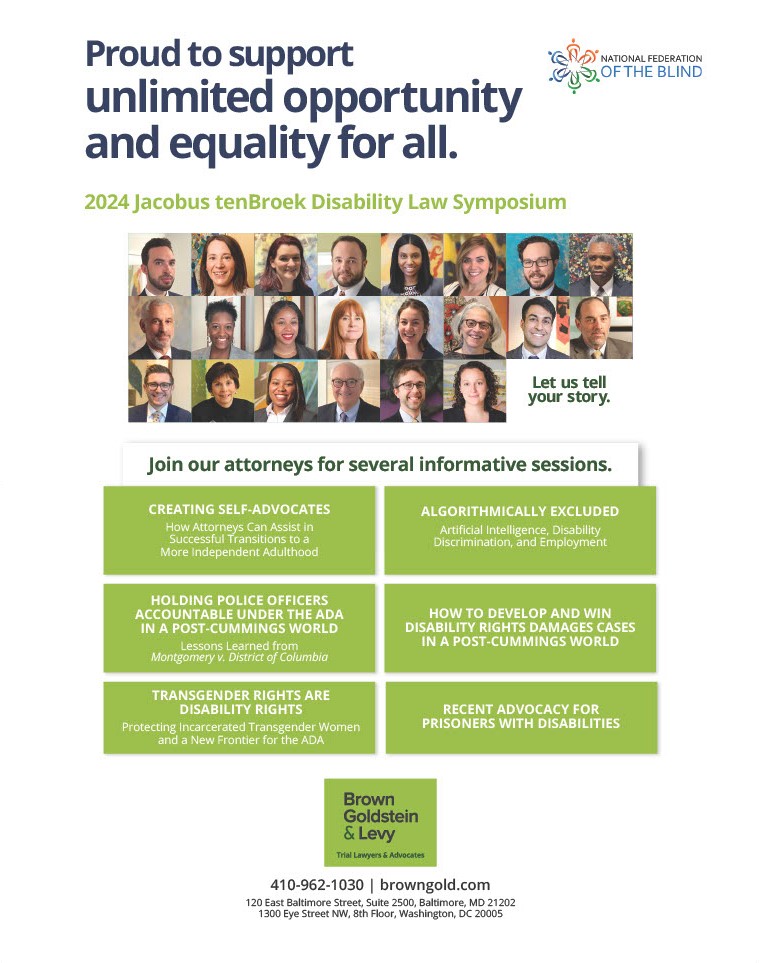
Brown Goldstein & Levy, LLP
Phone: 410-962-1030
Website: browngold.com
Address: 120 East Baltimore Street, Suite 2500, Baltimore, MD 21202; 1300 Eye Street NW, 8th Floor, Washington, DC 20005
Proud to support unlimited opportunity and equality for all. 2024 Jacobus tenBroek Disability Law Symposium. Let us tell you story. Join our attorneys for several informative sessions.
Sessions:
- Creating self-advocates; how attorneys can assist in successful transitions to a more independent adulthood
- Algorithmically excluded; artificial intelligence, disability discrimination, and employment
- Holding police officers accountable under the ADA in a post-cummings world; lessons learned from Montgomery v. District of Columbia
- How to develop and win disability right damages cases in a post-cummings world
- Transgender rights are disability rights; protecting incarcerated transgender women and a new frontier for the ADA recent advocacy for prisoners with disabilities
Rosen, Bien, Galvan & Grunfeld, LLP
Website: www.rbgg.com
Rosen Bien Galvan & Grunfeld is proud to support the 2024 Jacobus tenBroek Disability Law Symposium. Rosen Bien Galvan & Grunfeld LLP, founded in San Francisco in 1990, focuses its practice on complex litigation and regularly handles high profile cases that move and shape public policy. The firm’s civil rights work includes a series of disability right victories involving so-called “sharing economy” companies, such as Uber, Lyft and Airbnb, on behalf of blind and low-vision plaintiffs, as well as access to effective communications in hospitals for dead and hard of hearing clients. In 2018 we won a ground-breaking voting rights action that paves the way for equal access to absentee ballots for blind voters throughout California. The firm also represents individuals with certain types of disabilities who are incarcerated and on parole in California, including plaintiffs with mobility, sensory, kidney, learning, intellectual, and psychiatric disabilities.
Advancing justice and solving problems on behalf of classes, individuals, and businesses for over 30 years.
Silver Sponsors
McGuinness Law Group, PC
Introducing McGuinness Law Group. Representing people with disabilities throughout California. Celia McGuinness, owner; Deborah Gettleman, senior associate; Shalishah Patrick, paralegal.
Bronze Sponsors
Burton Blatt Institute
Law School Admission Council
Website: LSAC.org
LSAC, access, equity, fairness. At LSAC, these values are at the core of our missing to ensure everyone who wants to make an impact through the study and practice of law can do so without barriers. Together, we can build a future in which accessibility is the norm and every change maker can use their unique skills and passion to advance justice and opportunities for all.
Whiteford | Taylor | Preston
Website: whitefordlaw.com
Phone: 800-987-8705
Serving Delaware, Washington DC, Kentucky, Maryland, New York, Pennsylvania, and Virginia. Proudly supporting the National Federation of the Blind 2024 Jacobus tenBroek Disability Law Symposium.
White Cane Sponsors
Bazelon Center for Mental Health Law
Address: 1090 Vermont Avenue NW, Suite 220, Washington, DC 20005
Website: Bazelon.org
Proud to support the Jacobus tenBroek Disability Law Symposium. Fighting to protect and advance the rights of people with disabilities for over 50 years.
Disability Rights Advocates
Fighting for the civil rights of people with disabilities for over 30 years.
Disability Rights Education and Defense Fund
We envision a just world where all people, with and without disabilities, live full and independent lives free of discrimination.
Our new site is live! Explore at dredf.org
Presenters and Workshop Facilitators
Ariana Aboulafia is the Policy Counsel for Disability Rights in Technology Policy, where she leads CDT’s work in studying the ways in which certain technologies, including hiring algorithms and algorithmic surveillance, can impact disabled people, and advancing policy that protects their digital and civil rights.
An attorney with a strong background in holistic and community-centered public interest advocacy, Ariana previously served as an officer to the Journalism Department at the John S. and James L. Knight Foundation, where she oversaw a grant portfolio focused on providing legal services to journalists, enhancing journalist safety, and protecting the First Amendment. She has also served as an assistant public defender in Miami-Dade County, where she provided direct representation to clients facing both misdemeanor and felony criminal charges. Ariana holds a bachelor’s degree in political science and law, history, and culture from the University of Southern California, as well as a J.D. with a concentration in social justice and public interest from the University of Miami School of Law. While at Miami Law, Ariana served as a fellow to the Cyber Civil Rights Initiative, where her work included research to further their goal of combating online abuse and protecting civil liberties in online spaces.
Ariana’s academic works have been featured in several publications, including the University of Florida Journal of Law and Public Policy and the Connecticut Public Interest Law Journal, in topics ranging from consumer privacy and technology to hyper-viral police violence. Recently, she presented her research on the First Amendment at the Free Expression Scholars Conference at Yale University; in 2019, her paper on the criminalization of LGBTQ+ homelessness was honored by the National LGBTQ+ Bar Association. She is on the Board of Directors of SAVE LGBT, the longest-running LGBTQ+ rights organization in South Florida and serves as a member of Legal Services of Greater Miami’s Young Professionals Council.
Crystal Adams (she/hers) is a Trial Attorney in the Educational Opportunities Section of the Civil Rights Division at the U.S. Department of Justice. She is counsel in U.S. v. Georgia, a federal lawsuit challenging Georgia’s segregated GNETS Program on the grounds that it discriminates against students with behavior-related disabilities. Crystal previously served as a Senior Attorney at the National Center for Youth Law, where she conducted impact litigation on behalf of young people in immigration and juvenile detention, as well as schools. In addition, as an attorney at the U.S. Department of Housing and Urban Development, she pursued relief under the Fair Housing Act for victims of discriminatory conduct. Crystal obtained her Bachelor’s degree from Claremont McKenna College and her law degree from UC Irvine.
Jane Andersen: Jane is a trial attorney in the Disability Rights Section (DRS) of the U.S. Department of Justice’s Civil Rights Division. Jane joined DRS in 2023, and before that was an Assistant United States Attorney in the District of Maryland’s Civil Division and Civil Rights and Special Victims Section.
Monica Basche joined Brown Goldstein & Levy in September 2019. She represents clients in civil rights cases, including disability rights, housing discrimination, employment discrimination, and prisoners’ rights. Monica also has experience with commercial litigation and business disputes.
Prior to joining the firm, Monica was a law clerk to Judge George L. Russell, III on the United States District Court for the District of Maryland and to Judge Sally D. Adkins on the Supreme Court of Maryland (formerly known as the Court of Appeals of Maryland).
During law school, Monica was the Executive Articles Editor for the Maryland Law Review. She worked as a student attorney in the Gender Violence Clinic, where she represented clients in family and civil law matters in state court. Monica was also a research assistant to Professor Donald Gifford, whom she assisted with researching and editing the sixth edition of Cases and Materials on the Law of Torts, Harper, James and Gray on Torts, and Keeping Cases from Black Juries: An Empirical Analysis of How Race, Income Inequality, and Regional History Affect Tort Law.
Monica received the 2016 Elizabeth Maxwell Carroll Chesnut Prize, known as the “Dean’s Award,” which is given to a member of the graduating class for excellence in legal scholarship and writing. Prior to law school, Monica worked for Agora, Inc., where she focused on regulatory compliance for dietary supplements. She also taught English in Moscow, Russia.
Monica is an active member of the Bar Association of Baltimore City. She previously served as the Bar Association of Baltimore City Young Lawyers’ Division’s Treasurer and as Co-Chair of its Public Service Committee. She also serves on the board of Maryland CASA Association, which trains volunteer Court-Appointed Special Advocates to speak up for the best interests of children who are under the protection of the courts. Monica was also a member of the Maryland State Bar Association Young Lawyers’ Section Publications Committee. In addition, she served as member of the Uniform Bar Exam Maryland Law Component Committee, which helped design the new Maryland law portion of the bar exam.
Mika Baugh, MPH, is a doctoral candidate in Health Behavior at the Indiana University School of Public Health - Bloomington. Mika's research focuses on health equity among disabled youth and adults, with emphasis on sexual health and the ways in which language is used in healthcare settings. She has nearly 15 years of experience engaging with disabled students; teaching in pre-K-12 and post-secondary settings and facilitating and directing programming through community-based service providers. As a disabled teacher and researcher, Mika works to center the voices and prioritize the lived experiences and expertise of the populations with whom she works.
Tyler Beck, Advocacy Coordinator, joined the Epilepsy Foundation in October 2021, Tyer brings passion and personal experience to his role, as he lives with epilepsy himself. A member of the Consortium for Constituents with Disabilities (CCD) Transportation Task Force since 2022, he has joined as a co-chair to begin 2024. His interest in transportation issues began following a seizure he had in his vehicle in 2018. No longer able to drive, he was suddenly faced with the accessibility problems of our public transportation system that many Americans face every day.
In his previous role at the Texas Legislature, he helped ensure the legalization of Rideshare apps in the city of Austin following their city-wide ban. He also has a history in campaigning, having worked/campaigned for candidates across the political spectrum working to help people with disabilities. Tyler has a B.A. in Government from the University of Texas at Austin.
Michael W. Bien is a founding partner at the 34-year-old San Francisco litigation firm, Rosen Bien Galvan & Grunfeld LLP. He successfully litigated a series of major civil rights actions on behalf of incarcerated persons against prisons and jails over inadequate medical, dental, and mental health care, disability discrimination, sexual assault, use of force and solitary confinement. He is co-lead counsel of the legal team that prevailed in Plata v. Brown in the United States Supreme Court in 2011 requiring a 20% reduction in California’s prison population. He has brought successful ADA cases against Uber, Lyft, Airbnb, sports stadiums, hospitals, and movie theaters.
Mr. Bien recently led a team that secured a nationwide preliminary injunction, based on the First Amendment, against President Trump’s ban of the Chinese super-app, WeChat. He frequently writes and lectures on criminal justice reform, civil rights, disability rights, prisoner rights, and antitrust law. He received his B.A. from Brandeis University in 1977 and his J.D. from Northwestern University School of Law in 1980. He has served on the Boards of various not for profits including First District Appellate Project, Brandeis Hillel Day School, Camp Tawonga, the Mission YMCA, the Disability Rights Bar Association, and the New Israel Fund.
Margaret Bilyard, from Durham, North Carolina. I’m a retired teacher. I have a degree in Early Childhood Education, specializing in infant and two-year-old children. I worked in a Montessori setting for many years. I’ve been a Red Cross volunteer for 49 years. My local volunteer experience is working with the North Carolina agencies for the Blind and Deaf social workers teaching their students how to prepare for Disasters. Before Covid, I met with students throughout the central North Carolina area and conducted zoom calls to classes in the coastal areas of our state. I can relate well with someone with a visual disability for I have had Macular Degeneration for twenty years. I continue working on Disaster Operations throughout the country as a MassCare Supervisor in shelters. My second area is Disability Integration.
Lydia X. Z. Brown is NDI’s Director of Public Policy. They bring nearly 15 years of experience as a committed advocate, community organizer and policy expert at the nexus of disability rights and disability justice. Lydia has spoken and consulted internationally and throughout the U.S. on a range of topics at the intersections of disability, race, class, gender, and sexuality, and has published in numerous scholarly and community publications. Their work has often focused on interpersonal, state, and corporate violence, deprivation and exploitation targeting disabled people at the margins. Previously, Lydia served as Policy Counsel at the Center for Democracy & Technology, focusing on disability rights and algorithmic bias; Director of Policy, Advocacy, & External Affairs at the Autistic Women & Nonbinary Network; Justice Catalyst Fellow at the Bazelon Center for Mental Health Law; and Chairperson of the Massachusetts Developmental Disabilities Council.
Outside of their work at NDI, Lydia teaches at Georgetown University and serves as Co-President of the Disability Rights Bar Association, board member of the National Lawyers Guild and founding board member of the Alliance for Self-Direction and Disability Rights. They also serve as an advisor for the Transgender Law Center’s Disability Project, the Nonbinary & Intersex Recognition Project and Disability Rights Maryland. Lydia is the founder of the Autistic People of Color Fund, which advocates for disability, racial and economic justice with a focus on building generative economies and just transition.
Lydia is a lover of all cats, chronic autodidact, and polyglot, and deeply proud of their diverse culinary creations (which friends and family have described as “better than restaurants”).
Anita Cameron is Director of Minority Outreach for Not Dead Yet, a Rochester, NY-based, national disability rights group opposed to medical discrimination against disabled people, medical rationing, and assisted suicide. She has met with national and state policy makers and has written persuasively about opposition to a public policy of assisted suicide from the perspective of communities of color who experience disparities in access to healthcare. Her work and articles were cited in the 2019 National Council on Disability report on the dangers of assisted suicide as public policy.
Lauren DiMartino joined Brown, Goldstein & Levy to represent clients across various areas of civil rights law, including fair housing, education, and disability rights. Much of Lauren’s legal experience has centered on education equity and access, constitutional law, anti-discrimination, and government misconduct. She is a specialist on the Fair Housing Act, utilizing it to assist individuals impacted by discriminatory conduct and to challenge systems perpetuating segregation, with a particular interest in the intersection of housing and public education. She works with the Americans with Disabilities Act, Title IX, the Individuals with Disabilities Education Act (IDEA), and Section 504 of the Rehabilitation Act of 1973 to advocate for equity in the education system. Lauren has experience working with families of children beginning early intervention through high school—including assisting families with accommodations and Individualized Education Plans (IEPs)—in addition to experience working in higher education law and professional testing.
Prior to becoming an attorney, Lauren worked in marketing before transitioning to work in New York City community colleges because of her commitment to racial and economic justice. She worked as an academic counselor and the Assistant Director of ASAP, an accelerated education program aimed at removing systemic barriers to obtaining a degree. She remains active in higher education work and is on the Advisory Boards of the Urban Studies Program at Guttman Community College (CUNY) and of Baltimore Youth Arts and is teaching at the University of Maryland School of Law in Fall 2023.
Brian Dimmick is a senior staff attorney with the Disability Rights Program at the American Civil Liberties Union, where he focuses on impact litigation work in a number of areas of disability rights including criminal legal reform and voting. Prior to joining the ACLU in June 2020, Brian worked for over five years as an attorney with the U. S. Department of Education’s Office for Civil Rights on policy issues related to the rights of students with disabilities under section 504 and the ADA in elementary and postsecondary institutions. Before that, he was a staff attorney and director of litigation at the American Diabetes Association, where he focused on protecting the rights of people with diabetes in education, employment, prisons and other areas, and a Skadden Fellow at Disability Rights Advocates. He is a graduate of Stanford Law School and Wake Forest University and lives in Washington, D.C.
Robert D. Dinerstein is professor of law emeritus and former director (and founder) of the Disability Rights Law Clinic at American University, Washington College of Law (WCL), where he taught from 1983-2023. Prior to coming to WCL, he was an attorney for five years at the Department of Justice, Civil Rights Division, Special Litigation Section, where among other things he litigated cases concerning conditions in state institutions for people with intellectual disability, psychosocial disabilities, and juveniles. From 1994-2000, he was a member of the President’s Committee on People with Intellectual Disabilities. He currently chairs the ABA Commission on Disability Rights and is co-chair of the ABA Section of Civil Rights and Social Justice’s Disability Rights Committee.
He has served on a number of boards of directors and committees that address legal issues for people with disabilities (including serving on the steering committee for the Jacobus tenBroek Disability Law Symposium from 2006 through 2017), and currently is chair of the board the Equal Rights Center (Washington, DC). In the area of disability rights, Prof. Dinerstein’s work has focused on issues of consent, supported decision making, and deinstitutionalization of people with intellectual and developmental disabilities. He has an A.B. degree from Cornell University and a J.D. degree from Yale Law School.
Kevin Docherty is a trial lawyer at Brown Goldstein & Levy, LLP where he represents individuals in a variety of disability rights cases. In May 2023, he was part of the trial team that represented two blind students and the National Federation of the Blind against the Los Angeles Community College District, and helped secure a verdict finding that LACCD violated the ADA and awarding the plaintiffs more than 240,000 dollars in damages. Kevin also represents individuals employed at sheltered workshops for sub-minimum wages in cases under the FLSA and ADA. In addition to his civil rights work, Kevin represents businesses and businesspeople in complex commercial litigation. Before joining Brown Goldstein & Levy, Kevin clerked for Judge William Nickerson on the United States District Court for the District of Maryland. He is a graduate of Eastern Mennonite University and the University of Maryland Francis King Carey School of Law.
Joshua Erlich’s primary focus of his practice is to find creative ways to help clients. Client problems often require creative solutions and Josh prides himself on coming up with the best solution based on the individual needs of each client. More than anything else, Josh finds ways to use the law to help people who have been treated unfairly. This includes people of all races, religions, and genders, from entry level employees to executives, as well as small and medium size businesses in need of guidance. Often times, Josh litigates employment issues, non-competition disputes, and cases focused on unpaid wages, commissions, or bonuses. At other times, Josh is focused on complex cases involving prisoners’ rights, sexual assault, and police misconduct. He also regularly works on other civil matters, defamation and contract issues.
When he’s not litigating, Josh works with individuals and businesses to provide legal guidance on a wide range of issues, including severance negotiations, employee handbooks, and compliance concerns. Before Josh started his own firm, he was an Associate at McTigue & Veis, LLP. In that position, he worked on complex class action litigation and represented participants in employee benefit plans. He also served as a legal intern at the Department of Labor, Plan Benefits Security Division and in the Department of the Treasury’s Office of the Assistant General Counsel for General Law, Ethics, and Regulation.
Josh earned both his J.D. and his LL.M. in Taxation with a Certificate in Employee Benefits Law from Georgetown University Law Center. While at Georgetown, he was a Legal Research and Writing Fellow and worked as a research assistant for Martha Jo Wagner, an adjunct professor focused on ERISA litigation. He was a finalist in the American Bar Association’s Law Student Tax Challenge, LL.M. Division. Josh graduated from Louisiana State University in Baton Rouge with a B.A. in History, a minor in Philosophy, and a B.A. in Classics. He is admitted to practice in both Washington, D.C. and Commonwealth of Virginia. He has lived in Arlington since 2006.
Matt Faiella is a trial attorney in the Disability Rights Section (DRS) of the U.S. Department of Justice’s Civil Rights Division. Matt joined DRS in 2019, and before that worked at the U.S. Department of Education’s Office for Civil Rights from 2010-19, New York Civil Liberties Union from 2007-10, and U.S. Court of Appeals for the Eleventh Circuit from 2005-07.
Kobie Flowers is, first and foremost, a trial lawyer, with over twenty years of courtroom experience. Kobie has litigated cases in federal and state courts throughout the United States and internationally in the military commissions in Guantanamo Bay. His first-chair trial experience in building cases for the government as a federal civil rights prosecutor and in fighting the government’s efforts as an assistant federal public defender provides him with an uncommon insight into trial practice. Kobie typically represents high-profile clients in high-stakes criminal investigations, civil litigation, internal investigations, or trials. In his lifelong effort to end mass incarceration and police brutality, Kobie also represents the wrongfully convicted and sues police departments. Recognized by his peers for his trial acumen, Kobie teaches the art and science of trial lawyering to other trial lawyers around the country.
As a member of the Attorney General’s Honors Program, Kobie was a civil rights prosecutor at the United States Department of Justice for over four years. There, he conducted complex grand jury investigations involving fraud, false statements, obstruction of justice, and perjury charges as aspects of enforcing federal criminal civil rights statutes. While at the Department, he specialized in the prosecution of police brutality cases. Kobie was one of the prosecutors who successfully tried the largest case against federal correctional officers in the history of the Civil Rights Division. For that effort, he earned the Civil Rights Division’s Special Commendation for Outstanding Service. Kobie never lost a case as a federal civil rights prosecutor.
After his tenure as a federal civil rights prosecutor, Kobie sought out the challenge of defending against federal prosecutions as an Assistant Federal Public Defender in Baltimore. As an AFPD, Kobie successfully represented clients charged with federal felonies, including fraud, false statements, obstruction of justice, bribery, tax, and perjury charges. Kobie won two-thirds of his trials. When trial was not in the client’s best interest, Kobie navigated through the demands of the government and obtained numerous favorable, pre-verdict outcomes for his clients, including dismissals of cases. Before starting his legal career, Kobie served in the United States Peace Corps.
Allison Frankel is a Staff Attorney with the ACLU’s Criminal Law Reform Project (CLRP), where she focuses on challenging oppressive probation and parole systems that feed mass incarceration. Allison has developed litigation challenging issues including prolonged detention pending probation revocation proceedings, supervision systems' failure to accommodate disabilities, and juvenile life without parole.
Allison previously served as an Equal Justice Works Fellow with CLRP and the ACLU’s Human Rights Program, and as the Aryeh Neier Fellow with the ACLU and Human Rights Watch, where she authored a report, Revoked: How Probation and Parole Feed Mass Incarceration in the United States. Prior to joining the ACLU, Allison challenged unlawful restrictions on sex-offense registrants as a fellow with the Center for Appellate Litigation and served as a law clerk to the Honorable Andrew L. Carter, Jr. of the Southern District of New York. Allison is a graduate of Yale Law School and the University of Wisconsin-Madison.
Margaret Girard is a Trial Attorney in the Civil Rights Division of the U.S. Department of Justice. She joined the Disability Rights Section in 2021 after previously working in private practice. At DOJ, she has worked on investigations, litigation, and compliance under the Americans with Disabilities Act.
Danica Gonzalves is a zealous advocate for individuals with disabilities. Danica currently works as an Advocacy Attorney at Paralyzed Veterans of America (PVA), where she fights for the rights of people with disabilities. With a focus on physical accessibility, Danica advocates for all individuals with disabilities to ensure they have full and equal enjoyment in their daily lives. She has filed numerous complaints on behalf of PVA members, resulting in accessibility improvements. She also collaborates with places of public accommodation to increase accessibility. Danica is a current co-chair of the Consortium for Constituents with Disabilities (CCD) Transportation Task Force. Danica continues to fight for new laws and regulations to increase accessibility and protections for people with disabilities.
Danica graduated from The George Washington University Law School, where she was a speaker on the George Washington University’s Disability Students Speakers Bureau and founded a group to advocate for students with mental health conditions. She interned at multiple non-profits and government agencies, with a focus on disability rights. Upon graduating from law school in 2016, she received the Pro Bono Service Award and the President’s Volunteer Service Award. In 2017, Danica was awarded an Equal Justice Works fellowship to build the Discharge Upgrade Program at The Veterans Consortium Pro Bono Program. The nationwide program assisted veterans with mental health conditions and those who experienced military sexual trauma. She co-authored an article on discharge upgrades, published in the Stetson Journal of Advocacy & the Law. Outside of her professional life, Danica advocates for lawyers and law students with mental health conditions and substance use disorders as a volunteer for the DC Bar Association’s Lawyer Assistance Program and a member of the Lawyer Assistance Committee.
Steve Gordon for the last twenty-eight years has been employed by the United States Department of Justice (DOJ), most recently as an Assistant United States Attorney (“AUSA”) with the United States Attorney’s Office in the Eastern District of Virginia. As the founder and Coordinator of the US Attorney’s Office’s District-wide Civil Rights Enforcement Program, Steve has been the driving force behind the office’s Civil Rights Enforcement Program. He has handled a wide variety of ADA enforcement cases, including in education and healthcare settings has engaged in a wide variety of community outreach activities, and provides guidance to less experienced attorneys.
He has presented widely on a variety of disability rights topics including the ADA in higher education settings, the ADA in human and social service settings, the ADA in state and local criminal justice system, and disability discrimination in health care settings. Before becoming an AUSA, Mr. Gordon worked as a Trial Attorney for the Department of Justice’s Civil Division and as an attorney for the National Labor Relations Board and the law firm that used to be known as Wilmer, Cutler & Pickering. He earned his BA from Brandeis University and his JD from Northeastern University School of Law.
Meline Grigoryan, PhD Education expert and Education programs manager, Author of the book, "If you are a teacher, you are motivating, inclusive, valuing and...". Actively fosters the enhancement of skills among educational institutions’ specialists and is involved in designing and delivering courses, workshops, and programs based on the principle of inclusion.
Katherine M. Groot is a staff attorney in the Civil Practice, Disability Advocacy Project and Education Law Project at The Legal Aid Society. The Legal Aid Society, founded in 1876, fulfills a mission that no New Yorker should be denied access to justice because of poverty, and stands as the nation’s oldest and largest not-for-profit legal services organization. Katherine represents low-income New Yorkers in both special education and federal benefit matters.
In her special education practice, Katherine represents students with disabilities at IEP meetings, mediations, administrative hearings and appeals, federal district court, and related advocacy to ensure their access to a free, appropriate public education. Additionally, Katherine collaborates with pro bono partners on federal court filings on both individual plaintiff cases and systemic matters that directly impact clients. She earned a Juris Doctor from City University of New York School of Law, master’s degree in special education from the University of Missouri, St. Louis, and a bachelor’s degree in secondary education from Boston University.
Jasmine E. Harris is a Professor of Law at the University of Pennsylvania Carey Law School. She is a leading law and inequality scholar with expertise in disability law, antidiscrimination law, and evidence. Her recent academic articles have or will appeared in Columbia Law Review, New York University Law Review, UCLA Law Review, and University of Pennsylvania Law Review. Harris serves as a co-editor of the preeminent evidence treatise, McCormick on Evidence. Harris also writes frequently about disability law for popular audiences with by-lines and commentary in such publications and media outlets as the New York Times, San Francisco Chronicle, Ms. Magazine, Washington Post, TIME Magazine, Bloomberg, and National Public Radio. Harris graduated with honors from Dartmouth College and Yale Law School. She clerked for Harold Baer, Jr., United States District Judge for the Southern District of New York and practiced complex commercial litigation at WilmerHale and public interest law at the Advancement Project. Harris serves as a board member of The Arc of the United States where she chairs the organization’s Legal Advocacy Committee.
Kamisha Heriveaux is a 29-year-old self-advocate that works for Massachusetts Advocates Standing Strong (MASS), a statewide advocacy organization. She has been at MASS for ten years and currently serves as the Self Advocate Content Expert. Currently, Kamisha is working towards her G.E.D. so she can attend college and study photography, Spanish, music, writing, or filmmaking. She is very proud to have been living independently in her own apartment for over three years. She is passionate about traveling, always has a positive attitude, and dreams big.
Katherine Herrmann is a Partner at The Erlich Law Office, PLLC in Arlington, Virginia. Ms. Herrmann has a full scope employment practice, including representation of employees who have suffered sex and gender discrimination, disability discrimination, race discrimination, and other violations of rights. Her civil rights cases focus on police and prison abuses, including the use of excessive force, unconstitutional searches, and deliberate indifference in the denial of medical care to incarcerated persons.
Ms. Herrmann litigated the recent case of Williams v. Kincaid, which challenged the placement of a transgender woman among men at the Fairfax County Adult Detention Center and the facility’s denial of medical care to Ms. Williams to treat her gender dysphoria. The Fourth Circuit Court of Appeals held that gender dysphoria constitutes a disability under the law and that transgender individuals diagnosed with gender dysphoria are entitled to the protections of the Americans with Disabilities Act.
Ms. Herrmann is a board member of the Virginia Employment Lawyers Association, a member of the Virginia Equality Bar Association, and regularly litigates in the federal and state trial courts in Virginia, as well as the Fourth Circuit Court of Appeals.
Eve Hill is one of the nation’s leading civil rights lawyers, known especially for her work with clients with disabilities and LGBTQ+ clients. She has been recognized by Law360 as one of just 12 “Titans of the Plaintiffs’ Bar” for 2023, as well as by Lawdragon as one of the 500 Leading Lawyers in America (2022 and 2023). Her wide-ranging experience complements Brown, Goldstein & Levy’s decades of dedication to high-impact disability rights cases and its advocacy on behalf of individuals with disabilities and their families. Eve also leads Inclusivity, BGL’s Strategic Consulting Group, which works with organizations to promote the education, engagement, and employment of people with disabilities.
From 2011 to January 2017, Eve served as Deputy Assistant Attorney General of the U.S. Department of Justice, Civil Rights Division, where she was responsible for oversight of the Division’s disability rights, education, and Title VI enforcement and the American Indian Working Group. She was part of the negotiating team for the Marrakesh Treaty to Facilitate Access to Published Works for Persons Who are Blind, Visually Impaired or Otherwise Print Disabled; testified before the Senate Foreign Relations Committee to support ratification of the U.N. Convention on the Rights of Persons with Disabilities; enforced accessibility requirements for websites and other digital technology; implemented Olmstead community integration requirements in employment and education; and enforced disability rights in education, testing, and health care.
Eve is the former Senior Vice President at the Burton Blatt Institute of Syracuse University, where she was responsible for the Institute’s work on the Americans with Disabilities Act, disability civil rights, and communications issues. Preceding her employment at the Burton Blatt Institute, Eve was the District of Columbia’s first Director of the Office of Disability Rights, responsible for ensuring compliance with the ADA throughout District government. This position gave Eve an insider’s view on investigations of complaints, informal dispute resolution, litigation consultation, training, and disability policy development.
As the Executive Director of the Disability Rights Legal Center at Loyola Law School, Eve managed all aspects of this non-profit disability rights organization and supervised all major programs, including the Civil Rights Litigation Project, Disability Mediation Center, Cancer Legal Resource Center, Community Outreach Program, and Education Advocacy Project.
Patrick Holkins is a Trial Attorney in the Civil Rights Division of the U.S. Department of Justice. Patrick joined the Voting Section of the Civil Rights Division in 2014 through the Attorney General’s Honors Program. He transferred to the Special Litigation Section in 2017. At DOJ, he has worked on litigation and investigations under the Voting Rights Act, the National Voter Registration Act, and the Americans with Disabilities Act, including Olmstead matters in Mississippi, Georgia, and Alaska.
David John Hommel is a Partner in the Disability Rights section at Eisenberg & Baum, LLP where he ensures equal access for individuals with disabilities. David recently won a federal jury trial on behalf of a deaf individual who was denied interpreter services throughout a hospital stay. In addition, David is a director of the Appellate Practice Group where he has successfully argued for reversals in federal courts. Previously, David clerked for Judge Joanna Seybert in the U.S. District Court for the Eastern District of New York and then served as a Court Law Clerk in the same district. David earned his degrees from New York University and St. John’s University School of Law. In college, he captured the 2010 National Mock Trial Championship, and in law school, he won the 2014 National First Amendment Moot Court Competition.
Jessica Hunt is the Supervisory Accessibility Specialist for DOJ’s ADA Information Line, DOJ’s toll-free number, where specialists provide technical assistance and answer questions about ADA Titles II and III and how they apply to various situations. She is a disabled lawyer, who has experience advising both state and local government entities and members of the public on disability and civil rights laws.
Arlene S. Kanter is the founder and director of Syracuse University College of Law’s award-winning Disability Law and Policy Program (DLPP). The DLPP is the first and most extensive disability law program in the United States. At Syracuse, Professor Kanter also directs the College of Law’s International Programs and holds a courtesy appointment at the School of Education. Professor Kanter is a recipient of Syracuse University’s highest teaching award, the Laura J. and L. Douglas Meredith Professorship, as well as the College of Law’s Bond, Schoeneck and King Distinguished Professorship.
Professor Kanter is an internationally acclaimed expert in international, comparative, and U.S. disability law. She has written and edited several books, chapters in books published by Cambridge, Oxford, and Michigan, among others, and articles for law journals of such law schools as Columbia, Harvard, Hebrew University, NYU, Stanford, and Vanderbilt. Her most recent law review article, Remote Work and the Future of Disability Accommodations (2022) was published by the Cornell Law Review. Her last book, the Development of Disability Rights Under International Law: From Charity to Human Rights (Routledge, 2015, 2017), discusses the development of the UN Convention on the Rights of People with Disabilities (CRPD), which she helped to draft as part of an expert committee at the UN.
Professor Kanter has consulted with governments and organizations on the CRPD in more than a dozen countries, including Argentina, Brazil, China, Egypt, Georgia, Ghana, India, Ireland, Israel, Italy, Japan, Jordan, Kenya, Mexico, Palestine, Peru, South Africa, Turkey, the UAE, and Vietnam. Professor Kanter has been invited to address the UN General Assembly, the UN Committee of the Convention on the Elimination of Discrimination Against Women, and the UN CRPD Committee as well as presented at hundreds of conferences in the United States and abroad.
Professor Kanter is a former visiting scholar at Harvard Law School, the National Academy of Legal Studies and Research of India (NALSAR), Hebrew University in Israel, and Charles University in the Czech Republic. She was a Fulbright Scholar at Tel Aviv University in 2009, and the 2010 Distinguished Switzer Fellow, selected by the US Department of Education’s National Disability Rehabilitation Research Institute. Professor Kanter is co-editor of the Critical Disability Series at SU Press, founder, and editor of the SSRN Journal on Disability Law, co-founder of the Disability Law Section of the American Association of Law Schools, co-founder of the Disability Collaborative Research Group of the Law and Society Association, and a former Commissioner of the ABA’s Commission on Mental and Physical Disability Law.
Professor Kanter has been honored for her disability work by the American Bar Association, the American Association of Law Schools, the New York State Bar Association, and other organizations in the U.S. and throughout the world. Prior to joining the Syracuse Law faculty, Professor Kanter taught at Georgetown University Law Center and practiced law at a national disability rights organization in Washington, DC, now known as the Bazelon Center on Mental Health Law, where she represented clients before the United States Supreme Court and Congress. She received her LL.M. from Georgetown University Law Center and her J.D., with honors, from New York University School of Law.
Jinny Kim is a Supervising Attorney at Disability Rights Advocates. Ms. Kim started her legal career at Legal Aid at Work as the Félix Velarde-Muñoz Fellow where she litigated race, disability, national origin, and gender cases. Thereafter, she was a Georgetown Women’s Law and Public Policy Fellow where she served as Labor Counsel to Senator Edward Kennedy on the Committee for Health, Education, Labor, and Pensions. Ms. Kim returned to Legal Aid at Work in 2008 and served as the Director of the Disability Rights Program from 2014 to 2022 where she litigated individual employment cases and systemic disability access cases. Ms. Kim has also held positions at the Asian Pacific Islander Legal Outreach, as well as Schneider Wallace Cottrell Konecky LLP, and Goldstein, Borgen, Dardarian & Ho. Ms. Kim received her J.D. in 1999 from the University of California, Davis and her B.A. from the University of California, Berkeley in 1995.
Reyna Lubin is the Director of the Employment Discrimination Department at Eisenberg & Baum, LLP. She has successfully tried a broad range of discrimination matters throughout the nation’s state and federal courts. She recently won two federal jury trials in which she advocated for her client’s rights under federal antidiscrimination statutes. Reyna has successfully obtained multiple six-figure settlements for her clients who have been subjected to unlawful discrimination, retaliation, and termination by their employers. Previously, Reyna was an Assistant District Attorney at Kings County District Attorney’s Office. At the D.A.’s office, Reyna handled felony criminal cases involving intimate partner violence.
Sarah Malaier is Senior Advisor, Public Policy and Research, at the American Foundation for the Blind (AFB). She leads AFB’s federal legislative and regulatory policy advocacy and contributes to the development of strategy and priorities. Sarah has helped draft legislative bills on digital inclusion and the improvement of transportation services for people who are blind or have low vision. She has prepared comments on federal rulemaking, including several comments on autonomous vehicle policy and pedestrian safety. As part of AFB’s Public Policy and Research Institute, she has participated in the development and dissemination of several research studies on transportation, the COVID-19 pandemic, and digital inclusion.
Sarah serves as Co-Chair for the Consortium of Citizens with Disabilities Transportation Task Force, a cross-disability coalition, which advocates with the federal government for accessible, affordable, and effective transportation for people with disabilities. She serves on the Federal Communications Commission’s Disability Advisory Committee, and she also chairs AFB’s Institutional Review Board. Sarah holds an MA in International Relations and Economics from Johns Hopkins University and a BA in Political Science and German from the University of Alabama.
Anthony J. May has represented clients in a variety of complex litigation matters including assisting employees with disabilities in obtaining accessible technology and accommodations in the workplace, representing individuals who have been wrongfully convicted, commercial litigation disputes, and fighting workplace discrimination based on sexual orientation.
Prior to joining the firm, Anthony was the Francis D. Murnaghan, Jr. Appellate Advocacy Fellow at The Public Justice Center, where he represented indigent clients, authored amicus briefs, and argued in the United States Court of Appeals for the Fourth Circuit and Maryland appellate courts on various anti-poverty and civil rights cases. He clerked on the Appellate Court of Maryland (formerly known as the Maryland Court of Special Appeals) for the Honorable Deborah Sweet Eyler (Ret.).
While attending law school, Anthony worked as a law clerk at Brown Goldstein & Levy, was the Executive Symposium Editor of the Journal of Race, Religion, Gender & Class, a semi-finalist in the ABA Labor & Employment Law Trial Competition, and a Legal Writing Fellow.
Nancy Mayer is an attorney who has a solo practice in Research Triangle Park, North Carolina. Ms. Mayer has a BS from Cornell School of Engineering, MBA from Duke Fuqua School of Business, and a JD from North Carolina Central School of Law. Ms. Mayer is licensed to practice in North Carolina, District of Colombia, Eastern District of North Carolina Federal Court and the US Supreme Court. Ms. Mayer is a member of many professional organizations including, but not limited to the National Academy of Elder Law Attorneys and Disability Rights Bar Association.
Ms. Mayer’s professional experience includes thirty-four years with the Environmental Protection Agency, twenty-five years with collateral juries as an American Federal of Government Employees local steward focusing on the rights of people with disabilities, and seventeen years in private law practice concentrating on elder law, disability law and probate. Ms. Mayer’s relevant volunteer experience includes forty-four years with the American Red Cross teaching CPR/First Aid, teaching disaster preparation classes, working on several disasters as a Red Cross Volunteer, and representing the Red Cross on local/state Emergency Response Teams. Currently her focus is on providing debit cards for volunteers who respond to single/multifamily fires and the lead for Disaster Integration for the North Carolina Region.
Vardges Melkonyan, a passionate and dedicated Inclusive Education Trainer and Inclusion advocate with 17 years of experience in promoting inclusive practices within the education sector. With a strong background in teaching and a deep understanding of diversity, equity, and inclusion, committed to fostering inclusive environments that meet the diverse needs of all learners.
Evan Monod just joined Arc of the United States earlier this month as a staff attorney. Before that, Evan was with Brown, Goldstein & Levy as the Disability Rights Fellow. He is a disability rights advocate with a passion for justice for the vulnerable members of his community.
Prior to joining the firm, Evan worked as the Law Fellow at the American Constitution Society. While at ACS, he assisted the Policy and Programs department in writing and editing policy briefs and publications, creating panels and events for the ACS National Convention, and hosting episodes of their podcast. He became known as the go-to guy for constitutional, immigration, and disability rights law.
Evan graduated with honors from the George Washington University Law School in May 2021. He served as the Senior Notes Editor for the Public Contract Law Journal, where he managed a team of student editors and made selections for publication of student Notes. His own Note on disability affirmative action hiring in federal contracting was published in the Fall 2020 issue of the Public Contract Law Journal.
While in law school, Evan had summer internships with Quality Trust for Individuals with Disabilities and the Disability Rights Section of the U.S. Department of Justice. He also served as a disability policy intern for Chairwoman Patty Murray on the U.S. Senate Health, Education, Labor, and Pensions Committee.
Swatha Nandhakumar is the Advocacy and Outreach Specialist at the American Council of the Blind, a position she has held since March 2021. ACB is the nation’s leading member-driven organization of and for individuals who are blind or low vision with a mission to increase the independence, security, equality of opportunity, and to improve the quality of life for all individuals who are blind or experiencing vision loss. In her role, Swatha works on federal public policy and governmental affairs on issues including but not limited to access to transportation, voting, health care, and the digital built environment for individuals with disabilities, including blindness and low vision.
She currently serves as a Co-Chair of the Consortium for Constituents with Disabilities Transportation Task Force and represents ACB on several other advocacy and policy coalitions and with industry partners of the organization. Additionally, she engages directly with ACB’s nationwide membership to advocate and communicate on their, and the organization’s, priorities with Congress and the administration. Prior to ACB, Swatha graduated with a Bachelor of Arts in Political Science, magna cum laude, from Loyola University Chicago in 2020 and currently lives in the Washington, DC area.
Qudsiya Naqui serves as Senior Counsel in DOJ’s Office for Access to Justice, where her work focuses on the intersection of disability and access to our civil and criminal legal systems. She is a blind attorney of South Asian descent who has navigated the civil and immigration legal systems as a disabled lawyer herself and will bring these experiences to the conversation.
Mellie Nelson is a Supervisory Trial Attorney, Disability Rights Section, Civil Rights Division, U.S. Department of Justice where she oversees nationwide enforcement of the Americans with Disabilities Act with an emphasis on corrections. For the previous 16 years, she served as Deputy Chief of the Special Litigation Section, a Section with authority for nationwide institutional reform litigation, civil enforcement of the Freedom of Access to Clinic Entrances Act of 1994, police misconduct litigation, and the Religious Land Use and Institutionalized Persons Act. She received her Juris Doctor with honors from George Washington University. She serves as a mediator for the United States Court of Appeals for the District of Columbia Circuit and for the United States District Court for the District of Columbia.
Sarah North is Senior Litigation Counsel for the Civil Division of the U.S. Attorney’s Office for the Northern District of Illinois. She began with the office as an Assistant United States Attorney in 2014. Before that, she was an AUSA with the U.S. Attorney’s Office for the Southern District of New York. Her focus is on affirmative civil matters, including civil fraud investigations and litigation, along with civil rights, and providing strategic investigation and litigation guidance to AUSAs in her office.
Katharine (Kate) Peglow is a Research Project Coordinator in the Center for Precision Medicine and Genomics, Department of Medicine, Columbia University. Her work focuses on precision medicine research, disability inclusion, and issues related to the ethical, legal and social implications (ELSI) of genetics. She has an MPH from Columbia University in the Sociomedical Sciences department with a Certificate in Population Mental Health and a BS in Psychology with a double minor in Biology and Health Professions from Hobart and William Smith Colleges. While completing her MPH, Kate worked as a graduate research assistant at Columbia University’s Center for the Psychosocial Study of Health & Illness and completed a summer internship at the Center for Science in the Public Interest as a Data Collection and Research Intern. Additionally, prior to completing her MPH she was an AmeriCorps member serving as a Community Based Experiential Training Program Coordinator.
Kreenjala Pyakurel (she/her) works as a Research/Staff Associate in the Center for Precision Medicine and Genomics in the Department of Medicine at Columbia University on research projects focused on the ethical, legal, and social implications (ELSI) of precision medicine and disability inclusion in research. She recently completed her B.A. in Biology with a minor in Economics from Clark University. While completing her B.A., she interned at the Center for Medical Ethics and Health Policy at Baylor College of Medicine focusing on bioethics in the ELSI of Polygenic Embryo Screening research project.
Madeleine Reichman joined Disability Rights Advocates in 2022 as a Staff Attorney after several years of working for tenants’ rights, and became a Senior Staff Attorney in 2023. She started her career defending tenants in eviction proceedings at Mobilization for Justice (formerly MFY Legal Services). Later, she joined the New York City Commission on Human Rights, where she investigated and prosecuted source of income discrimination claims brought by recipients of rental vouchers and subsidies. In her spare time, Madeleine has volunteered with immigrants’ rights organizations helping individuals apply for asylum and other forms of humanitarian-based immigration relief. She graduated from Swarthmore College with a B.A. and received her J.D. from Georgetown University Law Center.
West Resendes is a staff attorney in the Disability Rights Program (DRP), where he uses disability rights impact litigation and community-centered integrated advocacy tools to advance the ACLU’s affirmative vision for reducing the role, power, presence, and responsibilities of police in communities and schools. West is engaged in ongoing litigation to reform the statewide carceral and parole systems in Georgia for deaf and hard of hearing people, and also works on aversive discipline issues impacting students with disabilities. West began his work at the ACLU as a Skadden Fellow. Prior to joining the ACLU, West earned his J.D. at Yale Law School where he worked on a nationwide class action lawsuit seeking relief for less-than-honorably discharged veterans from the Iraq and Afghanistan era with mental health disabilities. West holds an A.B. from Harvard College and was a Henry Russell Shaw Fellow.
Andrew Rozynski is a partner at Eisenberg & Baum, LLP, where he harnesses his extensive experience as a civil rights attorney to passionately advocate for his clients' rights. His successful advocacy efforts have set legal precedents that positively affect numerous lives nationwide. A seasoned litigator and appellate lawyer, he has been privileged to represent clients across a spectrum of civil rights cases, with a special focus on the Deaf community—drawing from his personal experience as a CODA. His legal journey has led him to secure over 25 trial verdicts in favor of his clients, reflecting a steadfast commitment to their rights. His appellate experience is marked by more than 10 favorable decisions in multiple U.S. Circuit Courts of Appeals and state appellate courts, and he has had the honor of arguing before the United States Supreme Court. He attributes these accomplishments to the collaborative efforts of his teams, who have worked under his guidance to secure justice for many.
Dr. Maya Sabatello is an Associate Professor of Medical Sciences at the Center for Precision Medicine and Genomics, Department of Medicine, and Division of Ethics, Department of Medical Humanities and Ethics, at Columbia University, where she also co-directs the Precision Medicine & Society speaker seminar & workshop. A former litigator with trans-disciplinary background, her research explores the ethical, social and policy issues relating to biomedical technologies, genomic information and Big Data and the impacts thereof on social structures, marginalized communities, individual rights, and health outcomes. Dr. Sabatello’s NIH-funded mixed-methods and community-based participatory research program focuses on the clinical and psychosocial impact of genomic data on adolescents and families and on issues of trust and inclusion of people with disabilities in precision medicine research.
Dr. Sabatello’s research is coupled with practical experience. She has extensive experience in national and international policymaking relating to disability rights. As a Permanent Representative for a nongovernmental organization at the United Nations, Dr. Sabatello participated in the drafting of the Convention on the Rights of Persons with Disabilities. Dr. Sabatello serves as a member of the ASHG’s Professional Practice & Social Implications Committee and the Institutional Review Board (IRB) of NIH’s All of Us Research Program. She is Co-chair of NHGRI’s Community Engagement in Genomics Working Group (CEGWG).
Stuart Seaborn is the Chief Litigation Officer at Disability Rights Advocates. Mr. Seaborn first joined DRA in 2011 and has been advocating in the public interest for more than 20 years. He specializes in systemic litigation on behalf of persons with disabilities and has achieved multiple national precedents on matters of first impression in the area of disability rights. In one example, Disabled in Action v. Board of Elections, Mr. Seaborn secured the first federal appellate decision to hold that, under the Americans with Disabilities Act, election officials must provide voters with disabilities the same private and independent voting experience they provide to non-disabled voters.
He was also lead counsel in Legal Services for Prisoners with Children v. Ahern, which resulted in a court-enforceable settlement agreement to provide disability-based accommodations to persons housed in one of the largest county jail systems in California, and Ochoa v. City of Long Beach, a class action resulting in the installation and improvement of thousands of curb ramps for persons who use wheelchairs. Mr. Seaborn is also an adjunct professor at UC Hastings School of Law. In addition to his work with DRA, he had a solo civil rights practice, and worked as a litigator at Disability Rights California. He received his law degree from the UCLA School of Law in 1998 and his BA from UC Berkeley in 1995.
Lori Scharff has been an advocate for people who are blind, low vision or deafblind since the 1990’s. She has practiced social work for 20 plus years, is a Work Incentive Practitioner-Certified and most recently obtained a masters in Vision Rehabilitation Therapy. Through Lori’s lived experience as a person who is blind as well as the knowledge she has developed in her work life, she strives to empower people who are blind, low vision or deafblind to maximize their potential. Regarding Accessible Pedestrian Signals, Lori has advocated for APS for over 20 years. It is her belief that if sighted people have access to the walk phase information when crossing a street, blind, low vision and deafblind individuals deserve access to the same information.
Megan E. Schuller (she/her) is the Legal Director of the Bazelon Center for Mental Health Law, an organization dedicated to advocating for the civil rights, full inclusion, and equality of adults and children with mental health and intellectual disabilities through high impact litigation, public policy advocacy, and technical assistance. She has spent the entirety of her career litigating cases to enforce the rights of people with disabilities and reform public service systems, including for over a decade enforcing the Americans with Disabilities Act at the U.S. Department of Justice in the Civil Rights Division. She speaks frequently on how algorithms and artificial intelligence can lead to disability discrimination, including in the criminal legal and family regulatory systems, and how the Americans with Disabilities Act applies.
Maitreya Shah is a blind lawyer and researcher. His work lies in the interstices of the ethics and governance of emerging technologies and disability rights. He graduated with dual degrees in Arts and Law (B.A. LL.B (Hons.) from Gujarat National Law University, India, and an LLM from the University of Pennsylvania Law School where he was a Dean’s Merit Scholar. He was most recently at Regulatory Genome, a spin-out of the University of Cambridge, and was previously a Legislative Assistants to Member of Parliament (LAMP) Fellow in India. He has extensively worked in the areas of digital accessibility, AI governance, regulatory technologies, and disability law. His research and scholarship integrates perspectives from AI ethics and critical disability studies to foreground the experiences of people with disabilities with emerging technologies. At BKC, he will examine AI fairness frameworks from the standpoint of disability justice and inclusion.
Suzy Rosen Singleton, a native user of American Sign Language, is the Chief of the Disability Rights Office of the Consumer and Governmental Affairs Bureau of the Federal Communications Commission (FCC). Since 2016, she oversees the division’s rulemaking proceedings and stakeholder activities to ensure the accessibility of emergency communications, modern communication technologies, and video programming for millions of individuals with disabilities. Since 1992, her disability policy expertise involved work as a litigator for the California Center for Law and the Deaf, government affairs counsel of the National Association of the Deaf, special education law compliance officer of the U.S. Department of Education, the ombuds of Gallaudet University, and an attorney with the FCC. Suzy is a member of the bar of the District of Columbia and holds a Juris Doctor from the UCLA School of Law, and a Bachelor of Arts in Political Science from the University of California, Berkeley.
Jamie Strawbridge joined Brown Goldstein & Levy in February 2020. His practice includes cases involving civil rights, disability rights, housing discrimination, and commercial litigation. Prior to joining the firm, Jamie worked as an associate at Covington & Burling, where he represented clients in a wide variety of civil matters at the trial level and on appeal. Jamie has represented individuals and companies in cases involving discrimination, harassment, police misconduct, contractual disputes, and products liability claims. His appellate experience includes drafting appeals in federal and state court and briefs in opposition to petitions for certiorari before the Supreme Court.
Jamie also has significant experience representing tenants in housing-related cases. He has represented plaintiffs in lawsuits alleging sub-standard living conditions and housing discrimination; defended tenants in eviction proceedings; and fought to preserve individuals’ housing-related benefits in administrative actions. After law school, Jamie clerked for the Honorable Diana Gribbon Motz on the U.S. Court of Appeals for the Fourth Circuit and for the Honorable Catherine C. Blake on the U.S. District Court for the District of Maryland.
In law school, Jamie served as a student attorney in Georgetown’s appellate litigation program. In that capacity, he helped represent employees alleging unlawful retaliation and an incarcerated individual seeking to overturn his conviction. Jamie also served as an editor for the Georgetown Law Journal. Before law school, Jamie worked as an investigative reporter in Washington, D.C. He wrote extensively on topics related to public health, labor and environmental rights, and international trade.
Tauna Szymanski, JD, MPA (she/her), is the Executive Director and Legal Director of CommunicationFIRST, the only civil rights organization led by and for and dedicated to protecting and advancing the rights and interests of the estimated 5 million people in the United States who cannot rely on speech alone to be heard and understood due to disability or other condition. Before joining CommunicationFIRST in 2019, she spent more than a decade practicing climate change law at a multinational law firm in London and Washington, DC. During that time, her pro bono and volunteer work focused on disability rights and inclusive education.
Ms. Szymanski received her JD from Stanford Law School, and an MPA in economics and public policy and MA in Urban Planning from Princeton University’s School of Public and International Affairs. She studied international relations and environmental policy as an undergraduate at Carleton College. She is licensed to practice law in New York and Washington, DC, and serves on the Board of Directors of the Disability Rights Bar Association. Ms. Szymanski grew up in China, Hong Kong, Taiwan, Israel, Burma, and the United States, is neurodivergent and multiply disabled, and expresses herself most effectively by typing, though is usually able to communicate using speech. She lives in the Washington, DC area.
Ingrid Tischer, (White, she/her) lives with muscular dystrophy, respiratory insufficiency, and depression and is one of the lawsuit's named individual plaintiffs. She is an organizational consultant and coach specializing in work-disability balance for disabled/aging/chronically ill workers and family caregivers. She was a Bay Area–based “accidental” fundraiser and non–profit manager for 30 years, beginning in a women’s free clinic on Haight Street before moving on to Breast Cancer Action, Equal Rights Advocates, and Legal Aid at Work. For10 years, she served as the Development Director for Disability Rights Education and Defense Fund (DREDF) and worked to redirect philanthropy’s culture of compliance toward an equity-based culture of access. She has led anti-ableism trainings for the Legal Aid Association of California, Legal Services Funders Network, and other groups. Her media advocacy includes working with the Labor Project for Working Families, MomsRising and The Impact Fund, Her blog Tales From the Crip explores the emotional landscape of disability and systemic ableism.
Maria Town is the President and CEO of the American Association of People with Disabilities. In this role, she works to increase the political and economic power of people with disabilities. Prior to this she served as the Director of the City of Houston Mayor’s Office for People with Disabilities where she advocated for the rights and needs of citizens with disabilities, served as a liaison between the mayor, city council, city departments and other public and private entities on matters pertaining to people with disabilities in Houston, and established local and national partnerships to advance inclusion.
Town is the former senior associate director in the Obama White House Office of Public Engagement where she managed the White House's engagement with the disability community and older Americans. She also managed the place-based portfolio and coordinated engagement across Federal agencies. Town also worked as policy advisor at the Department of Labor's Office of Disability Employment Policy. Town led and coordinated numerous efforts to improve employment outcomes for youth and young adults with disabilities. She has particular expertise in areas of youth development and leadership and promoting college and career readiness for all youth. Town is a member of the board of the Leadership Conference on Civil and Human Rights and is a part of the inaugural class of Ford Foundation Global Fellows. She hails from Louisiana, where her family still resides.
Michelle Uzeta is the Deputy Legal Director at the Disability Rights Education and Defense Fund (DREDF). She has specialized in civil rights law since 1993, with a particular emphasis on disability rights and fair housing litigation. Michelle previously served as the Legal Director at the Disability Rights Legal Center, the Litigation Director at the Southern California Housing Rights Center, and an Associate Managing Attorney at Disability Rights California. In addition, Michelle ran a successful private civil rights practice for nine years.
Michelle’s practice has focused on the litigation of high impact lawsuits and representation of individuals facing discrimination under the Americans with Disabilities Act, Section 504, Fair Housing Amendments Act, and related state laws. In addition to her role as a litigator, Michelle has lectured and written extensively on the legal rights of people with disabilities and has authored a number of amicus briefs on disability rights issues, including briefs before the U.S. Supreme Court. Michelle is a graduate of Stanford University and earned her Juris Doctorate and Certification in Public Interest Law from King Hall School of Law at the University of California, Davis.
Jessie Weber (she/hers) is a partner at Brown, Goldstein & Levy, LLP (“BGL”), where she works on a range of civil litigation matters nationwide, with a focus on civil rights, including disability and LGBTQ+ rights, workplace justice, and appellate litigation. She has successfully litigated or resolved cases involving voting rights, accessible technology and document formats, access to health care and educational opportunities, employment discrimination, and wage and hour violations. She recently represented blind students and the National Federation of the Blind in litigation against the Los Angeles Community College District, obtaining a jury verdict finding LACCD violated plaintiffs’ rights under Title II of the ADA by denying them an equal educational experience and awarding the students more than 240,000 dollars in damages.
Before joining BGL, Ms. Weber was a Francis D. Murnaghan, Jr. Appellate Advocacy Fellow at the Public Justice Center where she worked on issues affecting marginalized communities. Before that, she served as a law clerk for Judge Catherine C. Blake of the US District Court for the District of Maryland. She serves on the board of Disability Rights Maryland and previously served on the boards of the ACLU of Maryland and FreeState Justice. Ms. Weber obtained her AB from Princeton University and her JD from Yale Law School.
Lindsey Weinstock is a Trial Attorney in the U.S. Department of Justice Civil Rights Division’s Disability Rights Section. At the DOJ, Lindsey works to enforce the integration mandate of Title II of the ADA by conducting investigations, complex civil litigation, settlement negotiations, and monitoring, and she represents the United States in federal courts across the country. She also provides legal and policy counsel within, and has collaborated with agencies across, the federal government regarding efforts to implement the ADA’s integration mandate in the areas of health care and employment services. Most recently, Lindsey acted as lead counsel in United States v. Florida, 12-cv-60460 (S.D. Fla.), in which the Department, after a bench trial, secured a momentous decision bringing relief to hundreds of children with complex medical needs in Florida who are unnecessarily institutionalized in nursing facilities or at risk of such unnecessary segregation.
James Weisman is now General Counsel of United Spinal Association, after years of service as President/CEO. He joined United Spinal (then called Eastern Paralyzed Veterans Association) as an attorney in 1979. Eleven years before the passage of the Americans with Disabilities Act (ADA), Weisman sued NYC's transit system and won bus access, key subway and rail station access and the creation of a paratransit program to supplement mass transit for those whose disabilities prevent them from using bus and rail systems. He also sued Philadelphia's transit system yielding similar results by 1988.
Weisman was a key negotiator with members of Congress promoting the passage of the ADA, and the Act’s transportation provisions applied the agreements in NYC and Philadelphia to the whole country. He's a founding board member of the American Association of People with Disabilities (AAPD). His suit against NYC for curb ramps has resulted in a $400 million expenditure to date, and over 1 billion dollars during the next ten years. United Spinal, led by Weisman, was successful in getting NYC to agree to make 50% of its yellow cabs accessible by 2020. He is routinely consulted by advocates, attorneys, employers, real estate developers and others seeking to include people with disabilities in their workforce, programs and customer bases. He is a 1977 graduate of Seton Hall University Law School.
Bob Williams (he/him) co-founded CommunicationFIRST in 2019, after retiring from a distinguished four-decade career in federal and state government and the nonprofit sector, most recently as Director of the US Independent Living Administration at the US Department of Health and Human Services (HHS). He is a nationally recognized leader on policy issues relating to supporting people with the most significant disabilities to live, work, and thrive in their own homes and communities. When Mr. Williams was born with significant cerebral palsy in the 1950s, his parents were told to put him in a state institution and to never look back.
His parents rejected that advice; he did not enter that institution until he was an adult assisting with the lawsuit that closed it down. As a teenager, he led a successful strike of students in his segregated special education class to fight for equal educational opportunities and inclusion in regular education classes. After graduating with a degree in Urban Affairs from George Washington University, he joined the team appointed to monitor the closure of Forest Haven, the District of Columbia’s institution for people with intellectual and developmental disabilities, advocating on behalf of 120 residents with complex communication, developmental, and health needs. Mr. Williams has also served as Deputy Assistant Secretary of HHS for Disability, Aging, and Long Term Care Policy, and Commissioner of the US Administration of Developmental Disabilities.
He was HHS Secretary Donna Shalala’s principal advisor on the Americans with Disabilities Act (ADA), and he co-led the task force that developed the US government’s successful arguments in the Olmstead v. LC case before the US Supreme Court. Subsequently, he led HHS’s efforts to facilitate state implementation of the Olmstead decision to reduce the unnecessary institutionalization of people with disabilities and ensure they receive services in the most integrated setting appropriate to their needs. Mr. Williams has also served as head of the Social Security Administration’s (SSA) Office of Employment Support Programs, Senior Advisor to the Deputy SSA Commissioner for Retirement and Disability Policy and has held positions with the United Cerebral Palsy Association, the Youth Policy Institute, and the US Senate Subcommittee on the Handicapped. He has served on the Boards of TASH, Quality Trust, and Hear Our Voices. A video of Mr. Williams answering questions about the passage and implementation of the ADA on its 20th anniversary can be viewed on YouTube. For over 60 years, Williams has relied on an array of AAC strategies, including a series of speech generating devices over the past three decades. He lives with his wife, Helen Rader, in 2 Southwest Washington, DC, where they enjoy visits with the grandkids, walking along the riverfront, Netflix binges, and all things Springsteen.
Rebecca Williford is a globally recognized disability community leader and attorney with extensive experience litigating class action lawsuits on behalf of people with disabilities. Her first job at Disability Rights Advocates (DRA) was as a legal fellow, and she has built her career at DRA, becoming the organization’s President & CEO in April 2023. As an ardent disability rights litigator, she has achieved multiple precedents on matters of first impression, advancing the rights of people with disabilities throughout the country. For example, in Brooklyn Center for Independence of the Disabled v. Bloomberg, she litigated a class action to a successful trial verdict, representing more than 900,000 people with disabilities in a challenge to New York City’s failure to address their needs in its disaster plans.
In Legal Services for Prisoners with Children v. Ahern, she litigated a taxpayer action that resulted in a court-enforceable settlement agreement that will ensure dramatic improvements to basic accessibility for people with disabilities housed in one of the largest county jails in California. In American Council of the Blind v. Hulu, she represented people who are blind and have low vision, resulting in Hulu’s agreement to make its website and software applications accessible via screen readers and to increase audio description tracks for streaming content.
A steadfast leader and mentor in the disability community for the last two decades, Rebecca speaks frequently at national legal and disability conferences. She also serves on the Board of Directors of the Disability Rights Bar Association and is a member of the National Disabled Legal Professionals Association. She is a co-editor of Lawyers, Lead On: Lawyers with Disabilities Share Their Insights (ABA Press 2011) and a past Commissioner of the American Bar Association Commission on Disability Rights. From 2006 to 2009, she served a Governor appointment on the North Carolina Statewide Independent Living Council. She also co-founded and served as president of the National Association of Law Students with Disabilities. Rebecca earned her B.A. in political science with highest honors and her J.D. as a Jack Kent Cooke Scholar, both from the University of North Carolina at Chapel Hill. Her lived experience as a wheelchair-user since adolescence informs and motivates her career.
Thomas Zito joined Disability Rights Advocates in 2017 and is a Supervising Attorney. Prior to joining DRA, Mr. Zito was a Senior Attorney with the Fair Housing Law Project and Public Interest Law Firm of the Law Foundation of Silicon Valley. At the Law Foundation, Mr. Zito litigated individual and class action housing discrimination cases, as well as cases involving issues of affordable housing, predatory habitability, and tenants’ rights in state and federal court. He also engaged in state and local municipal advocacy around issues of housing discrimination and affordable housing.
Prior to joining the Law Foundation, Mr. Zito worked for five years as a litigation associate at a small public interest law firm in Massachusetts where he represented tenants, employees, and consumers in housing, employment, civil rights, and consumer protection cases in state and federal courts. Mr. Zito received his J.D. from Northeastern University School of Law and his B.A. from the University of California, San Diego. He is licensed in California and Massachusetts and is admitted to practice in the U.S. Court of Appeals for the Ninth Circuit, and the U.S. District Courts for the Northern District of California, the Eastern District of California, and the District of Massachusetts.
Steering Committee
Thank You to the 2024 tenBroek Law Symposium Steering Committee:
Deepa Goraya, National Federation of the Blind
Jasmine Harris, University of Pennsylvania Law School
Ronza Othman, National Federation of the Blind
Robyn Powell, University of Oklahoma Law School
Shira Wakschlag, The Arc
Jessie Weber, Brown, Goldstein, Levy
Rebecca Williford, Disability Rights Advocates
Silvia Yee, Disability Rights Education and Defense Fund
Larkin Taylor-Parker, Autistic Self Advocacy Network
Zainab Alkebsi, National Association of the Deaf
Tim Elder, National Federation of the Blind